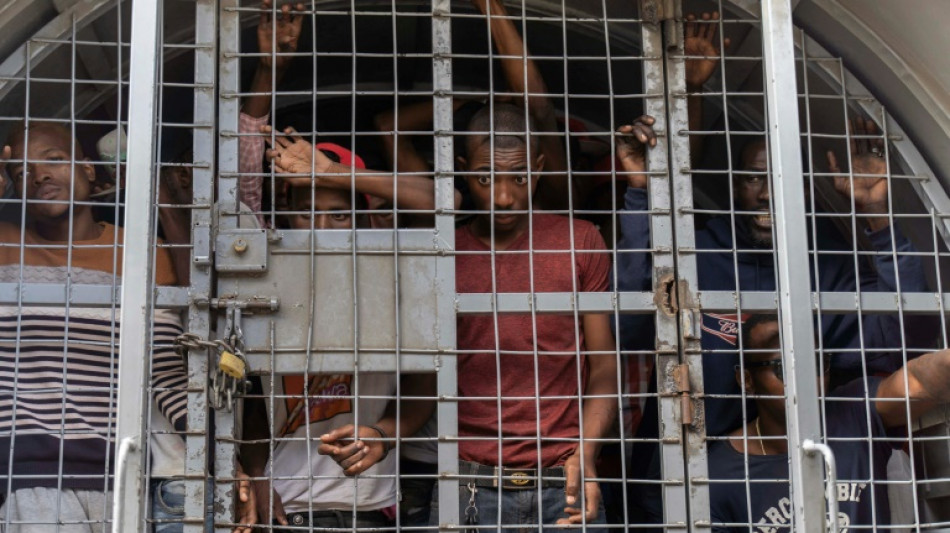
Haitians accuse Dominicans of race-based arrests, expulsions / Photo: Richard Pierrin - AFP/File

 Alcaraz exits Shanghai Masters in straight-sets loss
 Pope to enter hospital on Tuesday for lung operation
 Renshaw shines again before Australia declaration

 Atletico's Simeone encourages goalless Alvarez improvement
 FXGLOBE Rebuilds Its Copy Trading and PAMM Business With B2BROKER's B2COPY
 Nepal rescuers search for missing after flash flood
 Oil rises as Trump comments roil energy markets
 Premier League in limbo as Manchester City soar
 Zelensky vows to respond as Moscow silent on 'energy ceasefire'

 Thousands march in India's capital to demand election chief resign

 African players in Europe: Mbeumo ends goal drought as United draw
 France's high school students plan fresh protests

 NZ bank in free speech row over 'explicit' sheep memes
 China Open champ Zheng withdraws from Wuhan citing fatigue

 Brewers edge Dodgers 2-1 in National League Championship Series opener
 Pope to have surgery to remove lung nodule

 Stocks rise as oil prices tumble after Trump hails 'energy ceasefire'
 Man City charges cloud hangs over Premier League season
 Top NATO commander set to issue warning to Russia over any attack
 Software, sprints, trolls: Singapore Grand Prix talking points
 Riyadh airport hit by fresh Houthi strike day after deadly attack

 Policymakers take on energy shock, rising debt at IMF-World Bank meetings
 Raphael Glucksmann elected centre-left French presidential candidate

 'Dizzy' Lazio join Inter at top of Serie A as Roma, Juve and Milan held

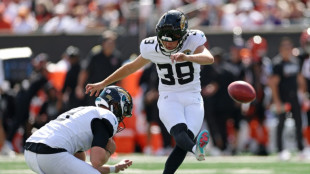 Jaguars edge Eagles as Packers beat Bears
His Haitian passport was in order, with up-to-date visas, so when police in the Dominican Republic detained him for hours, Josue Azor feels certain it was because of the black color of his skin.
The arrest of the young photographer came amid a wave of expulsions of Haitian migrants by the Santo Domingo government, with Black people being specifically targeted, according to advocacy groups in Haiti -- an allegation the Dominicans reject.
Haiti and the Dominican Republic share the Caribbean island of Hispaniola. But their economies and living conditions differ dramatically.
The much richer Dominican Republic, with its thriving tourism industry, attracts Haitian nationals hoping for a better life. Further fueling the migrant flow are the growing insecurity and political chaos that make life in Haiti increasingly challenging.
But Josue Azor was traveling for professional reasons -- working with Dominican friends on a stop-motion film. He had just arrived in Las Terrenas, a scenic tourist destination on the northeastern Dominican coast, when he was stopped by police.
"From the edge of town to the police station, the police were picking up young men at random, targeting them for the color of their skin," the 36-year-old photographer told AFP.
"It was like a hunt for Haitians," he said.
Azor said the police "were humiliating people" and refused to verify his identity papers or to let him make a phone call, placing him in a jail cell with a dozen other Haitians.
He was there for several hours, and only after the arrival of Dominican activists called by a friend of his was he allowed to prove his regular status.
- Border wall -
With criminal gangs increasingly taking control of neighborhoods in Haitian capital Port-au-Prince, the flow of migrants to the Dominican Republic has swollen, prompting Santo Domingo to harden its policy, even building a wall along about half the common border.
From September to November alone, Dominican authorities expelled more than 56,300 Haitians, far more than the 15,530 in the corresponding period in 2021, according to the Support Group for Returnees and Refugees (GARR).
The Haitian organization has denounced the "hatred" and "racial discrimination" that it says underlie the trend.
Advocacy groups for migrants in both Santo Domingo and Port-au-Prince say some expulsions have been conducted illegally -- at unofficial border crossings, often at night, and sometimes involving unaccompanied minors.
It is not only NGOs leveling criticism. In November, the United Nations called on countries to stop forcibly repatriating Haitians, given the grave humanitarian crisis gripping the country.
And in late November, the US State Department issued a warning to nationals considering trips to the Dominican Republic, saying some travelers had complained of being delayed or detained because of the color of their skin.
"There is evidence of racial prejudice and discrimination against persons of dark complexion, Haitians, or those perceived to be Haitian," a Country Security Report said.
Dominican authorities lashed out at that language, calling the report "ambiguous" and saying it provided no proof of any systematic scheme to violate migrants' rights.
Asked by AFP about the recent allegations of racially motivated expulsions, the Dominican government and police declined to comment.
In early December, Dominican President Luis Abinader said that "the sacrifice made by the Dominican Republic with the excess of irregular immigrants exceeds its possibilities of assimilation."
He called for greater international assistance for Haiti.
But the alleged official racism in the Dominican Republic appears to find an echo in the country's small but very active ultra-nationalist movement, which insists on its own Latino identity.
This group regularly displays its hatred toward the Black population, composed not just of Haitian migrants but of Dominicans whose ancestors were enslaved under the old Spanish colonial power.
"On TikTok, you can see black-skinned Dominicans describing humiliating situations they have been subjected to in their own country," said Edwin Paraison, executive director of the binational friendship group the Zile Foundation.
O.Mousa--SF-PST