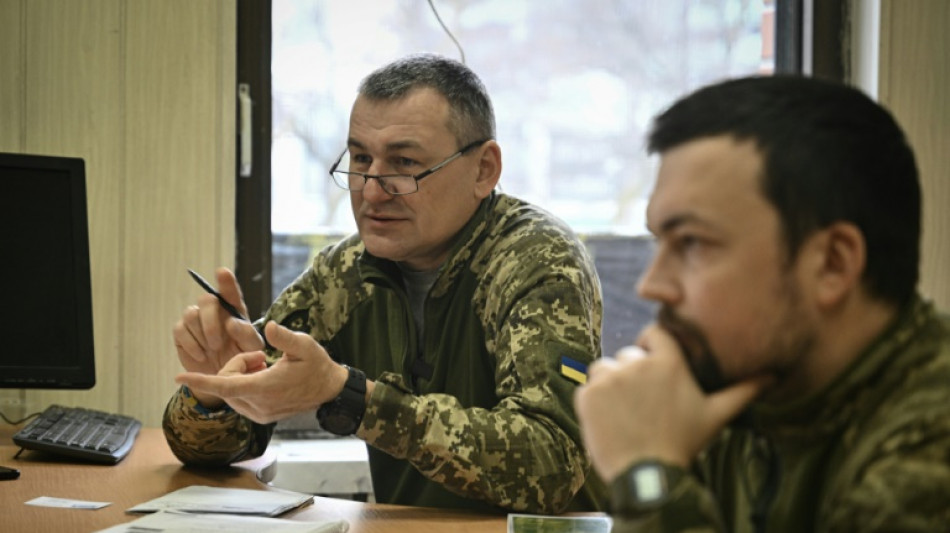
'Armed with English': Ukraine soldiers take language lessons / Photo: Genya SAVILOV - AFP

 Alcaraz exits Shanghai Masters in straight-sets loss
 Pope to enter hospital on Tuesday for lung operation
 Renshaw shines again before Australia declaration
 Atletico's Simeone encourages goalless Alvarez improvement
 FXGLOBE Rebuilds Its Copy Trading and PAMM Business With B2BROKER's B2COPY

 Nepal rescuers search for missing after flash flood
 Oil rises as Trump comments roil energy markets
 Premier League in limbo as Manchester City soar
 Zelensky vows to respond as Moscow silent on 'energy ceasefire'
 Thousands march in India's capital to demand election chief resign

 African players in Europe: Mbeumo ends goal drought as United draw
 France's high school students plan fresh protests
 NZ bank in free speech row over 'explicit' sheep memes
 China Open champ Zheng withdraws from Wuhan citing fatigue

 Brewers edge Dodgers 2-1 in National League Championship Series opener
 Pope to have surgery to remove lung nodule
 Stocks rise as oil prices tumble after Trump hails 'energy ceasefire'

 Man City charges cloud hangs over Premier League season
 Top NATO commander set to issue warning to Russia over any attack

 Software, sprints, trolls: Singapore Grand Prix talking points

 Riyadh airport hit by fresh Houthi strike day after deadly attack

 Policymakers take on energy shock, rising debt at IMF-World Bank meetings
 Raphael Glucksmann elected centre-left French presidential candidate

 'Dizzy' Lazio join Inter at top of Serie A as Roma, Juve and Milan held

 Jaguars edge Eagles as Packers beat Bears
When Olena Chekryzhova followed in her grandmother's footsteps and began teaching English, she never dreamt the job would lead to a months-long stay at a frontline military base.
But that has become her new reality as Ukrainian soldiers scramble to learn English –- military terms especially –- so they can make the most of combat aid from Washington and elsewhere against Russian forces.
Donated supplies like HIMARS rocket systems have already been a battlefront game-changer, and President Volodymyr Zelensky's lightning visit to Washington this week yielded further pledges –- including, for the first time, the Patriot missile defence system.
Soldiers have found, however, that training materials for this equipment are available mainly in English, which is often also necessary to communicate with foreign volunteer fighters they encounter in the field.
To help topple the language barrier, 35-year-old Chekryzhova has traded in her quiet life of classroom conjugation to give crash courses to the armed forces.
The work has included a five-month stint at a base in the eastern industrial Donetsk region, where she lived alongside soldiers and took part in training sessions.
"Some people think I'm crazy," she told AFP at the facility in Kyiv where she is currently stationed.
But she added, "I think that teaching English in this case is the small contribution that I can do for my country, for the people of my country and for the military, who are protecting us from this terrorist attack."
- Fighting words -
Nearly all Ukrainian soldiers had at least some English instruction in school, but it was not always useful –- especially for the older ones.
"It was back in Soviet times, and this English I learned at school is like nothing, basically," said 50-year-old Igor Soldatenko, one of Chekryzhova's students in Kyiv.
"The whole system was inadequate, as I see now. We were just learning texts without understanding them... Nobody could use it in real life."
The recent lessons, by contrast, have been more practical –- giving him words like "wounded", "semi-automatic" and "cache" as well as phrases such as "killed in action".
The learning goes both ways, with Chekryzhova gleaning a new understanding of tactics and strategy –- and an appreciation of the trials of military life.
While in Donetsk, she grieved along with soldiers who lost comrades –- some of whom she taught directly -– in fighting in her hometown of Bakhmut, a target of incessant Russian assault in recent months.
"For me it's a double pain. Because on the one hand it's my hometown, and on the other hand it has now become the grave of my students," she said.
During a recent one-hour conversation lesson in Kyiv, the only time Chekryzhova's students slipped briefly into Ukrainian was when discussing those they have lost.
But despite fighting back tears, 36-year-old soldier Yuriy Kalmutskiy insisted on completing his idea in English, even if it was somewhat broken.
"I lose a lot of friends... It was my circle of close people, and I lose... they. I lose they," he said. "It's very hard."
- Help win the war -
As they work towards ultimately mastering English, Chekryzhova's students told AFP they drew some inspiration from Zelensky's journey with the language.
"A few years ago, he (had) awful English. Everybody knows this," Kalmutskiy said. "But he learned."
That progress came in handy on Wednesday when Zelensky addressed the US Congress in English, declaring that "Ukraine is alive and kicking" while appealing for more aid.
Yet while individual students have made similar strides, Chekryzhova told AFP she is struggling to scale up her programme to reach even more.
International organisations have so far rebuffed her requests for funding, saying they can't be seen giving money to the military.
"They say they would like to help children, they would like to help animals, the elderly, maybe some internally displaced people or people who are abroad," she said.
Her students scoffed at this approach, and Chekryzhova said she has little interest in dealing with "puppies and kittens or some nice old ladies".
All said they were convinced studying English would help them win the war while furthering Ukraine's military integration with Western and other countries.
"So," Chekryzhova said as the lesson drew to a close. "Are you armed with English?"
"Yes," Soldatenko responded. "Yes, I think so."
L.AbuTayeh--SF-PST