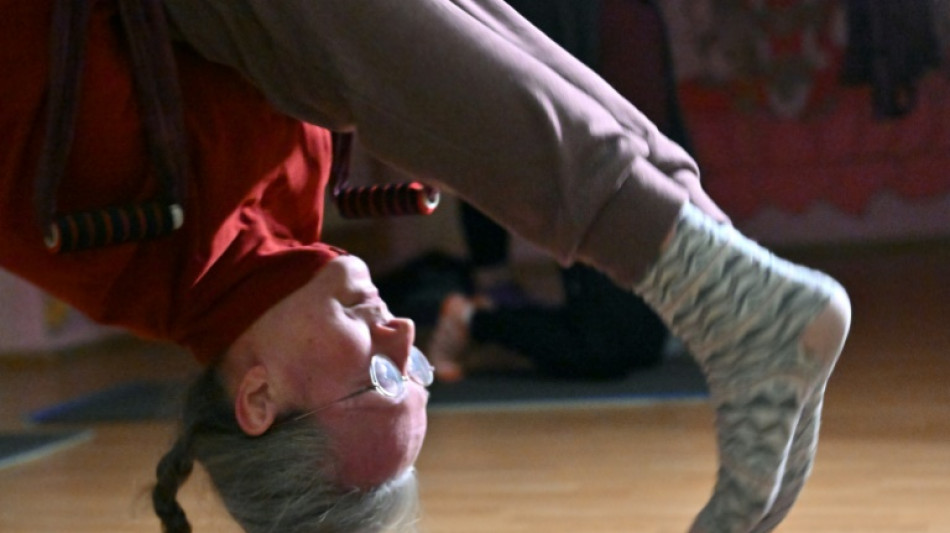
Ukraine's yogis breathe through wartime blackouts / Photo: Sergei SUPINSKY - AFP

 Zelensky doubtful on Russian acceptance of Trump's 'energy ceasefire'

 Federal agents search home of Trump critic Ilhan Omar: government

 Pakistan detains hundreds from ex-PM Khan's party as protests falter
 Australia's Smith off field after being struck on helmet

 UK retains early access to test latest US AI models
 Top NATO commander warns Russia any attack would be 'futile'

 Stolen Renoir paintings found behind wall in France: prosecutor

 UNHCR sounds alarm on funding crisis

 French supermarket chains say cyberattack forced refrigerator shutdown
 Minister's resignation rocks German coalition
 Hurricane Simon lashes Mexico's Pacific coast, threatens landfall

 France schools protest rumbles on as Macron urges 'respect'
 Americans Hall and Woodford win economics Nobel for stabilisation models
 MEXC Brings AI, TradFi and the Future of Trading to Life at TOKEN2049 Singapore

 Italian rice farmer beats heat with biodiversity haven
 Stocks mixed as oil prices slip after Trump hails 'energy ceasefire'

 Opposition, journalists allege police abuses during India protests
 DATA Network joins Sui and Walrus to scale the supply chain for AI training data

 Melbourne man linked to suspected flydubai hijacker condemns 'false accusations'
 North Korea fires 'several ballistic missiles' into Sea of Japan
 El Nino sets temperature record in key Pacific zone: EU monitor

 Nature does not respect borders: UN biodiversity chief
 World leaders urged to 'course correct' as UN nature goals fall short

 New York's notorious Rikers jail awaits elusive closure
 Unbeaten 49ers edge Seahawks while Vikings stay perfect
The women filed into the yoga studio, on the ground floor of an otherwise pitch-black apartment block, for an afterwork session that was specially tailored to Ukraine's current period of deprivation.
With power and heat cut off by Russian strikes on energy infrastructure, they wore thick sweatshirts and wool socks over their customary tank tops and leggings.
Their instructor, Galina Tkachuk, led them in rapid breathing exercises -- called Kapalabhati -- that were intended to warm them up as quickly as possible.
And ahead of the final resting pose, or Shavasana, she swaddled them in heavy blankets to keep them from shivering.
By the time it was over, Tkachuk felt she had succeeded in providing a brief but necessary break from the stresses of Ukraine's ten-month-old war, made worse in recent weeks by midwinter energy outages in the capital, Kyiv, and elsewhere.
Some of the women had even shed their extra clothing, making the studio more closely resemble how it would in normal times.
"Everyone is looking for a way to survive and stay sane in this situation, and yoga is a good option," said Tkachuk, standing in the dim light of the studio's single lamp.
"How does it help? It distracts from various negative thoughts. You don't think about anything [but] inner peace, positivity," said Viktoria, a 44-year-old yoga student and bank employee.
"Of course it's cold, you see I'm in a sweater... but you have to adapt to the current conditions."
- Spiking demand -
For 54-year-old Tkachuk, yoga has provided a mental escape from political turmoil for nearly a decade.
She began her practice in 2013, amid the pro-European protest movement centred on Kyiv's central square, the Maidan, in which around 100 civilians died in violent clashes with security forces that ultimately ousted Kremlin-backed President Viktor Yanukovych.
"I was very worried about these problems then," she said, recalling the "difficult period".
The studio where she teaches -- named Ram, for its Indian owner -- opened in 2015 and was thriving up until Russia's invasion in February, when the chaos of the war's first weeks forced it to close temporarily.
While other studios have remained shuttered, Ram reopened in April and experienced a surprising spike in demand.
"Immediately, from the first training after we opened, a lot of people came. I did not expect it, there really were a lot," Tkachuk said.
Among them was Maria Mykhaylenko, who credited a regimen of "yoga, tea and meditation" with helping her through the war.
"The fact that there is no heating here is not a problem, you can dress warmer," she said, adding that she especially likes it when the studio is lit with candles.
Frequent internet cuts in the studio's neighbourhood mean students often can't register for classes ahead of time, making it impossible to predict how many will show up on any given day.
But Tkachuk said these glitches were easy to ignore as she focuses on the benefits for those who do make it.
"In general, it is good for mental and physical health... and not only during the war," she said.
"Now this need has simply intensified."
K.AbuTaha--SF-PST