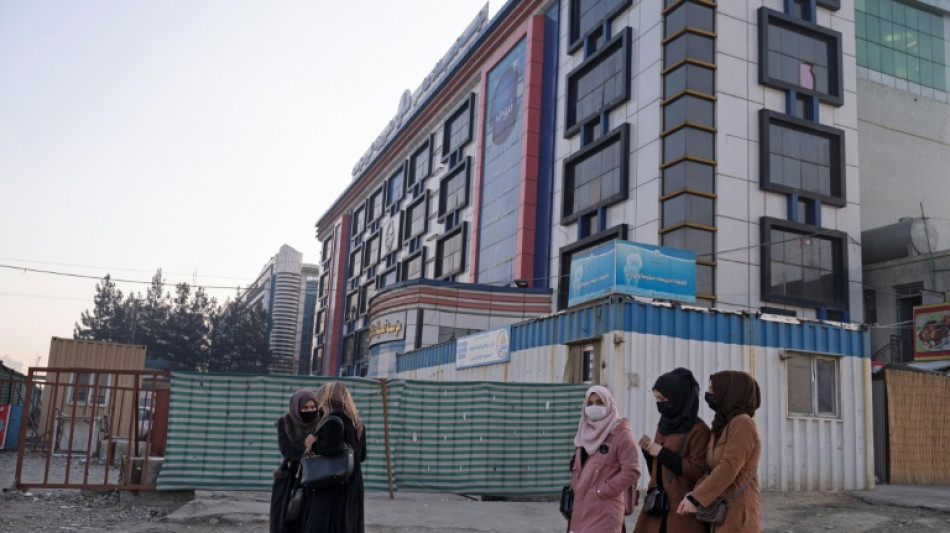
'Hugs, screams and cries': Afghan women anguished at university ban / Photo: Wakil KOHSAR - AFP

 Zelensky doubtful on Russian acceptance of Trump's 'energy ceasefire'

 Federal agents search home of Trump critic Ilhan Omar: government

 Pakistan detains hundreds from ex-PM Khan's party as protests falter
 Australia's Smith off field after being struck on helmet

 UK retains early access to test latest US AI models
 Top NATO commander warns Russia any attack would be 'futile'

 Stolen Renoir paintings found behind wall in France: prosecutor

 UNHCR sounds alarm on funding crisis

 French supermarket chains say cyberattack forced refrigerator shutdown
 Minister's resignation rocks German coalition

 Hurricane Simon lashes Mexico's Pacific coast, threatens landfall

 France schools protest rumbles on as Macron urges 'respect'
 Americans Hall and Woodford win economics Nobel for stabilisation models
 MEXC Brings AI, TradFi and the Future of Trading to Life at TOKEN2049 Singapore

 Italian rice farmer beats heat with biodiversity haven
 Stocks mixed as oil prices slip after Trump hails 'energy ceasefire'
 Opposition, journalists allege police abuses during India protests
 DATA Network joins Sui and Walrus to scale the supply chain for AI training data

 Melbourne man linked to suspected flydubai hijacker condemns 'false accusations'
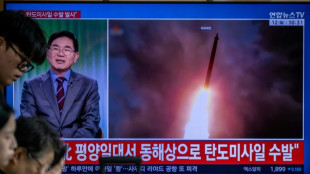 North Korea fires 'several ballistic missiles' into Sea of Japan

 El Nino sets temperature record in key Pacific zone: EU monitor

 Nature does not respect borders: UN biodiversity chief
 World leaders urged to 'course correct' as UN nature goals fall short

 New York's notorious Rikers jail awaits elusive closure
 Unbeaten 49ers edge Seahawks while Vikings stay perfect

Women university students across Afghanistan were in disbelief on Wednesday, barred by the Taliban from studying and condemned to a life of feeling "like caged birds".
In Kabul, home to the country's largest universities, students gathered outside campuses dressed in the black cloaks and tight headscarves imposed by the Taliban since they took control last year.
Elsewhere, students sought consolation from friends and family as they digested news of the university ban.
"We all felt like caged birds, we hugged each other, screamed, and cried 'why is this happening to us'?" Amini, a 23-year-old nursing student in Kunduz, told AFP.
She was with her three sisters –- two already barred from secondary school and another studying for a degree –- when social media exploded with the news of the late-night order.
Faculties across the country were already closed for the winter break, but students had been able to access campuses for exams or to study in libraries.
In Kandahar, the cradle and spiritual heart of the Taliban movement, male students were able to sit exams in classrooms still segregated with screens, which until the day before made it possible for women to study.
Now, the university gates shut them out.
- 'No one will listen' -
A Taliban guard told AFP that some women had not been aware of the exclusion until the morning.
"My sister is studying computer science... I didn't inform her last night. I know she would be traumatised," said a young male law student in Kabul, who asked not to be named for fear of reprisals.
"It really expresses (the Taliban's) illiteracy and poor knowledge of Islam and human rights. If the situation continues like this, the future will be worse. Everyone is scared."
In the eastern city of Jalalabad, some male students walked out of their exams in protest against the decision.
Upon their return to power, the Taliban had promised to be more flexible, but they quickly re-enforced a harsh interpretation of Islam that had marked their first stint in power between 1996 and 2001.
The restrictions on women have multiplied in recent months. They are banned from most government jobs or paid a pittance to stay at home, not authorised to travel alone outside their city, and are excluded from parks and gardens.
"We have no power to do anything and there is no one to listen to us," said one 29-year-old, who is doing a masters in Pashto literature in Kabul.
"We can't protest, we are hopeless. In every aspect of life we are doomed," she told AFP.
"We don't have jobs, we can't go anywhere, and we can't leave the country. We have lost everything."
Deep in anguish, she still clung to the hope that the Taliban –- whose restrictions on women have only become increasingly severe –- would row back on the announcement after the winter break.
"We will wait for the next three months to see if they change their order. They might change their policies and restart the universities."
If they do not, she called on men to stop attending classes in protest.
"They too must stay at home until the girls are allowed to go back," she pleaded.
J.Saleh--SF-PST