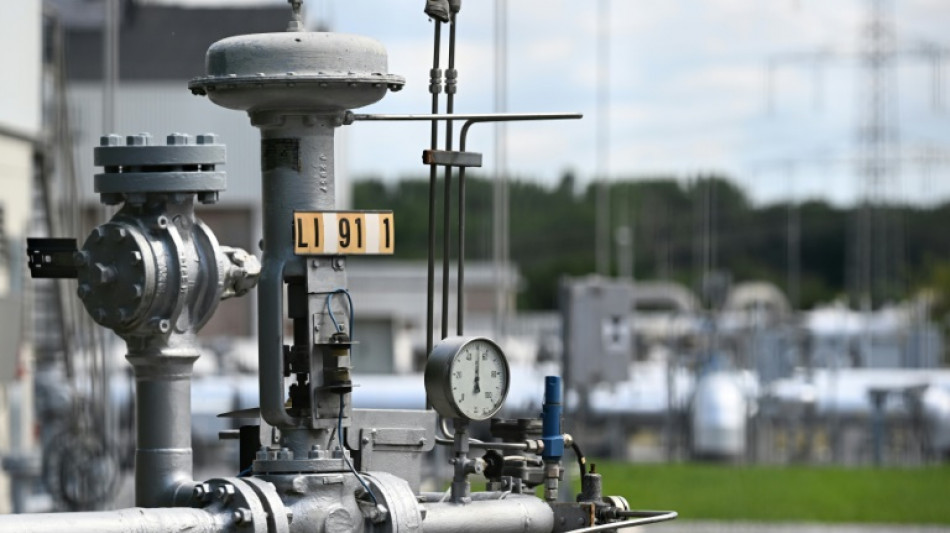
EU reaches gas price cap agreement, angering Russia / Photo: Ina FASSBENDER - AFP/File

 Fury as US federal agents search anti-Trump lawmaker's home

 One goal enough for Flick as Barca enter Galatasaray cauldron
 A7 to unveil a service that will re-invent the international payments market
 'Status quo' with EU 'not good enough', UK PM says as summit date set
 Stolen Renoir paintings found behind wall in France
 French supermarkets suffer refrigerator shutdown after 'unprecedented' cyberattack
 Arsenal lose Hincapie and Zubimendi in freak double blow
 Saudi says resilience tested, vows response after deadly airport attacks
 Alcaraz exits Shanghai Masters in straight-sets loss
 Pope to enter hospital on Tuesday for lung operation
 Renshaw shines again before Australia declaration
 Atletico's Simeone encourages goalless Alvarez improvement
 FXGLOBE Rebuilds Its Copy Trading and PAMM Business With B2BROKER's B2COPY
 Nepal rescuers search for missing after flash flood
 Oil rises as Trump comments roil energy markets
 Premier League in limbo as Manchester City soar
 Zelensky vows to respond as Moscow silent on 'energy ceasefire'

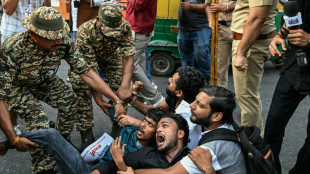 Thousands march in India's capital to demand election chief resign
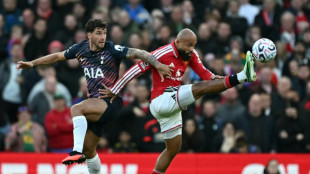 African players in Europe: Mbeumo ends goal drought as United draw
 France's high school students plan fresh protests
 NZ bank in free speech row over 'explicit' sheep memes
 China Open champ Zheng withdraws from Wuhan citing fatigue

 Brewers edge Dodgers 2-1 in National League Championship Series opener
 Pope to have surgery to remove lung nodule
 Stocks rise as oil prices tumble after Trump hails 'energy ceasefire'
EU energy ministers on Monday overcame months of wrangling to agree a price cap for natural gas in the bloc, drawing an immediate warning from Russia that the move was "unacceptable".
The price ceiling was fixed at 180 euros per megawatt hour, but with conditions attached and a word of caution from the European Commission that it may suspend the measure if "the risks outweigh the benefits".
The aim of the cap on gas prices traded within the European Union is to mitigate an energy crunch brought on by Russia's invasion of Ukraine.
EU countries are worried that they will have a hard time filling gas storage tanks in time for next winter.
Russia -- before the war, the top exporter of gas to the EU -- has turned off the taps in retaliation for a series of crippling sanctions against it designed to deplete its income used for its war.
The Kremlin has already said it won't supply oil to countries applying a distinct EU embargo on its shipments of crude, and on Monday lashed out at the gas price cap.
"This is a violation of the market price-setting, an infringement on market processes, any reference to a (price) cap is unacceptable," Kremlin spokesman Dmitry Peskov was cited as saying by Russian state-run news agencies.
- Divisive issue -
The EU price cap will apply from February 15 and run for a year.
It will be triggered if the European benchmark price for natural gas futures goes above 180 euros per megawatt hour for three consecutive days.
That ceiling would then apply on trades for at least following 20 working days. For the cap to be deactivated, there has to be three consecutive days of trading below the 180-euro ceiling.
The mechanism is in response to high gas prices seen in Europe in August, which briefly soared to nearly 340 euros per megawatt hour, rattling EU governments.
The price of gas in Europe has since fallen, but remains historically high, and was trading at just under 112 euros per megawatt hour on Monday.
The gas price cap divided EU countries.
Many said it was urgent to bring it in to force down energy costs. But others -- led by economic powerhouse Germany -- feared it could provoke suppliers of liquified natural gas (LNG) to snub Europe in favour of more lucrative Asian markets.
- Consequences -
The European Commission was also wary of the consequences of a price cap, and it initially proposed a ceiling of 275 euros and a two-week period above that number before it could be activated.
But that proposal met fierce objections from countries, such as Spain and Greece which made other broadly-backed energy measures -- including joint gas purchases and speeded-up authorisations for renewable energy sources -- contingent on a viable price cap.
Monday's meeting saw Germany agree to the much lower price cap, and the much shorter triggering period to unlock the entire package.
"It wasn't an easy thing to achieve," Maltese Energy Minister Miriam Dalli said.
In acknowledgement of Germany's concerns, a condition attached to the price cap is that futures prices for gas in Europe must to be at least 35 euros more than that paid for LNG on global markets.
EU energy commissioner Kadri Simson also said the European Securities and Markets Authority (ESMA) and the bloc's Agency for the Cooperation of Energy (ACER) would present a "data report" on the likely consequences of the unprecedented price cap before it takes effect.
"The Commission stands ready to suspend ex-ante the activation of the mechanism, if an analysis from ECB (European Central Bank), ESMA and ACER shows that the risks outweigh the benefits," she said.
France's energy minister, Agnes Pannier-Runacher, said that, with the price cap agreed, attention must now turn to a longer-term reform of the EU's energy market, notably unhitching the price of gas from that of electricity.
T.Ibrahim--SF-PST