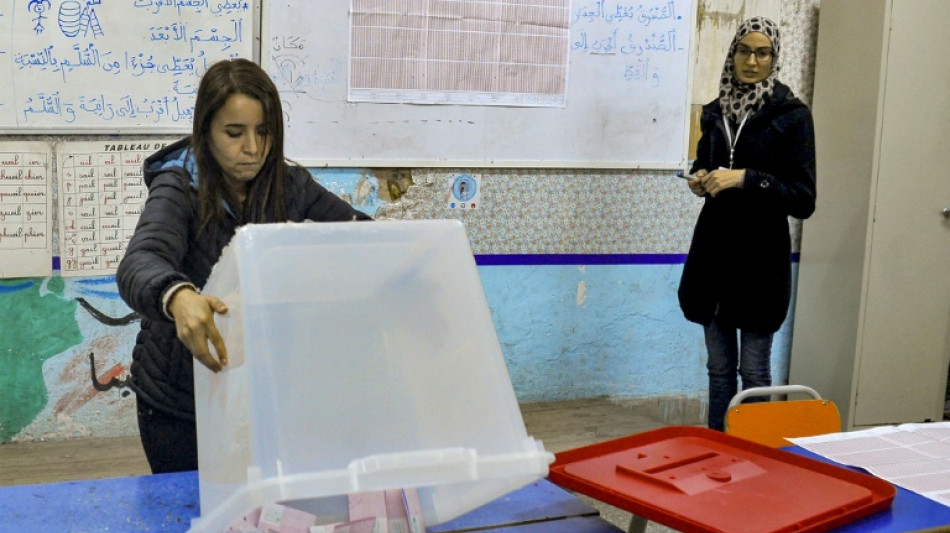
Tunisia uncertainty after poll snub, calls for president to quit / Photo: Yacine Mahjoub - AFP

 Fury as US federal agents search anti-Trump lawmaker's home

 One goal enough for Flick as Barca enter Galatasaray cauldron
 A7 to unveil a service that will re-invent the international payments market
 'Status quo' with EU 'not good enough', UK PM says as summit date set
 Stolen Renoir paintings found behind wall in France
 French supermarkets suffer refrigerator shutdown after 'unprecedented' cyberattack
 Arsenal lose Hincapie and Zubimendi in freak double blow
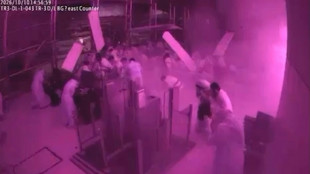 Saudi says resilience tested, vows response after deadly airport attacks
 Alcaraz exits Shanghai Masters in straight-sets loss
 Pope to enter hospital on Tuesday for lung operation
 Renshaw shines again before Australia declaration
 Atletico's Simeone encourages goalless Alvarez improvement
 FXGLOBE Rebuilds Its Copy Trading and PAMM Business With B2BROKER's B2COPY

 Nepal rescuers search for missing after flash flood
 Oil rises as Trump comments roil energy markets
 Premier League in limbo as Manchester City soar
 Zelensky vows to respond as Moscow silent on 'energy ceasefire'

 Thousands march in India's capital to demand election chief resign

 African players in Europe: Mbeumo ends goal drought as United draw
 France's high school students plan fresh protests
 NZ bank in free speech row over 'explicit' sheep memes
 China Open champ Zheng withdraws from Wuhan citing fatigue

 Brewers edge Dodgers 2-1 in National League Championship Series opener

 Pope to have surgery to remove lung nodule
 Stocks rise as oil prices tumble after Trump hails 'energy ceasefire'
Tunisia plunged into political uncertainty Sunday after voters overwhelming snubbed elections for a neutered parliament, as the main opposition alliance called on President Kais Saied to "leave immediately".
The move comes as Saied's government negotiates a nearly $2-billion package from the International Monetary Fund to bail out the North African country's crippled public finances.
The electoral board said 8.8 percent of the nine-million-strong electorate had turned out for Saturday's polls, the culmination of a power grab by Saied in the only democracy to have emerged from the Arab Spring uprisings.
Ahmed Nejib Chebbi, president of the National Salvation Front alliance, said Saied had "lost all legal legitimacy".
An abstention rate of more than 91 percent "shows that very, very few Tunisians support Kais Saied's approach", Chebbi told AFP.
He said the result showed "great popular disavowal" of the process that began when Saied, elected in 2019, seized executive powers last year.
The president in July 2021 sacked the government, froze parliament and surrounded it with military vehicles, following months of political deadlock and economic crisis exacerbated by the coronavirus pandemic.
Saied, a former law professor, followed up by seizing control of the judiciary and pushing through a constitution that consolidated his near-absolute power in a widely boycotted referendum in July.
His moves, a decade after the ouster of dictator Zine El Abidine Ben Ali, have sparked fears of a return to autocracy.
- 'Isolated' -
Political analyst Slaheddine Jourchi said Saturday's "shock" low turnout had left Saied "more isolated from the elite, the parties -- and now the people too".
"This turnout, the lowest ever recorded, shows that the people have no trust" in the president, Jourchi added.
The National Salvation Front -- which includes the Islamist-inspired Ennahdha party, Saied's nemesis -- boycotted Saturday's election, saying it was part of a "coup" against Tunisia's democracy.
"The situation is critical," Chebbi said.
"We should agree on a high-ranking judge" who could "oversee immediate presidential elections", he added.
Political scientist Hamadi Redissi called the turnout "a personal disavowal for Mr. Saied", adding that the president's "legitimacy is in question".
But he said the opposition was "weak and divided", and that many Tunisians blame Ennahdha for the country's woes over the past decade.
There is also "no legal mechanism to dismiss the president" under the new constitution, Redissi said.
Abir Moussi, who heads the anti-Islamist Free Destourian Party, which also boycotted the vote, joined calls Sunday for Saied's resignation.
- Broken promises -
The ballot for the new 161-seat assembly followed three weeks of barely noticeable campaigning, with few posters in the streets and no serious debate among a public preoccupied with day-to-day economic survival.
"The people are angry at the economic situation and the high cost of living," said Hamdi Belgacem, a 37-year-old unemployed man in the capital Tunis.
He said he had backed Saied's takeover last year but had been left disillusioned.
"He (Saied) promised us investments, and he didn't keep his promises," Belgacem said. "He promised us to fight corruption and he didn't -- he promised us a lot of things that he didn't deliver."
Saied's moves were initially supported by some Tunisians tired of the messy and sometimes corrupt democratic system installed after the revolution.
But almost a year and half on, the country's economic woes have gone from bad to worse and inflation, at around 10 percent, is higher than Saturday's voter turnout.
The previous Ennahdha-dominated legislature had far-reaching powers in the mixed presidential-parliamentary system, enshrined in Tunisia's post-revolution constitution.
But the new chamber "won't be able to appoint a government or censure it, except under draconian conditions that are almost impossible to meet," analyst Redissi said.
Candidates were required to stand as individuals, in a system that neuters political parties.
Hamza Meddeb, a fellow at the Carnegie Middle East Center, said the election was a "formality to complete the political system imposed by Kais Saied and concentrate power in his hands".
S.AbuJamous--SF-PST