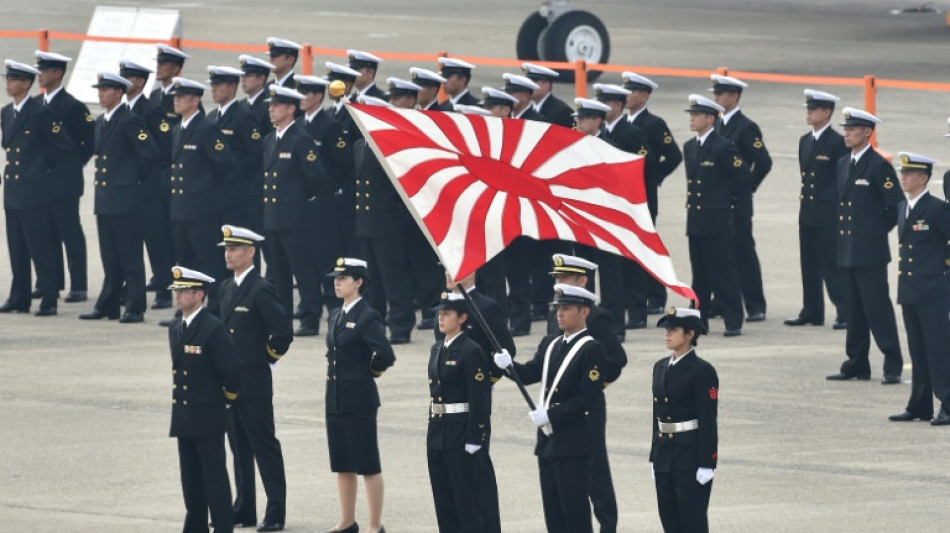
Counterstrikes and controversy: Japan's defence overhaul / Photo: Kazuhiro NOGI - AFP/File

 One dead as Hurricane Simon creeps along Mexico's Pacific coast

 Carrick's Man United 'hungry and eager' to fix worst start in decades

 Fury as US federal agents search anti-Trump lawmaker's home

 One goal enough for Flick as Barca enter Galatasaray cauldron
 A7 to unveil a service that will re-invent the international payments market

 'Status quo' with EU 'not good enough', UK PM says as summit date set
 Stolen Renoir paintings found behind wall in France

 French supermarkets suffer refrigerator shutdown after 'unprecedented' cyberattack

 Arsenal lose Hincapie and Zubimendi in freak double blow
 Saudi says resilience tested, vows response after deadly airport attacks
 Alcaraz exits Shanghai Masters in straight-sets loss
 Pope to enter hospital on Tuesday for lung operation

 Renshaw shines again before Australia declaration

 Atletico's Simeone encourages goalless Alvarez improvement
 FXGLOBE Rebuilds Its Copy Trading and PAMM Business With B2BROKER's B2COPY

 Nepal rescuers search for missing after flash flood

 Oil rises as Trump comments roil energy markets
 Premier League in limbo as Manchester City soar

 Zelensky vows to respond as Moscow silent on 'energy ceasefire'

 Thousands march in India's capital to demand election chief resign

 African players in Europe: Mbeumo ends goal drought as United draw

 France's high school students plan fresh protests

 NZ bank in free speech row over 'explicit' sheep memes
 China Open champ Zheng withdraws from Wuhan citing fatigue

 Brewers edge Dodgers 2-1 in National League Championship Series opener

Japan has laid out plans to expand its defence capabilities drastically over five years.
The new security strategy marks a major shift, as Japan confronts China's growing military might.
- Why are the changes controversial? -
Japan's constitution, drafted by the United States after World War II, does not officially recognise the military, so moves to bolster its capacity are highly sensitive.
The constitution limits spending on the army, navy and air force to nominally defensive capabilities, and bans the "use of force as means of settling international disputes".
Although defence spending has risen every year for decades, the total has long hovered at around one percent of GDP, below the NATO standard of two percent.
That level "became symbolic of Japan's security policy that focuses exclusively on self-defence", Naoko Aoki of the Atlantic Council think tank told AFP.
Now Prime Minister Fumio Kishida has pledged to ramp up spending to two percent by 2027, although how to finance the rise is proving a political headache.
"Breaching this self-imposed cap does not mean that Japan is abandoning its policy," said Aoki.
"But it reflects the alarm and concern that the Japanese feel about their security environment."
- What is 'counterstrike capacity'? -
A pillar of the new strategy is to acquire "counterstrike capacity": weapons to destroy enemy missile launch sites during an attack.
The move is delicate "because it would exceed what Japan has traditionally considered necessary to defend itself", Aoki said, although polls show most Japanese are in favour.
The government has insisted for decades that carrying out counterstrikes under certain conditions would not violate the pacifist limits of the constitution.
Even so, questions remain about the efficacy of counterstrike missiles given the sophisticated capacities of China and other neighbours, said James Brady, vice president of Teneo consultancy.
"North Korea alone has recently been demonstrating multiple types of mobile launch platforms, including road, railway, and submarine," he warned.
"Even with counterstrike capacities, Japan's defence planners would face a whack-a-mole scenario."
- Why is Japan doing this now? -
Unease has grown in Japan over China's rapidly modernising military and North Korea's wave of missile tests.
Russia's invasion of Ukraine has also "reinforced Japanese concerns", Aoki said.
Japanese officials have regularly protested Chinese maritime incursions, and raised concerns about joint aerial exercises by Chinese and Russian planes.
Under President Xi Jinping, China has also become more bellicose toward Taiwan, which it considers a part of its territory to be taken by force one day if necessary.
So "a key question going forward will be the extent to which Japanese and US forces can better integrate planning to respond jointly to something like a Taiwan contingency," Brady said.
- How will the changes be received? -
Plans to bolster Japan's missile arsenal have faced some hesitancy from the ruling party's coalition partner Komeito, which takes a traditionally pacifistic stance.
"Similarly, neighbouring capitals have traditionally opposed the idea of Tokyo re-arming, worried that it might prelude a return to the military expansionism of the pre-1945 era," Brady said.
Japan's ties with China have already deteriorated in recent years, and Beijing has said it is "firmly opposed" to the overhaul.
Russia too will likely see the moves as a further nail in the coffin for ties.
Tokyo's key ally Washington, however, is expected to welcome the shift and play a key role in bolstering Japan's defences.
Surveys also show Japan's public is broadly supportive of efforts to boost defences, including through the counterstrike capacity, though there is opposition to new taxes to finance spending.
U.AlSharif--SF-PST