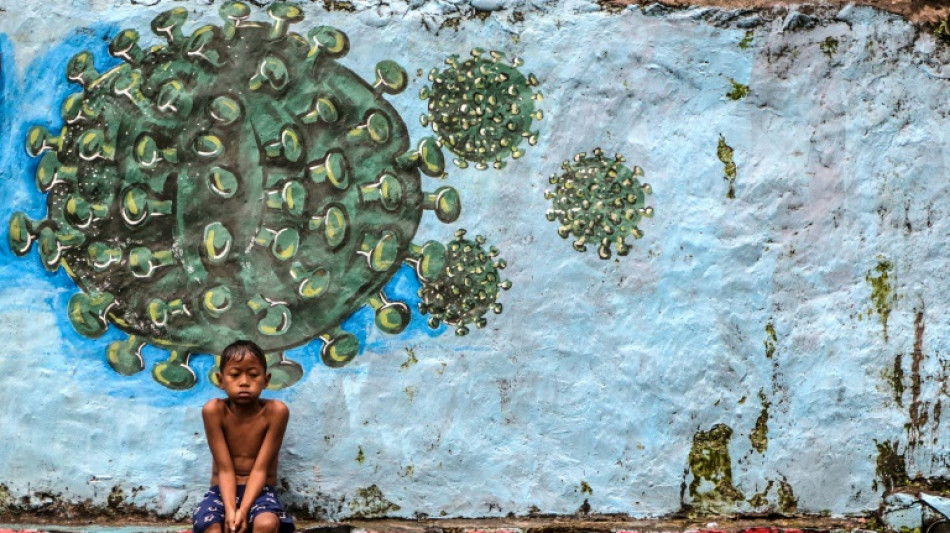
Three years into Covid, are we ready for the next pandemic? / Photo: ADITYA AJI - AFP/File

 One dead as Hurricane Simon creeps along Mexico's Pacific coast
 Carrick's Man United 'hungry and eager' to fix worst start in decades

 Fury as US federal agents search anti-Trump lawmaker's home

 One goal enough for Flick as Barca enter Galatasaray cauldron

 A7 to unveil a service that will re-invent the international payments market
 'Status quo' with EU 'not good enough', UK PM says as summit date set

 Stolen Renoir paintings found behind wall in France
 French supermarkets suffer refrigerator shutdown after 'unprecedented' cyberattack

 Arsenal lose Hincapie and Zubimendi in freak double blow

 Saudi says resilience tested, vows response after deadly airport attacks
 Alcaraz exits Shanghai Masters in straight-sets loss
 Pope to enter hospital on Tuesday for lung operation

 Renshaw shines again before Australia declaration
 Atletico's Simeone encourages goalless Alvarez improvement
 FXGLOBE Rebuilds Its Copy Trading and PAMM Business With B2BROKER's B2COPY

 Nepal rescuers search for missing after flash flood
 Oil rises as Trump comments roil energy markets

 Premier League in limbo as Manchester City soar

 Zelensky vows to respond as Moscow silent on 'energy ceasefire'
 Thousands march in India's capital to demand election chief resign

 African players in Europe: Mbeumo ends goal drought as United draw

 France's high school students plan fresh protests
 NZ bank in free speech row over 'explicit' sheep memes

 China Open champ Zheng withdraws from Wuhan citing fatigue

 Brewers edge Dodgers 2-1 in National League Championship Series opener

Three years after the first Covid case was identified in China, preparations to stave off the next pandemic are starting to ramp up but far more needs to be done to avoid repeating past mistakes, experts told AFP.
Last week the 194 member states of the World Health Organization agreed to start negotiations in February over a draft of a pandemic treaty aiming to better respond to future threats.
Meanwhile the Pandemic Fund, which is hosted by the World Bank and was launched last month by G20 nations, said on Wednesday it is preparing for its first round of funding with a total of $1.6 billion pledged so far.
Another effort is being led by the Coalition for Epidemic Preparedness Innovations (CEPI), which has a five-year, $3.5 billion plan that includes a "100 Days Mission".
CEPI aims to develop a new vaccine against a potential "disease X" within 100 days of the WHO identifying a pandemic threat.
CEPI CEO Richard Hatchett told AFP that the foundation was still around $800 million short of its funding goal, urging global decision makers not to lose sight of pandemic preparedness while "focusing on the many crises in front of them".
The plan includes connecting different institutes focusing on pandemic preparedness such as the United States' BARDA, European Union's HERA, Japan's SCARDA and more.
"I think with some light coordination, we could collectively advance global preparedness very rapidly, particularly on the countermeasures side," Hatchett said.
- Treatments and testing -
One of those countermeasures would be swiftly developing new drugs to treat an emerging "disease X".
In late August Canadian-born businessman Geoffrey Cumming donated AUS$250 million ($170 million) to set up a centre in the Australian city of Melbourne to work towards that goal.
Infectious diseases expert Sharon Lewin, who will lead the Cumming Global Centre for Pandemic Therapeutics, said it would aim to develop platform technologies that can be rapidly updated to target new pathogens, similar to what was done with mRNA vaccines for Covid.
While the centre is still recruiting, Lewin told AFP it would be "up and running on the science" within six months.
Another key will be making tests available across the world as soon as possible.
The non-profit FIND, the global alliance for diagnostics, has worked with WHO to get Covid tests to low- and middle- income countries.
However because CEPI did not reach its replenishment goal earlier this year, "the entire diagnostics component of the 100 Days Mission is currently unfunded," FIND CEO William Rodriguez told AFP.
"I don't think we're doing enough yet to be prepared for the next pandemic from a resource perspective," he said.
- Potential virus threats -
The WHO is currently working on updating its list of priority pathogens, which will list the top contenders for the virus that could pose the next pandemic threat.
Coronaviruses and influenza viruses will be among the main suspects because of their proven pandemic potential.
Other possibilities include known threats such as Ebola and Zika.
"Each of these viruses may be just a few mutations away" from being able to spread beyond their current limits, said Jennifer Nuzzo, the founding director of the Pandemic Centre at Brown University in the US.
Other potential threats include Marburg and the arenavirus and paramyxovirus families -- as well as the risk of new unknown diseases jumping from animals over to humans.
But when it comes to deploying future vaccines, Nuzzo said "it's not the science that worries me as much: it's the production."
- Inequality remains -
"The tragedy of Covid, in my mind, was the unequal distribution of vaccines when they became available," CEPI's Hatchett said, adding that this inequity "prolonged the pandemic and probably led to the propagation of variants".
All the experts who spoke to AFP emphasised that for the next pandemic, regions such as Africa, South America, South Asia and the Middle East must be able to access and manufacture future vaccines and treatments.
Mohga Kamal-Yanni of the NGO coalition People's Vaccine Alliance said early statements from rich countries about the pandemic treaty were "incredibly worrying".
"Any pandemic treaty should commit to an automatic waiver of intellectual property rules for products needed to combat the health threat," she said.
"And it should mandate the sharing of technology and know-how needed for developing countries to manufacture medical technologies."
H.Nasr--SF-PST