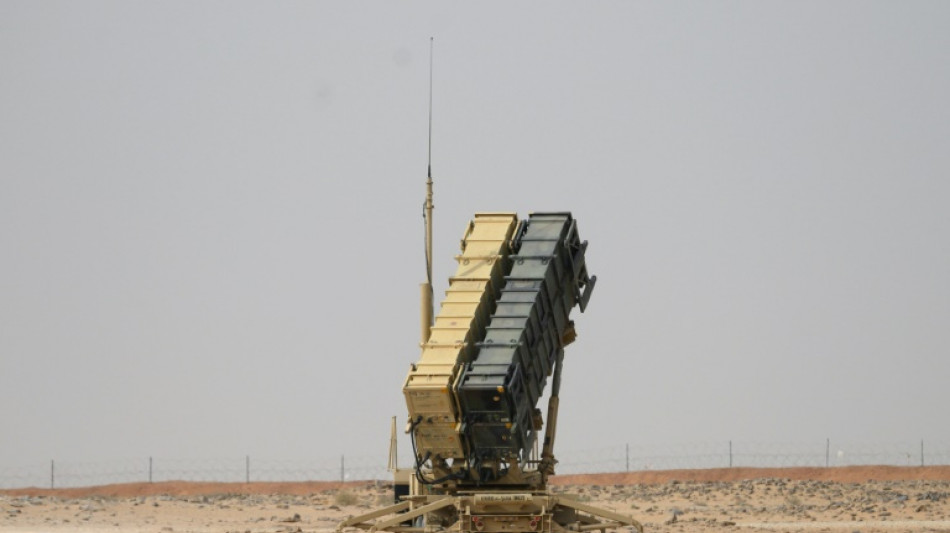
Patriot missiles: crucial but limited help for Ukraine / Photo: ANDREW CABALLERO-REYNOLDS - POOL/AFP

 One dead as Hurricane Simon creeps along Mexico's Pacific coast

 Carrick's Man United 'hungry and eager' to fix worst start in decades

 Fury as US federal agents search anti-Trump lawmaker's home

 One goal enough for Flick as Barca enter Galatasaray cauldron

 A7 to unveil a service that will re-invent the international payments market

 'Status quo' with EU 'not good enough', UK PM says as summit date set

 Stolen Renoir paintings found behind wall in France

 French supermarkets suffer refrigerator shutdown after 'unprecedented' cyberattack

 Arsenal lose Hincapie and Zubimendi in freak double blow

 Saudi says resilience tested, vows response after deadly airport attacks

 Alcaraz exits Shanghai Masters in straight-sets loss

 Pope to enter hospital on Tuesday for lung operation

 Renshaw shines again before Australia declaration

 Atletico's Simeone encourages goalless Alvarez improvement

 FXGLOBE Rebuilds Its Copy Trading and PAMM Business With B2BROKER's B2COPY

 Nepal rescuers search for missing after flash flood

 Oil rises as Trump comments roil energy markets

 Premier League in limbo as Manchester City soar

 Zelensky vows to respond as Moscow silent on 'energy ceasefire'

 Thousands march in India's capital to demand election chief resign

 African players in Europe: Mbeumo ends goal drought as United draw

 France's high school students plan fresh protests

 NZ bank in free speech row over 'explicit' sheep memes

 China Open champ Zheng withdraws from Wuhan citing fatigue

 Brewers edge Dodgers 2-1 in National League Championship Series opener

The United States is expected to announce it will equip Ukraine with Patriot missile units, boosting its defenses against Russia's assault on its infrastructure.
The move will also send a strong message to both Moscow and European allies that Washington is prepared to support Kyiv with some of its most advanced weaponry to battle Russian invaders.
Patriots are "far from a silver bullet," against the low-flying cruise missiles and drone bombs that Russian forces have pummeled Ukraine with, according to Ian Williams of the Missile Defense Project at the Center for Strategic and International Studies in Washington.
But they will add a layer of protection on top of Ukraine's current systems, and also defend against short-range ballistic missiles that Western officials think Russia is seeking from Iran, Williams said.
"Having layered defenses is helpful when you're dealing with this kind of complex air attack," he told AFP.
- What is the Patriot system? -
Made by Raytheon, the MIM-104 Patriot is a surface-to-air missile (SAM) system initially developed to intercept high-flying aircraft. It was modified in the 1980s to focus on the new threat of tactical ballistic missiles. Patriots proved themselves against Iraq's Russian-made Scuds in the first Gulf War.
Patriot systems come in fully mobile batteries that include a command center, a radar station to detect incoming threats, and launchers.
The launchers can handle a pod of four PAC-2 missiles at a time, which have a 160 kilometer (100 mile) range, or 16 of the newer PAC-3, which have a range of 40 kilometers but greater precision with onboard radar.
- Why are Patriots needed? -
To battle Russia's low-flying cruise missiles and bomb-like Shahed-136 drones, Ukraine has used a number of different short-range air defense systems, including Russian-made Buks and S-300s, old-generation US-made Hawk missiles, and modern SAM systems from allies like Germany and Italy.
The arrival of two US NASAM systems in October helped limit the damage from Russia's massive November 17 barrage; they were reportedly 100 percent effective in hitting their incoming targets, said Williams.
But modern SAM system launchers and missiles are in extremely short supply. For example, the US can't send any more NASAM systems until late next year.
Meanwhile, Russia is expected to continue its air assault on Ukraine infrastructure.
Ukraine "needs capacity, they need volume" for air defense, said Williams.
The Patriot "allows them to layer their defenses a bit more."
- What Patriots can do -
The Patriots' biggest value is countering high-flying tactical ballistic missiles. Russia has not used many ballistic missiles in its war on Ukraine, but that could change if it does acquire them from Iran.
The Patriots have proven very effective in Saudi Arabia against Iranian-design ballistic missiles fired from Yemen.
Against cruise missiles and drones, Williams points out, Patriots have limited value because their radar systems only cover a 120 degree portion of the horizon, unlike the 360 degree coverage of NASAMs.
"In the kind of environment we're seeing in Ukraine, where threats can come in from multiple directions, you either have to have more radars or more batteries," said Williams.
If the US gives Ukraine the longer-range PAC-2, he said, the likely target is the current cruise missile and drone threat. PAC-3s will indicate the focus is ballistic missiles.
The number of batteries the US will supply at first, he said, is likely to be just one or two. Training takes time, and US forces don't have many if any spare systems. Washington might have to coax batteries from one of the 17 countries which have them.
Then the question is where to put them: one battery could defend a city, or a power station, but not a broad swathe of territory.
"You have to decide what you're going to defend. You have to prioritize. It's not going to defend the whole country," said Williams
Another limiting issue is the cost: an individual Patriot missile runs about $3 million, triple the price of a NASAM missile.
H.Darwish--SF-PST