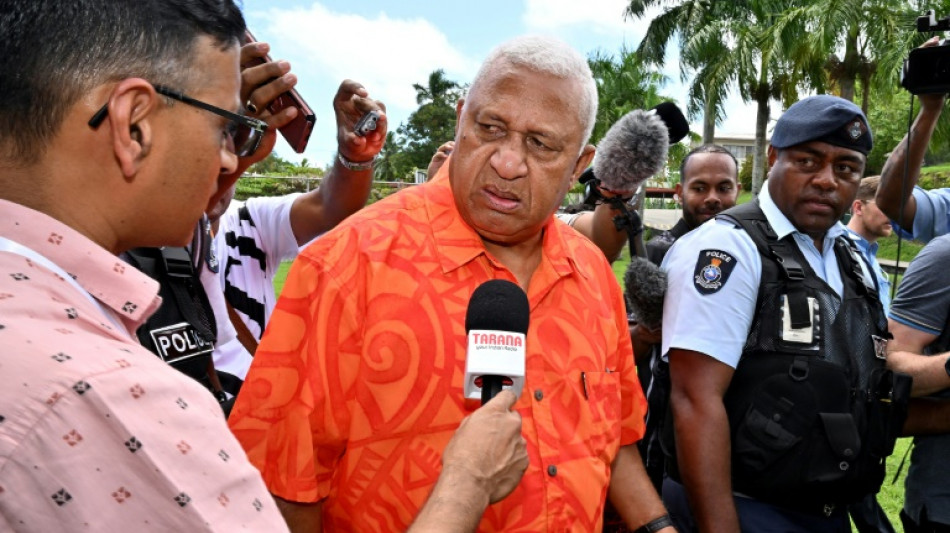
Fiji PM vows to respect election result, as vote gets under way / Photo: SAEED KHAN - AFP

 'Devastating' waves leave California beach homes on brink of collapse

 Meta says its new AI models on par with OpenAI, Anthropic

 Talarico rejects mental health conspiracy theory after return from flu
 Brazil presidential candidate Flavio Bolsonaro to visit jailed father

 Brazil's patron saint reappears in polarized election campaign

 US Open champ Zverev to become tennis world number one
 Migrant crisis wounds unhealed in Ceuta as Spanish royals visit

 Brazilian judge allows Flavio Bolsonaro to visit jailed father
 France braces for fresh student demonstrations as Macron calls for 'respect'

 Zelensky doubtful on Russian acceptance of Trump's 'energy ceasefire'

 Federal agents search home of Trump critic Ilhan Omar: government

 Pakistan detains hundreds from ex-PM Khan's party as protests falter

 Australia's Smith off field after being struck on helmet

 UK retains early access to test latest US AI models
 Top NATO commander warns Russia any attack would be 'futile'
 Stolen Renoir paintings found behind wall in France: prosecutor

 UNHCR sounds alarm on funding crisis

 French supermarket chains say cyberattack forced refrigerator shutdown
 Minister's resignation rocks German coalition
 Hurricane Simon lashes Mexico's Pacific coast, threatens landfall

 France schools protest rumbles on as Macron urges 'respect'
 Americans Hall and Woodford win economics Nobel for stabilisation models
 MEXC Brings AI, TradFi and the Future of Trading to Life at TOKEN2049 Singapore
 Italian rice farmer beats heat with biodiversity haven
 Stocks mixed as oil prices slip after Trump hails 'energy ceasefire'
Prime Minister Frank Bainimarama vowed to respect the outcome of Fiji's election Wednesday, as he faced a rival ex-coup leader looking to end his 16 years in power and pivot away from China.
Bainimarama, 68, led a coup to seize control of Fiji in 2006 and has since legitimised his grip on power with election wins in 2014 and 2018.
Casting his ballot in the capital Suva, Bainimarama was asked if he would respect the result. "Of course," he replied, before lashing out at reporters, suggesting they ask "better questions."
Standing in the way of Bainimarama's third elected term is his chief political rival, Sitiveni Rabuka, a 74-year-old former military commander nicknamed "Rambo" after leading two coups in 1987.
Rabuka -- who is also a former Fijian international rugby player and Commonwealth Games hammer thrower -- served as Fiji's prime minister between 1992 and 1999.
"I'm feeling great and getting better. But victory belongs to the lord," Rabuka told reporters after casting his vote at a makeshift polling booth in the capital, Suva.
Rabuka called into question whether the prime minister would concede if defeated.
"I accepted my defeat in 1999," he said. "I hope he can do that. We cannot live forever, we cannot rule forever."
The buildup to the vote has been marked by a strict media blackout, preventing Fijian media from reporting on any aspect of the election for 48 hours before voting day and until polls close.
Suva voter Avinay Kumar, 26, said there was a palpable feeling of tension ahead of the vote.
"It's a bit tense at the moment, because the older parties and the new parties are clashing with each other," he told AFP.
The vote is seen as a test of Fiji's fledgling democracy, and of China's quest for Pacific influence.
Rabuka has signalled Fiji could pivot away from Beijing under his leadership, saying it was time for Fiji to "reassess our associations" while explicitly ruling out a security pact with China.
Fiji has grown closer to China under Bainimarama, who used a "look north" policy to stabilise the economy after Australia and New Zealand hit the country with heavy trade sanctions in retaliation for his 2006 coup.
In recent years, Bainimarama has switched his fatigues for suits and colourful bula shirts and focused heavily on Fiji's fight against climate change -- an existential issue for the low-lying nation.
The military's role could yet be key in a tightly contested vote -- commanding officer Major General Jone Kalouniwai has insisted his forces will "honour the democratic process by respecting the outcome".
There are no reliable polls that give any indication about the outcome, but it is expected to be close.
Ahead of election day, the 97-person-strong Multinational Observer Group said it had been given "full access" to election sites and had not "observed any irregularities" in registration or pre-polling.
- 'It is prohibited' -
While Bainimarama has billed the contest as Fiji's most crucial vote "ever", it was almost impossible to tell on the oppressively humid streets of Suva that an election was at hand.
The capital has been purged of political billboards, and campaign adverts have been erased from the airwaves under strict blackout laws meant to preserve the integrity of the election.
On election day, Suva's distinctive open-air buses blasted reggae and dance music over the radio instead of once-ubiquitous campaign messages.
As the polls opened, only the sight of queues of voters fanning themselves with blue election booklets and seeking out trees for shade gave a hint that the election was under way.
Voting will take place in 1,436 polling stations dotted across a large number of Fiji's 300-plus islands.
Campaign blackouts are not unusual internationally, but Fiji's laws are notably harsh.
The government must approve all election-related local media coverage during the blackout -- which started on December 10 and ends at 6:00 pm local time (0600 GMT) Wednesday -- and breaches can result in up to five years in prison.
"It is prohibited for any media organisation to publish, print or broadcast any campaign advertisement, debate, opinion or interview on any election issue," Supervisor of Elections Mohammed Saneem told reporters in the lead-up to the poll.
S.Barghouti--SF-PST