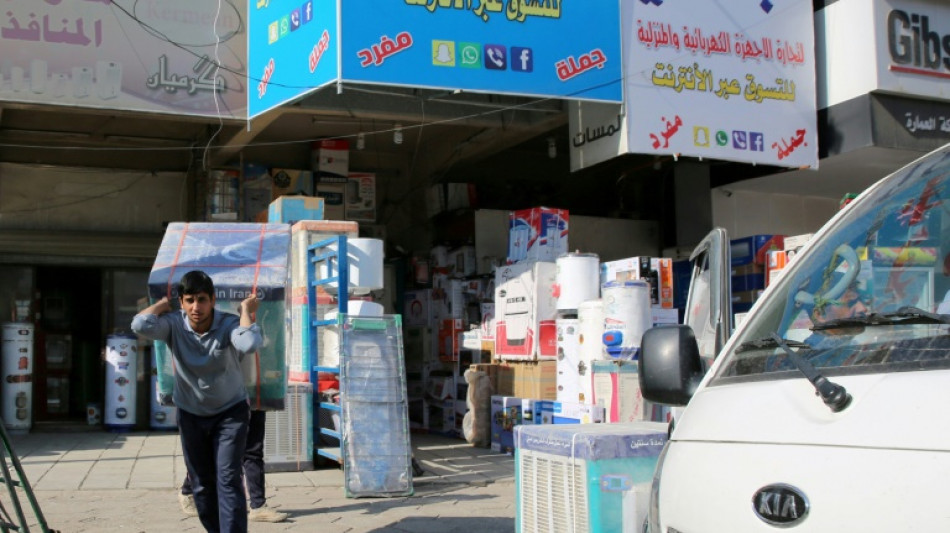
Iran strengthens political, economic hold over Iraq / Photo: SABAH ARAR - AFP/File

 'Breaking Bad' actor RJ Mitte dead: representatives

 Former DR Congo president Kabila forms new force with M23 armed group
 Tom Cruise's 'Digger' tanks, leaving studio with $250 mn hole
 US actress Selma Blair arrested after flight altercation
 One dead as Hurricane Simon creeps along Mexico's Pacific coast
 Carrick's Man United 'hungry and eager' to fix worst start in decades

 Fury as US federal agents search anti-Trump lawmaker's home

 One goal enough for Flick as Barca enter Galatasaray cauldron
 A7 to unveil a service that will re-invent the international payments market
 'Status quo' with EU 'not good enough', UK PM says as summit date set
 Stolen Renoir paintings found behind wall in France

 French supermarkets suffer refrigerator shutdown after 'unprecedented' cyberattack
 Arsenal lose Hincapie and Zubimendi in freak double blow
 Saudi says resilience tested, vows response after deadly airport attacks
 Alcaraz exits Shanghai Masters in straight-sets loss
 Pope to enter hospital on Tuesday for lung operation

 Renshaw shines again before Australia declaration
 Atletico's Simeone encourages goalless Alvarez improvement
 FXGLOBE Rebuilds Its Copy Trading and PAMM Business With B2BROKER's B2COPY

 Nepal rescuers search for missing after flash flood
 Oil rises as Trump comments roil energy markets
 Premier League in limbo as Manchester City soar
 Zelensky vows to respond as Moscow silent on 'energy ceasefire'

 Thousands march in India's capital to demand election chief resign

 African players in Europe: Mbeumo ends goal drought as United draw
Sanctions-hit Iran is consolidating its hold over neighbouring Iraq, an economic lifeline where pro-Tehran parties dominate politics, all to the chagrin of the United States, experts say.
For years, Iraq has been caught in a delicate balancing act between its two main allies Tehran and Washington, themselves arch foes.
After a 2003 US-led invasion toppled Iraqi dictator Saddam Hussein, Iran's influence has grown through political links among both countries' Shiite-Muslim majorities.
Pro-Iran parties now dominate Iraq's parliament, and in October they named a new prime minister following a year-long tussle with their Shiite rivals.
Iraq has become an "economic lifeline" for Iran, said Ihsan al-Shammari, a political scientist at the University of Baghdad.
This is "even more so with sharpening Western economic sanctions and nuclear negotiations that do not seem to be leading to a favourable deal for Iran", Shammari said.
"Iran's role will be even more important than during previous (Iraqi) governments"
During a visit to Tehran late last month, Prime Minister Mohammed Shia al-Sudani and Iranian officials urged greater bilateral cooperation in all fields.
He thanked Iran which provides gas and electricity -- around one-third of Iraq's needs -- and added this would continue until Iraq was self-sufficient.
His country is already the number one importer of Iranian goods.
In Shammari's view, Tehran has an "urgent need" to keep Iraq close.
- 'Contested' -
Under a 2015 nuclear deal with world powers, Iran agreed to curbs on its atomic programme in exchange for relief from economically crippling sanctions.
The deal began unravelling in 2018 when then-president Donald Trump withdrew the United States, and reimposed financial penalties including a ban on Iran's oil exports. Efforts to revive the nuclear deal since then have largely stalled.
Western countries have imposed additional sanctions following Iran's crackdown on protests that have rocked the country since September.
Iran accuses exiled Kurdish opposition groups of fomenting the unrest, and has carried out cross-border strikes in Iraq against them.
"Iraq is contested by the United States and Iran, with Turkey in third place in the north," said Fabrice Balanche, from France's Lumiere Lyon 2 university.
"With a pro-Iranian figure at the head of the government, Iran will be able to further take advantage of the Iraqi economy," he added, referring to Sudani, who is close to pro-Iran former prime minister Nuri al-Maliki.
Iran's influence can also be seen through its links with Iraq's Hashed al-Shaabi, a former paramilitary force made up mainly of pro-Iran militias that have since been integrated into the regular forces.
The Hashed played a major role in defeating the Islamic State group in Iraq and now has a significant presence in the country's politics.
Its representatives are part of the Coordination Framework parliamentary bloc, which controls 138 of the legislature's 329 seats and is made up of pro-Iran factions, including that of Maliki.
- 'Not fair' -
Last month, Iraq's government handed the Hashed control of a new public company, endowed with around $68 million in capital.
The Al-Muhandis firm's mission in oil-rich but war-ravaged Iraq is "provincial rehabilitation and development: infrastructure, housing, hospitals, factories", said a Hashed communications official on condition of anonymity, in keeping with the low profile officials have adopted over the project.
The company's name is in homage to Hashed deputy commander Abu Mahdi al-Muhandis. He was killed in a US drone strike in Baghdad in 2020 along with Iranian General Qasem Soleimani, who headed that country's Quds Force, the foreign operations arm of the Islamic Revolutionary Guard Corps.
In November, Iraqi Foreign Minister Fuad Hussein said it was "not fair" to consider his coalition government "an attachment" to Iran's.
The Iraqi Kurdish diplomat pointed to its multi-party and multi-confessional make-up as showing "balance" between the different forces.
But pro-Iran parties appear to now have free rein, after rival Shiite leader Moqtada Sadr tried for months to name a prime minister and prevent Sudani's appointment.
The standoff led to deadly clashes in late August that pitted Sadr supporters against Hashed members and the army.
As Iran's influence grows, ally the United States still remains present, with around 2,500 US troops stationed in Iraq as part of ongoing efforts to combat the Islamic State group.
Sudani has held several meetings with the US ambassador Alina Romanowski since her appointment.
Balanche noted that Washington monitors Iraq's banking system to ensure Iran is not using it to evade existing restrictions, and US influence is present via "the threat of financial sanctions".
"The United States is staying in Iraq so as not to totally abandon the country to Iran," he added.
B.AbuZeid--SF-PST