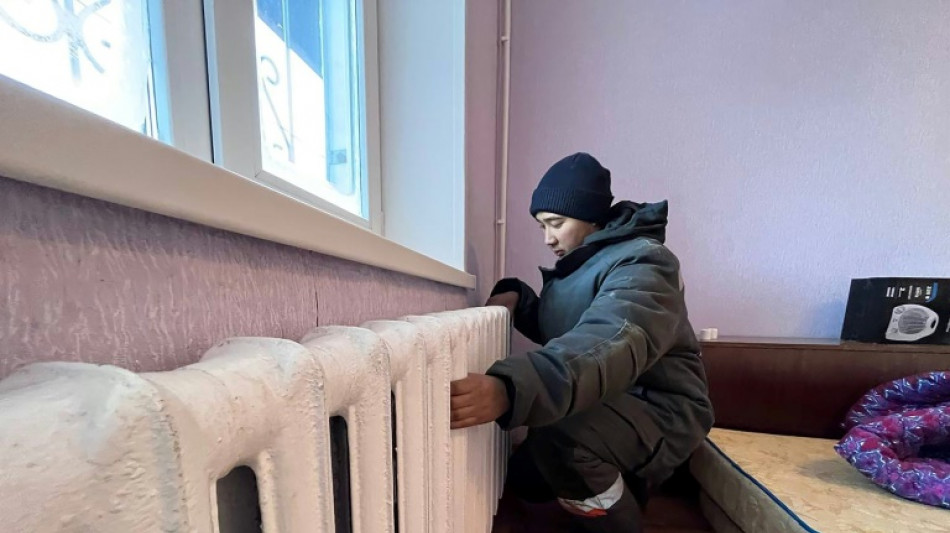
Power cuts in -30C spark anger in Kazakhstan / Photo: HANDOUT - KAZAKHSTAN'S GOVERNMENT PRESS SERVICE/AFP

 'Breaking Bad' actor RJ Mitte dead: representatives

 Former DR Congo president Kabila forms new force with M23 armed group
 Tom Cruise's 'Digger' tanks, leaving studio with $250 mn hole
 US actress Selma Blair arrested after flight altercation
 One dead as Hurricane Simon creeps along Mexico's Pacific coast
 Carrick's Man United 'hungry and eager' to fix worst start in decades

 Fury as US federal agents search anti-Trump lawmaker's home

 One goal enough for Flick as Barca enter Galatasaray cauldron
 A7 to unveil a service that will re-invent the international payments market
 'Status quo' with EU 'not good enough', UK PM says as summit date set
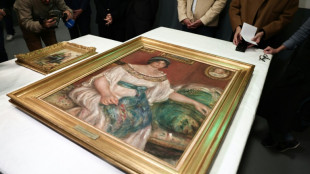 Stolen Renoir paintings found behind wall in France

 French supermarkets suffer refrigerator shutdown after 'unprecedented' cyberattack

 Arsenal lose Hincapie and Zubimendi in freak double blow
 Saudi says resilience tested, vows response after deadly airport attacks
 Alcaraz exits Shanghai Masters in straight-sets loss
 Pope to enter hospital on Tuesday for lung operation

 Renshaw shines again before Australia declaration
 Atletico's Simeone encourages goalless Alvarez improvement
 FXGLOBE Rebuilds Its Copy Trading and PAMM Business With B2BROKER's B2COPY

 Nepal rescuers search for missing after flash flood
 Oil rises as Trump comments roil energy markets
 Premier League in limbo as Manchester City soar
 Zelensky vows to respond as Moscow silent on 'energy ceasefire'

 Thousands march in India's capital to demand election chief resign

 African players in Europe: Mbeumo ends goal drought as United draw
The plight of a city in Kazakhstan left without heating for over a week in temperatures that dropped to minus 30 degrees Celsius (minus 22 degrees Fahrenheit) has sparked anger and highlighted the deplorable state of the country's Soviet-era infrastructure.
This month the northeastern city of Ekibastuz, with a population of around 150,000 people, descended into an icy hell, highlighting the dire consequences of power disruptions in winter, as European countries struggle with shortages due to Moscow's assault on Ukraine.
Ekibastuz was home to a Soviet-era prison camp where writer Alexander Solzhenitsyn was imprisoned between 1950 and 1953.
The camp became the inspiration for Solzhenitsyn's classic novel "One Day in the Life of Ivan Denisovich."
Images broadcast in Kazakhstan in recent days showed long icicles forming inside apartments, while residents burnt anything they could find to keep warm.
Teams had to work day and night to repair water pipes that had burst due to the cold.
On November 28, authorities declared a state of emergency in Ekibastuz after a malfunction at a thermal power plant deprived several districts of electricity and heating.
The state of emergency was lifted on Thursday and the situation has gradually improved, but the problem has sparked outrage across the country.
Dimash Kudaibergen, a popular Kazakh singer with nearly four million followers on Instagram, said those responsible should pay for the "tears of the mothers left on the streets".
"I believe that all the perpetrators, starting with the head of the thermal power plant, should be held accountable and serve their sentences in a prison without heating," he said.
- Run-down infrastructure -
President Kassym-Jomart Tokayev, who saw deadly protests break out over fuel price hikes in January last year, fired the local governor and dispatched senior officials to the scene.
The city's plight has sparked an outpouring of support, with residents of Kazakhstan collecting donations and sending heaters and blankets to Ekibastuz.
Funds were even collected in neighbouring Kyrgyzstan, which itself suffers from power outages.
The Ekibastuz ordeal is just the latest in a long list of accidents involving thermal infrastructure in the vast Central Asian country.
Kazakhstan's energy system, inherited from the Soviet Union, is still run-down despite investments.
"As they say here, the first time it's an accident, the second time it's a coincidence, but the third time it's a rule," energy expert Zhakyp Khairushev told AFP.
According to government data, heating plants were on average built more than 60 years ago under Soviet leader Nikita Khrushchev.
Khairushev said that more than 1,000 emergency shutdowns had occurred at thermal power plants since the start of the year.
President Tokayev has lamented that the hydrocarbon-rich nation is "one of the world's most energy-intensive countries" and depends on imports from Russia.
- 'Unprofitable' company -
To meet the high demand, power stations need to operate at full capacity, which increases the risk of accidents.
Khairushev said the recent expansion of the power-hungry crypto mining industry was adding to the risks.
Twenty-two of Kazakhstan's 37 thermal power stations are in private hands, and Tokayev has said he is considering the nationalisation of a number of assets.
Many have laid the blame for the most recent accident on tycoon Alexander Klebanov, the owner of the Ekibastuz power station.
Klebanov, described by Forbes as the Central Asian country's 15th richest man, has denied responsibility.
In a video statement, he said he had repeatedly warned the authorities about the condition of the plant.
"But as a private company, we cannot raise consumer tariffs," he said. "So the company has been unprofitable from the very beginning."
Khairushev struck a similar note.
"The existing infrastructure is deteriorating," he said.
"If urgent measures are not taken, including the revision of tariffs, then, unfortunately, such accidents will not be uncommon."
S.Barghouti--SF-PST