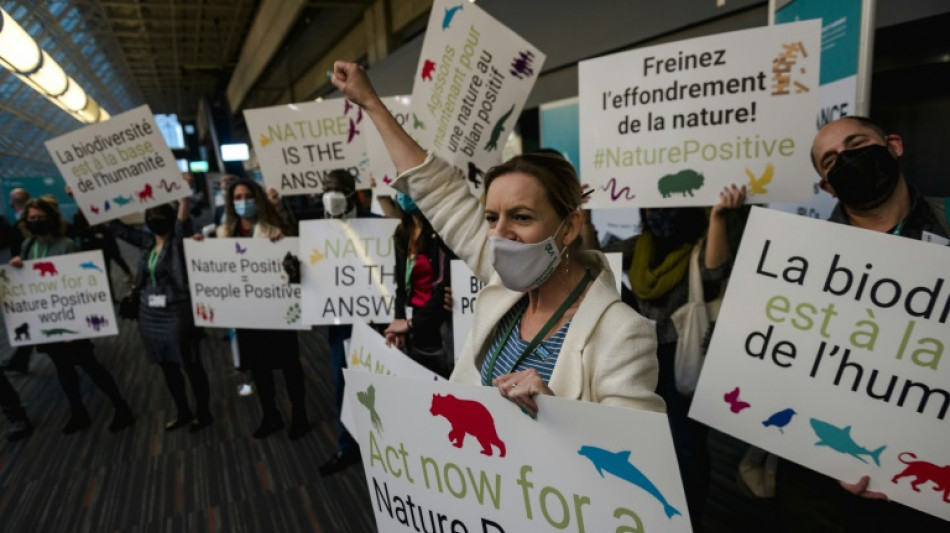
Civil society wants voice heard at COP15 biodiversity meeting / Photo: Andrej Ivanov - AFP

 Teenager shoots headmaster, teacher at French school
 'Breaking Bad' actor RJ Mitte dead: representatives

 Former DR Congo president Kabila forms new force with M23 armed group
 Tom Cruise's 'Digger' tanks, leaving studio with $250 mn hole
 US actress Selma Blair arrested after flight altercation
 One dead as Hurricane Simon creeps along Mexico's Pacific coast
 Carrick's Man United 'hungry and eager' to fix worst start in decades
 Fury as US federal agents search anti-Trump lawmaker's home

 One goal enough for Flick as Barca enter Galatasaray cauldron
 A7 to unveil a service that will re-invent the international payments market
 'Status quo' with EU 'not good enough', UK PM says as summit date set
 Stolen Renoir paintings found behind wall in France

 French supermarkets suffer refrigerator shutdown after 'unprecedented' cyberattack

 Arsenal lose Hincapie and Zubimendi in freak double blow
 Saudi says resilience tested, vows response after deadly airport attacks
 Alcaraz exits Shanghai Masters in straight-sets loss
 Pope to enter hospital on Tuesday for lung operation
 Renshaw shines again before Australia declaration
 Atletico's Simeone encourages goalless Alvarez improvement
 FXGLOBE Rebuilds Its Copy Trading and PAMM Business With B2BROKER's B2COPY

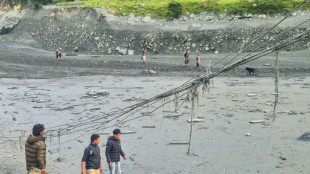 Nepal rescuers search for missing after flash flood
 Oil rises as Trump comments roil energy markets

 Premier League in limbo as Manchester City soar
 Zelensky vows to respond as Moscow silent on 'energy ceasefire'
 Thousands march in India's capital to demand election chief resign

Protests, public debates and film screenings: this is the other side of the COP15 summit, where NGOs are mobilizing to raise awareness of the need to protect biodiversity and lobbying for a major deal to do just that.
To coordinate and amplify their voices, over a hundred organizations recently banded together to create the "COP15 Collective" ahead of the December 7-19 conference in Montreal.
"It's no longer just a question of environmentalists. Everyone is around the table, everyone wants to do something and it's super encouraging," the group's spokeswoman Anne-Celine Guyon told AFP, calling it a "historic" moment for Canada's Quebec province.
And they've vowed to be heard: inside the convention center where delegates are meeting, participating in the negotiation process, and marching in the streets.
Meetings that are open to all, humorous and artistic workshops, an immersive wall projection on the impacts of oil drilling on whales -- some sixty events are planned around the conference in Montreal.
The top event will arguably be a "great march for the living" planned in the city's downtown on December 10. Organizers expect thousands of participants, but acknowledge that it's far fewer than the half a million who came out to march with climate activist Greta Thunberg in September 2019.
- 'Political momentum' -
After the pandemic disrupted student gatherings over the past two years, COP15 will be "an important meeting to reconnect, to renew relationships", says 20-year-old Albert Lalonde, a project manager with the David Suzuki Foundation.
Due to exams though, students -- usually on the frontlines of climate protests -- may not be as present at COP15, Lalonde adds.
Despite the fact that no government leaders are planning to attend except Canadian Prime Minister Justin Trudeau, all are hoping the COP15 summit achieves "a political momentum similar to the Paris agreement" with the adoption of an "ambitious global framework," says Eddy Perez, another spokesperson for the collective.
A recent Greenpeace poll showed that, in Canada, eight out of ten people believe the government should lead by example by making strong commitments to protect nature.
"People are getting the message that this is important, that we are going through a crisis, that there are thousands of species that are in danger on our planet," believes Marie-Josee Beliveau of Greenpeace's Canadian branch.
Full of hope for this "crucial meeting," she said negotiators should know "a very mobilized civil society" is closely following the talks.
There is "a lot of interest, all of a sudden, for the issues of protecting biodiversity, probably as we have never felt," suggests Anne-Sophie Dore, an environmental lawyer and lecturer.
She adds that real educational work remains to be done, as "most people didn't even know that biodiversity COPs existed compared to climate COPs."
Canada's Indigenous population, as elsewhere, has claimed for a long time that more attention should be given to the living environment. According to UN climate experts, their traditional lands are home to 80 percent of the remaining biodiversity on Earth.
"During time immemorial, the caribou saved us," explains Jerome Bacon St-Onge, member of the Innu people in Canada's far north, evoking a "sacred species" for the Indigenous way of life, precious for its meat and its fur in particular.
"The fact that it is wasting away, it causes us very, very heavy damage in terms of cultural identity," he said, warning that "time is running out" to act.
Q.Najjar--SF-PST