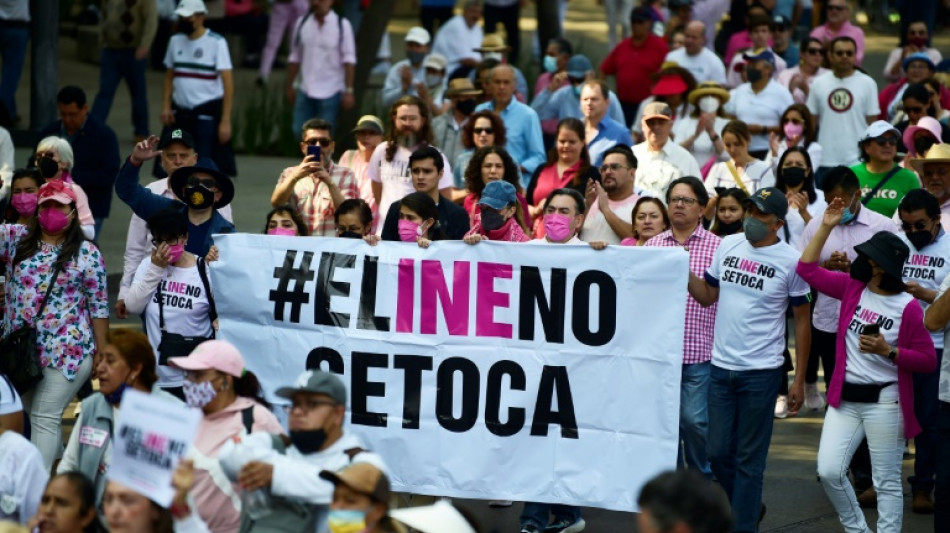
Mexico lawmakers block president's electoral reform, advance 'Plan B' / Photo: CLAUDIO CRUZ - AFP/File

 Teenager shoots headmaster, teacher at French school

 'Breaking Bad' actor RJ Mitte dead: representatives

 Former DR Congo president Kabila forms new force with M23 armed group
 Tom Cruise's 'Digger' tanks, leaving studio with $250 mn hole

 US actress Selma Blair arrested after flight altercation
 One dead as Hurricane Simon creeps along Mexico's Pacific coast
 Carrick's Man United 'hungry and eager' to fix worst start in decades
 Fury as US federal agents search anti-Trump lawmaker's home

 One goal enough for Flick as Barca enter Galatasaray cauldron

 A7 to unveil a service that will re-invent the international payments market
 'Status quo' with EU 'not good enough', UK PM says as summit date set
 Stolen Renoir paintings found behind wall in France

 French supermarkets suffer refrigerator shutdown after 'unprecedented' cyberattack

 Arsenal lose Hincapie and Zubimendi in freak double blow

 Saudi says resilience tested, vows response after deadly airport attacks

 Alcaraz exits Shanghai Masters in straight-sets loss
 Pope to enter hospital on Tuesday for lung operation

 Renshaw shines again before Australia declaration

 Atletico's Simeone encourages goalless Alvarez improvement

 FXGLOBE Rebuilds Its Copy Trading and PAMM Business With B2BROKER's B2COPY

 Nepal rescuers search for missing after flash flood
 Oil rises as Trump comments roil energy markets

 Premier League in limbo as Manchester City soar
 Zelensky vows to respond as Moscow silent on 'energy ceasefire'

 Thousands march in India's capital to demand election chief resign

Mexican lawmakers blocked divisive electoral reforms proposed by President Andres Manuel Lopez Obrador that sparked mass street protests, but advanced less radical changes on Wednesday.
The rejection by the lower house of Congress late Tuesday was a blow to Lopez Obrador, who needed support from at least two-thirds of lawmakers to change the constitution.
Instead he sought to push through watered-down reforms, including a reduction in the budget of the National Electoral Institute (INE), the independent body that organizes the country's elections.
Lopez Obrador's so-called "Plan B," which required approval by a simple majority of lawmakers, was passed in the Chamber of Deputies by 261 votes in favor and 216 against.
The opposition Institutional Revolutionary Party branded the changes a "betrayal of Mexico."
The proposals must still be approved by the upper house, the Senate, where the ruling party and its allies also have a majority.
Last month, tens of thousands of demonstrators marched in Mexico City demanding a halt to the proposed reforms, which they see as an attack on one of the country's most important democratic institutions.
Lopez Obrador alleges that the INE endorsed fraud when he ran unsuccessfully for the presidency in 2006 and 2012, before winning in 2018.
Under his initial plan, the INE would have been replaced by a new body with members chosen by voters instead of lawmakers.
The number of seats in the lower house of Congress would have been reduced from 500 to 300, and those in the Senate from 128 to 96.
New York-based advocacy group Human Rights Watch warned before the vote that the changes "could seriously undermine electoral authorities' independence, putting free, fair elections at risk."
"President Lopez Obrador's proposed changes to the electoral system would make it much easier for whichever party holds power to co-opt the country's electoral institutions to stay in power," said HRW researcher Tyler Mattiace.
"Given Mexico's long history of one-party rule maintained through questionable elections, it is extremely problematic that legislators would consider a highly regressive proposal that would weaken the independence of the elections authority."
Lopez Obrador, who has an approval rating of nearly 60 percent but is barred by the constitution from running for a second term, insists that his reform plan sought to "strengthen democracy."
He dismissed the opposition protest against his proposal, and two weeks later led hundreds of thousands of his supporters on a march through Mexico City in a show of political strength.
B.Mahmoud--SF-PST