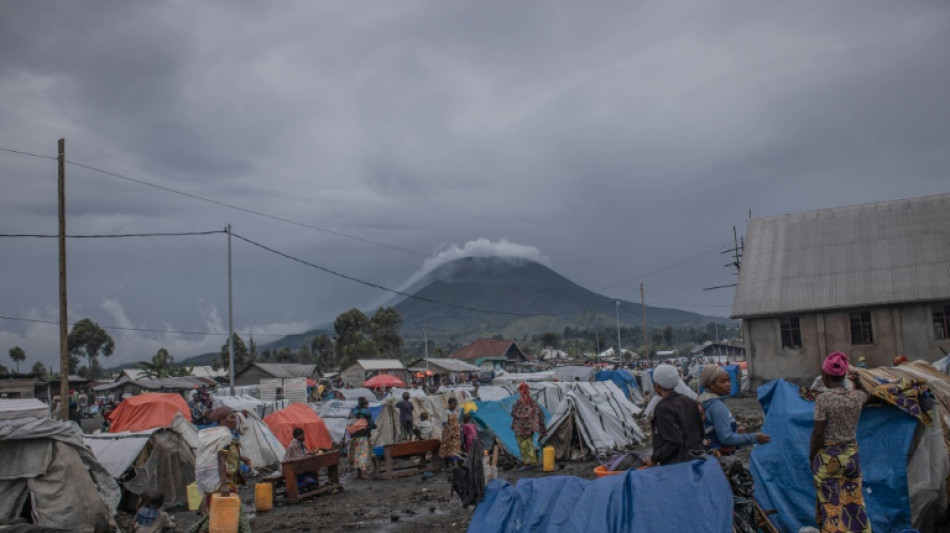
Hunger, cholera stalk displacement camps near east DR Congo city / Photo: Guerchom Ndebo - AFP

 Malaysia's Firefly extends flight cancellations due to haze

 IMF upgrades 2026 growth forecast but warns of 'split' outlook
 Infantino could pull off 'Houdini' act as critics struggle for candidate

 France braces for fresh nationwide student demonstrations
 Ahead of Israel vote, desert town becomes frontline against ultra-Orthodox expansion

 El Nino Watch: the impacts around the world this week

 Man City, PSG clash at contrasting time for state-backed projects
 Melbourne imam denies links to suspected flydubai hijacker

 Coventry crush Newcastle to climb out of relegation zone
 'Devastating' waves leave California beach homes on brink of collapse

 Meta says its new AI models on par with OpenAI, Anthropic

 Talarico rejects mental health conspiracy theory after return from flu
 Brazil presidential candidate Flavio Bolsonaro to visit jailed father

 Brazil's patron saint reappears in polarized election campaign

 US Open champ Zverev to become tennis world number one

 Migrant crisis wounds unhealed in Ceuta as Spanish royals visit

 Brazilian judge allows Flavio Bolsonaro to visit jailed father

 France braces for fresh student demonstrations as Macron calls for 'respect'

 Zelensky doubtful on Russian acceptance of Trump's 'energy ceasefire'

 Federal agents search home of Trump critic Ilhan Omar: government

 Pakistan detains hundreds from ex-PM Khan's party as protests falter

 Australia's Smith off field after being struck on helmet

 UK retains early access to test latest US AI models
 Top NATO commander warns Russia any attack would be 'futile'

 Stolen Renoir paintings found behind wall in France: prosecutor

Thousands of tiny makeshift shelters hug the road leading north out of Goma, a symptom of the vast humanitarian crisis gripping DR Congo's turbulent east.
Since late October, many tens of thousands of people have flocked towards the relative safety of the city, fleeing the advance of the M23 rebel group.
The most vulnerable have settled near the roadside, packed inside tents cobbled together from sticks and tarpaulin on fields of lava spouted from the looming volcano Mount Nyiragongo.
Despite aid efforts, all of the displaced people interviewed by AFP complained of hunger, and several described having to fight for food. Cholera, a consequence of poor hygiene, has also broken out.
"I don't know where to find food," said Suzanne Niramivumbi Kavakura, a small 90-year-old woman, wrapped in a colourful shawl and headscarf.
Sitting outside her hutch-like shelter, she recounted how she fled her native Rugari, in North Kivu province, as fighting approached six weeks ago.
Kavakura's grandchildren found her on the road and they fled south together to Kanyaruchinya, a hillside area overlooking Goma which is now thronged with displaced people and serried rows of tents.
Precise numbers are hard to come by, but according to International Organisation for Migration (IOM) figures from late November, over 140,000 people are camping in the Nyiragongo area north of the city of two million, or sleeping in churches and schools.
Pelagie Ngayabaseka, a 54-old woman with her infant grandchild swaddled to her back, said there wasn't enough food to go around.
"If you don't have the strength to fight, you won't get anything," she said, as dozens of young children crowded around her.
- 'Exponential dimensions' -
The M23, a predominantly Congolese Tutsi rebel group, lay dormant for years.
But it took up arms again late last year and in June seized Bunagana, a strategic town on the border with Uganda.
After a brief period of calm, the rebels went on the offensive again in October, capturing swathes of North Kivu province and forcing hundreds of thousands to flee.
"The scale (of the humanitarian crisis) completely changed after this offensive," said Anne-Sylvie Linder, head of the International Committee of the Red Cross in North Kivu.
Fighting in the province displaced about 370,000 people by November 28, according to the IOM, compared to about 90,000 in late October.
Conditions in camps such as Kanyaruchinya are shocking, Linder added, explaining that aid organisations are struggling to respond to the massive movement of people.
Among myriad other problems, there is little fresh water in Kanyaruchinya and the rocky lava field makes digging adequate latrines impossible.
Most of the displaced people sleep with just a blanket laid over the rocks. Regular downpours due to the Democratic Republic of Congo's rainy season make conditions all the more wretched.
Cholera has also recently broken out, with 21 confirmed cases as of Monday, according to a humanitarian official who requested anonymity.
"Cases have tripled every week for three weeks," said Marie-Pierre Poirier, UNICEF's west and central Africa director, during a visit to Kanyaruchinya the same day.
The growing numbers of displaced people is a problem taking on "exponential dimensions," she warned.
- 'We need to go home' -
Theo Musekura, the president of a displaced people's committee, said about 50 people had already died of illnesses such as cholera, malaria and diarrhoea.
A local hospital offers treatment, but "there are too many people," he said.
Eighty percent of the displaced people in Kanyaruchinya are Congolese Hutus from the Rutshuru area of North Kivu, Musekura estimated.
"They fled because when the M23 comes, they kill people," the 48-year-old said matter-of-factly.
The danger remains close by. Kanyaruchinya lies several kilometres (miles) from the front line, which has been quiet in recent weeks.
Standing in drizzle by the roadside in Kibati -- just north of Kanyaruchinya and about 10 kilometres (six miles) from the front -- Adela Mufasano said she and her children needed to go home.
"The kids sleep on the rocks," the 54-year-old said. "When the rain comes, it's a catastrophe".
Andre Bahati Musarumu, watching men play cards in front of a tent in Kanyaruchinya, also said he wanted the situation to end.
"We want to go home to look for food," said the 60-year-old, who fled with eight children.
"The government needs to decide between negotiation and war."
I.Matar--SF-PST