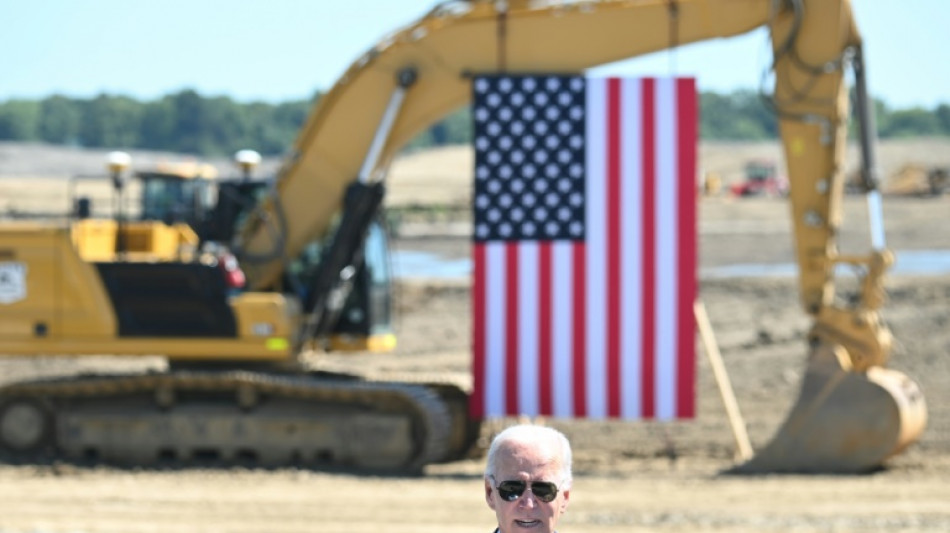
Biden celebrates giant TSMC semiconductor project / Photo: SAUL LOEB - AFP

 Malaysia's Firefly extends flight cancellations due to haze

 IMF upgrades 2026 growth forecast but warns of 'split' outlook

 Infantino could pull off 'Houdini' act as critics struggle for candidate

 France braces for fresh nationwide student demonstrations

 Ahead of Israel vote, desert town becomes frontline against ultra-Orthodox expansion

 El Nino Watch: the impacts around the world this week

 Man City, PSG clash at contrasting time for state-backed projects

 Melbourne imam denies links to suspected flydubai hijacker

 Coventry crush Newcastle to climb out of relegation zone

 'Devastating' waves leave California beach homes on brink of collapse

 Meta says its new AI models on par with OpenAI, Anthropic

 Talarico rejects mental health conspiracy theory after return from flu

 Brazil presidential candidate Flavio Bolsonaro to visit jailed father

 Brazil's patron saint reappears in polarized election campaign

 US Open champ Zverev to become tennis world number one

 Migrant crisis wounds unhealed in Ceuta as Spanish royals visit

 Brazilian judge allows Flavio Bolsonaro to visit jailed father

 France braces for fresh student demonstrations as Macron calls for 'respect'

 Zelensky doubtful on Russian acceptance of Trump's 'energy ceasefire'

 Federal agents search home of Trump critic Ilhan Omar: government

 Pakistan detains hundreds from ex-PM Khan's party as protests falter

 Australia's Smith off field after being struck on helmet

 UK retains early access to test latest US AI models

 Top NATO commander warns Russia any attack would be 'futile'

 Stolen Renoir paintings found behind wall in France: prosecutor

President Joe Biden flies Tuesday to Arizona to celebrate the mammoth expansion of a Taiwanese semiconductor plant, citing the project as proof the United States is finally breaking dangerous dependency on foreign manufacturers for the vital component.
TSMC announced it is building a second facility in Phoenix by 2026, ballooning its investment from $12 billion to $40 billion. About 10,000 high-tech jobs will be created once both plants are working, the company said.
With a target of producing some 600,000 microchips a year in the twin facilities, TSMC's project would go a long way to meeting the US goal of ending reliance on factories based abroad -- particularly in Taiwan, which is under constant threat of being absorbed or even invaded by China.
The "major milestone" adds up to "the largest foreign direct investment in Arizona history and it's one of the largest in US history," White House National Economic Council Director Brian Deese told reporters.
Biden will speak at the TSMC site, accompanied by senior political figures and titans of the corporate world, including Apple CEO Tim Cook, TSMC's founder Morris Chang and Micron CEO Sanjay Mehrotra.
The Democrat will seek to take credit for the investment influx, pointing to the effect of his signature CHIPS Act, which sets aside almost $53 billion for subsidies and research in the semiconductors sector.
It's a message he'll be especially keen to spread in Arizona, which was long a Republican-dominated state but has turned into a battleground where Democrats do increasingly well.
The plant expansion -- coming on top of other significant microchip manufacturing projects dotted around the country -- is part of an overall plan by the Biden administration to shift the center of gravity in the increasingly strategic, global industry.
Most supply currently comes from companies based in reliable US allies in Asia, but the sheer distance from producers and, especially, the geopolitical tensions around Taiwan are triggering a push to shrink the supply chain.
"Virtually every large tech firm, including automotive firms and any company that uses technology is sweating bullets that something's going to happen between Taiwan and China. And so there's a massive rush to shift manufacturing out of both countries," technology analyst Rob Enderle said.
- Smaller the better -
In the high-stakes world of microchips, sheer quantity is important. The miniscule, hard-to-make gadgets are at the heart of almost every modern appliance, vehicle and advanced weapon.
But quality -- and small size -- is also increasingly important for sophisticated everyday devices like smartphones and on that front the White House says it has good news.
The new TSMC plant will produce tiny 3 nanometer chips, while the existing facility will start reducing the size of its current 5 nanometer chips to 4 nanometers.
Building a plant, or a "fab," takes several years. But once "at scale, these two fabs could meet the entire US demand for advanced chips when they're completed. That's the definition of supply chain resilience," Ronnie Chatterji, National Economic Council deputy director for industrial policy, told reporters.
Deese, one of Biden's most senior advisors, said the broader message from the White House is that US industrial strategy is undergoing a rebirth.
For almost four decades, the idea was "trickle down," where government would "get out the way" and cut taxes for big companies to attract investment, he said.
Instead, Biden's policy -- both through the CHIPS Act and the giant Inflation Reduction Act -- uses public money to attract, or "crowd in" private investment.
The goal is not to exclude "private companies, but in fact, encouraging private investment at historic scale," Deese said.
E.Qaddoumi--SF-PST