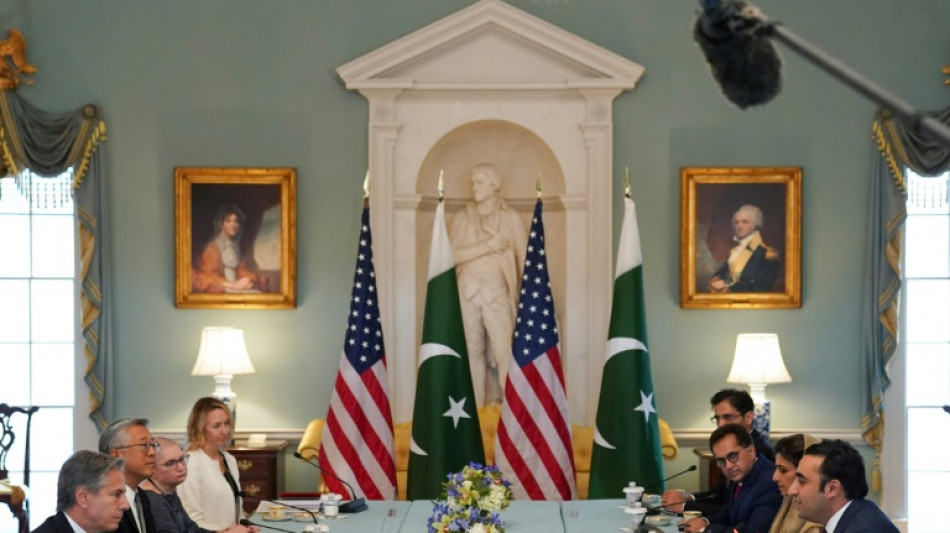
Study eyes US cooperation with Pakistan amid China rise / Photo: KEVIN LAMARQUE - POOL/AFP/File

 PU Prime Deepens Argentina Presence Through FX Expo Buenos Aires 2026

 Nothing to seal here: NZ police help stranded pup home

 White House releases list of products US, China could tax less

 'Pseudo-journalism': Partisan 'news' sites target US midterms

 'Currently impossible': North Korea defections in freefall

 Erasmus sizes up 'improved' Wallabies ahead of 2027 World Cup

 Scandal-weary Brazilians to vote as Lula faces Bolsonaro son

 SpaceX aims to put Starship in orbit for the first time

 Pope to speak on united Europe from French border town

 Scheffler makes sportsmanship stand over tee screamer

 Anthropic CEO Amodei to dine with Trump at White House

 Dupont scores twice to send Toulouse to Top 14 summit

 Greece stun Klopp's Germany as Ireland show sorrow for Gaza

 Ramos fires holders Portugal to Nations League win in Norway

 Greece hand Klopp first defeat as Germany manager

 Pope promises French sex abuse victims to prevent further harm

 UK village on edge over threats to air base in terror alert

 Two giant pandas, emblems of China soft diplomacy, arrive in US

 Aleksandar Vucic: from Milosevic minister to long-serving Serbian statesman

 Trump expects new Iran talks despite rejecting deal offer

 Xavi gets first win as Netherlands boss, Denmark beat Wales

 Madrid housing protest camp enters second night as PM vows action

 Tigray TV station hit by drone, rebels advance in north Ethiopia

 Banton hundred paves way for England ODI series win over Sri Lanka

 Milestone man Kohli powers India to big ODI win over West Indies

The United States needs to keep engaging Pakistan despite lingering distrust over Afghanistan, with investment and climate cooperation key to reducing the South Asian nation's growing reliance on China, a study group recommended Tuesday.
The group released its findings during a visit to Washington by the head of Pakistan's powerful military, General Qamar Javed Bajwa, a week after a trip by the civilian foreign minister, Bilawal Bhutto Zardari.
The study group, which did not involve the US government, included scholars and former US ambassadors to Pakistan Ryan Crocker, Cameron Munter and Robin Raphel, along with Husain Haqqani, Pakistan's former ambassador in Washington.
Pakistan and the United States were partners in the Cold War and, officially, in the Afghanistan war. But American officials lost patience with Islamabad which they suspected of quietly maintaining support for the Taliban, who triumphed as US troops withdrew last year.
"Instead of allowing existing differences to define the partnership, it may be time to recognize that both sides need to understand the other's interests so that they can then find a way to work on areas of mutual concern," the study group said.
The United States must move beyond leveraging aid to change Pakistan's policies, a tactic that has been a proven failure.
Islamabad, in turn, needs to accept "that all of Pakistan's problems, especially terrorism and militancy, cannot be laid at the door of the US."
Pakistan has forged increasingly close relations with China, triggering warnings from the United States that Beijing -- seen as Washington's key global competitor -- will saddle the economically troubled nation with debt.
The study group said that after previously linking the Pakistan relationship to Afghanistan or its historic rival India, the United States should avoid now seeing ties through the lens of China.
Instead, the United States can "help build Pakistan's capacity for transparency and compliance" on Chinese loans and can reduce reliance on China by encouraging investment by US companies and others, it said.
The United States can also focus on building climate resilience -- a key challenge for Pakistan, which was recently devastated by floods.
While the United States wants to step back from Afghanistan, the study group said the need for counterterrorism cooperation with Pakistan "has if anything increased" due to the loss of US intelligence assets on the ground.
"While Pakistan and the US often fail to see eye-to-eye when it comes to Afghanistan, China, or India, they do share mutual interests in seeking stability in the region, combatting the problem of extremism and averting armed conflict in nuclear South Asia," it said.
H.Nasr--SF-PST