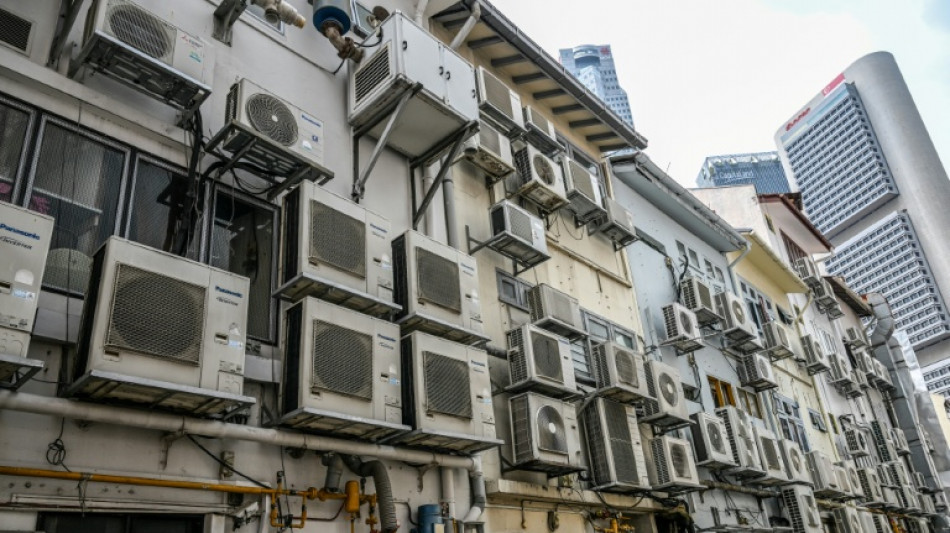
'Air-con nation' Singapore eyes alternatives to cool down / Photo: Roslan RAHMAN, Roslan RAHMAN - AFP

 Brazil Faces Debt and Inflation Test as Lula Prepares Fourth Term

 مركز "شمس" في اليوم الدولي للتسامح: التسامح لا يسقط حق الضحايا في العدالة

 Canada Expands Asian Trade Push as US Negotiations Resume

 Quebec Math-Rock Duo Angine de Poitrine Earns Four Grammy Nominations
 Italy Raises 2026 Growth View but Warns Energy Will Keep Inflation High

 شطب 130 مليون اسم من قوائم الناخبين في الهند يثير مخاوف الترحيل
 US Wholesale Inflation Eases Monthly but Hits a Four-Year Annual High

 India's Wholesale Inflation Jumps to 12.29% as Fuel Costs Surge
 Japan's Economy Edges Into Contraction as Costly Oil Weighs on Demand

 Modi’s ASEAN Agenda Prioritizes Trade Balance and Defense Ties in Manila

 Egypt Demands Tripling of Climate Adaptation Finance for Africa by 2035

 Met Office Issues Yellow Snow Warning for Nottinghamshire on Tuesday

 اللواء أبو هارون: توطين التدريب العسكري الفلسطيني بنسبة 100% رغم القيود الإسرائيلية

 Ali Almansoori Claims BTCC Double at Bahrain National Race Day

Long dubbed an "air-conditioned nation", Singapore is experimenting with cooling alternatives from chilled beams to "passive displacement" to curb its thirst for energy-guzzling air conditioning.
The city-state has the highest per-capita air conditioner ownership rate in Southeast Asia, with about 99 percent of private residences equipped with cooling units.
Singapore's local building sector accounts for one-fifth of its emissions, while cooling itself accounts for 40 to 60 percent of a building's energy consumption, according to studies.
A stroll down renowned thoroughfare Orchard Road highlights that dependence. Shoppers are greeted by blasts of cool air that waft into the street as doors swing open -- a major draw given daytime highs hover between 31C and 33C year-round.
But air conditioning can make the heat problem worse. Compressor units belch hot air back out into the environment, and the electricity that powers the systems can contribute to climate change if generated from fossil fuels.
- Alternative options -
Some buildings in Singapore are looking at other options, including active chilled beams, which are perforated panels equipped with cooling coils that are mounted on ceilings.
A chiller plant on the building's top floor cools water down to 9C, then pumps it into the coils. Simultaneously, air is blasted through small nozzles inside the beams.
The jets of air create a low-pressure zone that sucks up warmer air from the room below so it passes over the coils and is cooled before recirculating.
The technology keeps the offices at the eight-storey Paya Lebar Green building in eastern Singapore at a comfortable 24C.
A visiting AFP team felt noticeably cooler air flowing from the sleek white panels on the ceiling of the building, described as one of Singapore's "greenest".
The system is also quiet, without the constant hum of air conditioning units.
When HR professional Renuga Shekar first moved into an office space at Paya Lebar Green last November, the 30-year-old and her colleagues just thought the exposed pipes and panels on the ceiling was a "warehouse kind of look".
"We didn't really think much about it. No one really commented about it," she told AFP.
It was only months later, after noticing how quiet the office was and hearing technicians mention "ACB" during maintenance, that they realised it was cooled by active chilled beams.
"We didn't even realise how different the air cooling system is because it was very seamless, and in terms of the temperature, ideal for everybody in the office," she said.
Together, the system cut energy use by more than 30 percent compared with conventional air conditioning, according to the building's designers, DP Architects.
A similar system is in use at Singapore's ports authority maintenance building at western Tuas harbour.
The building uses passive displacement cooling, which taps natural airflow to reduce reliance on mechanical fans.
Ceiling cooling coils chill the air, which sinks before naturally rising back to the coils as it warms. This continuous cycle reduces the need for fans, cutting energy use and noise.
- 'Mindset shift' -
Another alternative is radiant cooling, where water chilled to between 14C and 18C flows through pipes or panels and absorbs heat radiating from people or objects to reduce ambient temperatures.
The push to find new cooling solutions has government backing.
A 2024 government study identified alternative cooling technologies (ACTs) as a key strategy which found they could save the city up to 48 percent in energy.
By mid-2026, at least 33 public and 14 private buildings had adopted ACTs, Singapore's building authorities said. The city-state has an ambitious goal to achieve net-zero carbon emissions by 2050.
The figures are still relatively small, and it can be challenging to find an ACT that is acceptable to users familiar with tried-and-tested air conditioners.
Supporters of alternative systems acknowledge that they cost more to install than conventional air‑conditioning, but say they more than make up for it over time with much lower running costs thanks to big energy savings.
The most popular alternative method remains hybrid cooling -- simply turning up air conditioning to a higher temperature of 25.5C to 27C, and pairing it with fans.
"Everybody's more used to having air-conditioned office spaces, so for them to suddenly accept 26 degrees, I think the mindset shift has not reached a threshold where it's generally accepted yet," said Chua Zi Jun, director at DP Architects.
Demand for cooling is only increasing as climate change raises temperatures and humidity in Singapore and beyond.
Traditional air-conditioning systems rely on vapour compression, using refrigerants to move heat from one place to another.
ACTs use the same basic principle, but either spend less energy moving cool air or reduce run-time by leaning on people's ability to adapt to slightly higher temperatures.
"The technologies are a step in the right direction and should eventually incorporate more sophisticated controls, including predictive systems that adjust temperatures before rooms become too hot or cold," said Wan Man Pun, a cooling tech expert at Nanyang Technological University.
But "we still haven't found any alternative cooling methods that have a higher coefficient of performance, or efficiency, than vapour compression", Wan said.
H.Jarrar--SF-PST