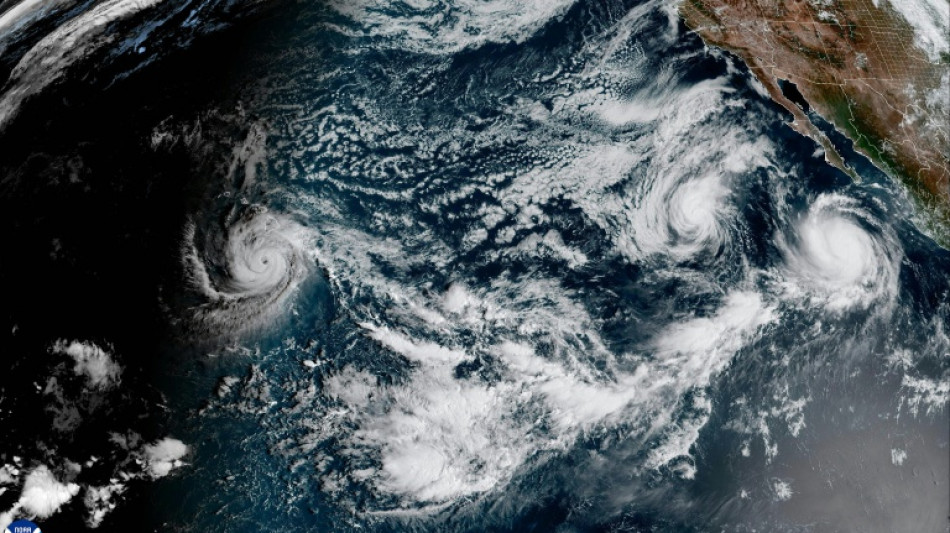
Hurricane Polo approaches Mexico, threatens severe damage / Photo: Handout - NOAA/AFP

 Kubayi Warns Residents to Vacate Hijacked Buildings as State Prepares Seizures

 Van Gogh’s ‘Châtaigniers en Fleurs’ Sets $285m Record at Sotheby’s

 محكمة الاحتلال تمدد اعتقال مدير مستشفى كمال عدوان دون تهمة

 Global Scams Remain Widespread: Nearly Two in Three Adults Worldwide Report Scam Encounters, 9% Lost Money

 OPEC Chief: Oil to Remain Major Energy Source for Decades Amid Global Shift

 Hyundai Offers £1,000 Deposit Contribution on Black Friday for Tucson, Santa Fe, Kona, Ioniq 9 and Bayon
Hurricane Polo is expected to make landfall on Monday in a small town off Mexico's Pacific coast, where authorities expect heavy rain and severe damage.
Puerto San Carlos, a small fishing port of nearly 6,000 people, lies in the path of the hurricane, which is a Category 3 on the Saffir-Simpson scale, according to the US National Hurricane Center (NHC).
The NHC said "life-threatening winds and flash floods" were expected across Mexico's Baja California Sur and Sonora states on Monday and Tuesday.
Only a handful of homes and businesses in Puerto San Carlos, which is in Baja California Sur, had wooden boards up to protect doors and windows on Sunday.
"Let's hope it doesn't hit so hard," Marta Maldonado, a 62-year-old waitress at a seaside restaurant with no protection, told AFP.
"Tomorrow they'll surely put up some boards," she said.
The hurricane is expected to make a second landfall in northwestern Mexico on Monday or Tuesday, the NHC said.
Mexico gets hit by hurricanes every year, both on the Pacific coast and the Atlantic coast, usually between May and November.
The El Nino weather pattern has intensified this year's storm season.
The cyclical climate phenomenon raises surface temperatures in the central and eastern equatorial Pacific Ocean and causes global changes in winds and rainfall as well as erratic weather conditions.
T.Khatib--SF-PST



