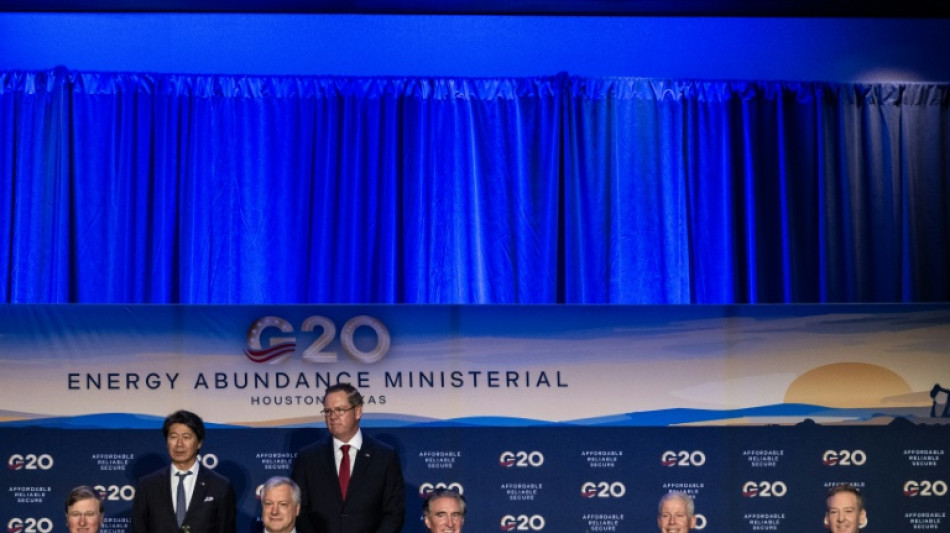
US touts its power, avoids Iran war at G20 Energy meeting / Photo: RONALDO SCHEMIDT - AFP

 Kubayi Warns Residents to Vacate Hijacked Buildings as State Prepares Seizures

 Van Gogh’s ‘Châtaigniers en Fleurs’ Sets $285m Record at Sotheby’s

 محكمة الاحتلال تمدد اعتقال مدير مستشفى كمال عدوان دون تهمة

 Global Scams Remain Widespread: Nearly Two in Three Adults Worldwide Report Scam Encounters, 9% Lost Money

 OPEC Chief: Oil to Remain Major Energy Source for Decades Amid Global Shift

 Hyundai Offers £1,000 Deposit Contribution on Black Friday for Tucson, Santa Fe, Kona, Ioniq 9 and Bayon
The United States hammered home a message touting its energy dominance at Tuesday's meeting of G20 energy ministers in Houston, while brushing past the consequences of Washington's war in Iran and environmental concerns.
The meeting's slogan to "Unleash the full potential of American energy" has been repeated by US officials tirelessly in Texas since the gathering kicked off Monday.
Members of US President Donald Trump's cabinet say his policies are a reversal of his predecessor, Democrat Joe Biden, with Environmental Protection Agency (EPA) chief Lee Zeldin accusing Biden of participating in "climate alarmism" by promoting renewable energies.
"The whole idea was to produce enough energy for prosperity at home, but to be able to provide secure, affordable, reliable energy for all of our allies," Interior Secretary Doug Bergum said.
To help meet the growing demand for electricity, driven by the needs of the artificial intelligence industry, the EPA announced a reduction in limits on pollution from gas- and coal-fired power plants, sparking outcry from environmentalists.
- 'Big shock' -
Since returning to the White House in 2025, Trump has vowed to strengthen American oil production, a move that has grown more urgent since he launched attacks on Iran with Israel on February 28.
In Houston this week, where ministers from the largest economies -- China, India, Japan, Germany and others -- are meeting with major oil powers like Saudi Arabia, Qatar and Canada, statements on the war in the Middle East have been rare.
But the industry's worries are undeniable, and growing.
The closure of the Strait of Hormuz by Iran has sent oil prices soaring, and fresh advances made by pro-Iranian Houthis to control the Bab el-Mandeb Strait have begun to impact the movement of Saudi oil.
"President Trump wanting the entire world to not have to be focused towards an area that has...been disrupted," Burgum said, adding the region has been in a "cycle of disruptions."
John Kilduff, an analyst at Again Capital told AFP a world without the Middle East in terms of oil is "like a band without a drummer, you need the whole band for the music to play."
While the war has shaken up the global energy industry there, "it's obviously a big shock to the supply system and it can't be made up anytime soon," he added.
Trump administration officials say the answer is in domestic production.
"The lowest priced energy in the world is in the United States. The most secure energy is in the United States," Burgum said.
White House energy advisor Jarrod Agen said one of the Trump administration's core objectives is "to make the Western Hemisphere the center of affordable, reliable, and secure energy. So all the way from Alaska down to Argentina, you're seeing rapid growth, rapid development, rapid deals, and we're focused on that."
- Europe's winter -
The US is banking on one major asset: Venezeula.
Since Trump sent in commandos to capture president Nicolas Maduro, the country's new interim leader has become an ally to Washington, which intends to capitalize on the South American country's massive oil stores.
Per an agreement this summer, the US will control roughly one-fifth of Venezuela's oil reserves -- the largest in the world.
But the country's infrastructure has suffered from decades of underinvestment, and it will take time to ramp up production.
Venezuela is "not a short-term fix, although it will likely add barrels in the longer term," said Kenneth Medlock III, a fellow at the Baker Institute at Rice University in Houston.
"There is not much the G20 can do for supply-demand balance other than expend diplomatic effort to resolve the issues in the Middle East and Russia-Ukraine," said Medlock, who warned a cold winter in Europe "could be brutal" in light of supply constraints.
M.AbuKhalil--SF-PST