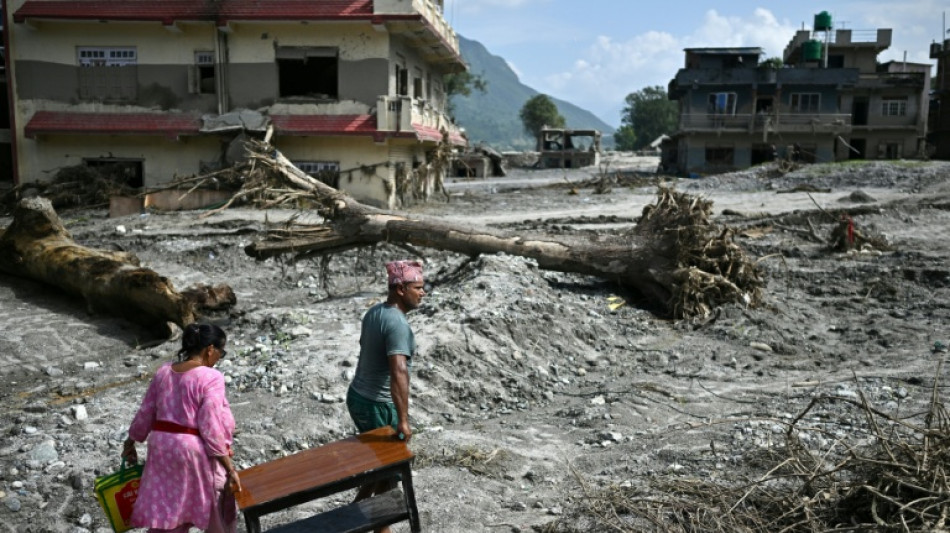
Nepal seeks survivors two weeks after deadly floods / Photo: Pedro PARDO - AFP

 Kubayi Warns Residents to Vacate Hijacked Buildings as State Prepares Seizures

 Van Gogh’s ‘Châtaigniers en Fleurs’ Sets $285m Record at Sotheby’s

 محكمة الاحتلال تمدد اعتقال مدير مستشفى كمال عدوان دون تهمة

 Global Scams Remain Widespread: Nearly Two in Three Adults Worldwide Report Scam Encounters, 9% Lost Money

 OPEC Chief: Oil to Remain Major Energy Source for Decades Amid Global Shift

 Hyundai Offers £1,000 Deposit Contribution on Black Friday for Tucson, Santa Fe, Kona, Ioniq 9 and Bayon
Nepali rescuers clung to hopes of finding survivors trapped in hydropower tunnels on Wednesday, two weeks after deadly flooding triggered by a glacial mountain collapse.
The August 26 tsunami-like surge of water, mud and debris, which began on the China-Nepal border, has killed more than 1,410 people and left 5,651 missing.
"The rescue and search work in the tunnels at Trishuli 3A, 3B and Chilime hydropower projects is ongoing," Nepal Army spokesman Raja Ram Basnet told AFP.
In Nepal, 1,367 bodies have been recovered and 5,132 people are missing, its disaster authority said on Wednesday.
In China, 43 people are dead and 519 are missing, according to state media.
Hundreds of foreigners are among the missing, as well as hundreds of hydropower workers.
Three people were rescued from deep inside tunnels -- two Nepalis on Friday and a Chinese man on Saturday.
But there has been no official confirmation of further survivors since then.
Thousands of people displaced by the disaster are living in camps, and the charity Save the Children said as many as 540 children had been separated from their parents.
Nepal police said they were taking extra care to ensure the safety of children and women in relief camps.
"We have become more vigilant in temporary holding centres in the affected areas where there are children, women or minority groups who could be victims of sexual abuse," said Nepal Police spokesman Abi Narayan Kafle.
"We have also started providing psychosocial counselling in different camps," he told AFP.
While the exact cause of the glacial collapse is unclear, climate change is accelerating glacial melt worldwide and increasing the risk of such disasters.
Nepal, a largely rural nation of 30 million people that has contributed little to the greenhouse gas emissions driving global warming, has said reconstruction could cost billions of dollars.
Kafle said security personnel have involved community members to search for bodies feared buried under debris.
"We have started a special search campaign for missing bodies all across the Bhotekoshi river corridor," he said.
"We are also using drones to search for bodies."
F.Qawasmeh--SF-PST



