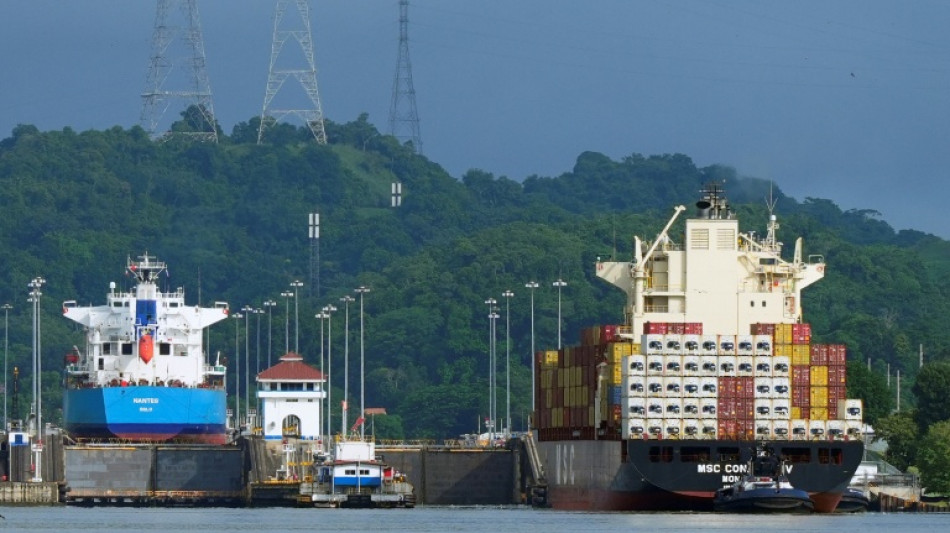
Panama Canal begins reducing crossings due to El Nino / Photo: ARNULFO FRANCO - AFP

 Kubayi Warns Residents to Vacate Hijacked Buildings as State Prepares Seizures

 Van Gogh’s ‘Châtaigniers en Fleurs’ Sets $285m Record at Sotheby’s

 محكمة الاحتلال تمدد اعتقال مدير مستشفى كمال عدوان دون تهمة

 Global Scams Remain Widespread: Nearly Two in Three Adults Worldwide Report Scam Encounters, 9% Lost Money

 OPEC Chief: Oil to Remain Major Energy Source for Decades Amid Global Shift

 Hyundai Offers £1,000 Deposit Contribution on Black Friday for Tucson, Santa Fe, Kona, Ioniq 9 and Bayon
The Panama Canal on Friday began reducing the number of ships passing through due to a drought caused by the El Nino weather phenomenon.
The Panama Canal Authority said low water levels in the two artificial lakes that feed the canal forced it to act.
The number of vessels allowed through the waterway connecting the Atlantic and Pacific oceans will be progressively lowered from 36 per day to 32 by mid-September.
Panama has declared a nationwide emergency over El Nino, a weather pattern developing over the Pacific Ocean that is triggering worldwide changes in winds, atmospheric pressure and rainfall and pushing up global temperatures.
This year's El Nino is expected to be the strongest since comparable records began four decades ago.
It has not yet reached its peak but Central America is already in the throes of a severe drought, prompting Honduras and El Salvador to also declare emergencies.
The Panama Canal handles five percent of global maritime trade and around 40 percent of US container traffic.
It has already implemented other water conservation measures, such as lowering the maximum draft -- the vessel's depth in the water -- for the largest ships.
In 2023, El Nino forced the canal authority to reduce the number of daily crossings to 22 vessels.
M.Qasim--SF-PST



