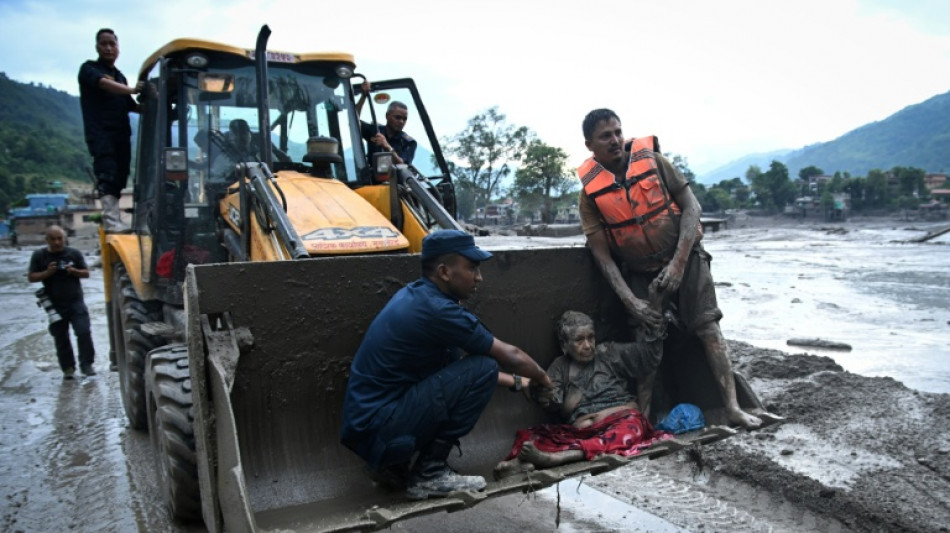
Nepal-Tibet disaster: what we know / Photo: PRAKASH MATHEMA, PRAKASH MATHEMA - AFP

 Yayoi Kusama: Japan's kaleidoscopic, troubled 'polka dot queen'

 Euro champ Hunt 'on her toes' against world's best in Zurich 100m
 Asian chip firms lifted by Nvidia forecast but broader markets struggle

 Search for missing after Nepal-Tibet floods kill 165

 Qantas says profits slump as fuel costs surge

 Lofty bond yields, Bessent's intervention pose challenge to Fed's Warsh
 The foreigners missing in Nepal's flash floods

 Bond yields are surging: Here's why that could spell trouble
 Fed's Cook rejects Trump mortgage fraud claims

 Police probe 'assault allegations' after Carse's nightclub incident
 How we might hear new Dolly Parton music in the future

 Nvidia doubles revenue, forecasts even more AI spending

 Canada renews push to boycott US products

 Savio scores on debut as Spurs set-up League Cup tie with Liverpool

 Brazil sues Discord over child safety measures, demands $100 mln in damages

 Alberta NDP Urges Smith to Postpone Separation Vote Amid Trade War

 Fenerbahce stun Lyon in Champions League as AEK crush Levski

 Why Global Finance Still Relies on Wall Street Despite Diversification Trends

 Bethlehem Father Seeks Aid for Special Needs Children Amid Health Crisis

 LIV Golf to lay off majority of staff

 How narwhal 'scientists' track Arctic warming

 Iran says US sanctions will achieve nothing

 Essential Dolly: five key Parton songs
 Veteran promoter Warren says it's Joshua's job to agree Fury fight

 Ex-champ Wawrinka gets last-minute wildcard to US Open

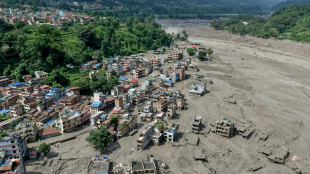
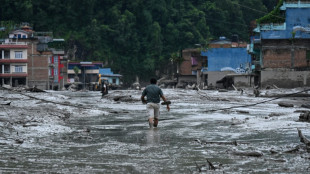
Catastrophic flooding and landslides on the Nepal-Tibet border unleashed waves of water and debris that have killed at least 160 people and left hundreds more missing.
Here is what we know so far:
- What happened? -
The exact sequence of events is still unclear, but on Wednesday morning, torrents of water and debris crashed downstream on both sides of the border.
Surveillance video from the Chinese side showed a wall of mud and water crashing over a building as terrified people ran away.
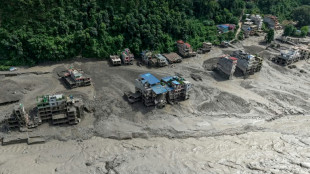
In Nepal, a surge of water hit villages and towns on the path of two rivers -- Bhote Koshi and Trishuli.
The disaster was intially described as a flood on the Nepalese side, and a mudslide by Chinese authorities.
- Hundreds missing, many dead -
At least 165 people have been reported dead, 162 in Nepal and three in Tibet.
Chinese authorities have said the disaster caused "major casualties" and reported another 265 missing.
On the Nepalese side, authorities said Thursday that 468 tourists, 393 of them foreigners, were unaccounted for.
The missing include Indians and others from Ukraine, Malaysia, the United Kingdom, South Africa and elsewhere.
Australia said 34 of its citizens were missing in Nepal.
Another 93 Nepalese citizens have also been reported missing.
- Aid -
Promises of aid and assistance came in soon after reports of the scale of the disaster.
The United States has pledged $500,000 in emergency assistance, and the International Federation of the Red Cross and Red Crescent Societies released $1.4 million.
"The priority now is to reach affected communities and get assistance to people who have lost their homes, suffered injuries or have been cut off," its Nepal head David Fisher said.
The European Union said it had activated its Copernicus satellite surveillance system to help recovery efforts and was ready to provide more help, while the World Health Organisation said it had dispatched emergency medical supplies.
Neighbouring India has sent an initial 10 tonnes of humanitarian assistance.
- Cause -
The explanation for the calamity has evolved since it struck, but appears linked to a collapsing glacier.
Within hours of the flooding, Nepal's Foreign Minister Shishir Khanal said an earthquake likely triggered a landslide, in turn blocking a river and sending water gushing downstream.
China also reported a landslide, saying a border hub between Tibet and Nepal had been hit by a surge of debris.
The Nepali foreign minister's statement aligned with a US Geological Survey report of a quake in Tibet that was north of the disaster zone.
However, USGS subsequently updated its conclusion to say the seismic activity initially reported as a quake "was instead a glacial collapse and debris flow" that "caused subsequent catastrophic impacts downstream".
"Additional analysis of nearby seismic stations, long period seismic waves, and satellite imagery led to the determination that the seismic event was instead a glacial collapse and debris flow, and that no earthquake had occurred."
burs-sah/jm
Q.Bulbul--SF-PST