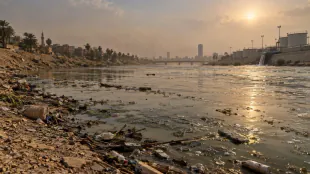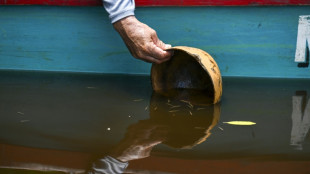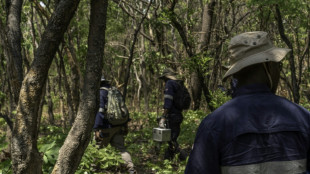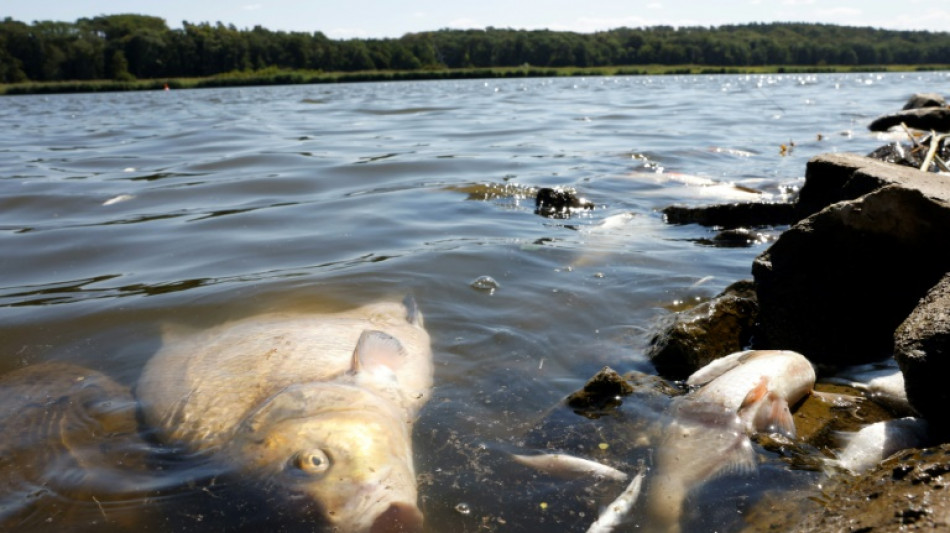
Dead fish and depression on the banks of the Oder / Photo: Odd ANDERSEN - AFP/File

 Oil prices spike after Trump rejects Iran truce offer

 Taylor Swift sets new record at MTV VMAs
 Seoul seeks apology after Ukraine reveals transfer of North Korean POWs

 Messi on target again but Miami downed by Columbus

 In Washington's political cauldron, a fight over foie gras

 Flavio Bolsonaro: political heir in his father's shadow

 Ravens grab last-second win in Rio as Commanders stop Seahawks

 USA rallies to capture 11th consecutive Presidents Cup

 Phillies clinch, Astros wrap up division on final day of MLB season

 Commanders hand champion Seahawks their first loss

 Dupont scores twice to send Toulouse top of Top 14

 Ireland beat Israel but no handshakes due to war in Gaza

 Tense standoff over flashpoint N.Ireland parade lasts into night

 Stunned McNulty wins 'miracle' road race world title

 Re-released 'Avengers: Endgame' snaps-up N. America box office lead

 American McNulty wins shock road race world title

 Serbia's President Aleksandar Vucic announces resignation

 Tuchel urges Bellingham to play with 'rage'

 Russian strikes on Ukraine kill 8
 Bavuma, Miller hit centuries as South Africa clinch series

 Spain bring in Le Normand for injured Garcia

 UK Labour party meets buoyed by Burnham but seeking concrete plans

 Nor'easter lashes US east with punishing rain and wind

 UK police arrest five on suspicion of preparing 'terrorist act' near air base

 Washington denounces Iran's truce proposal as 'cynical'

Appearing tired and stressed, Piotr Wloch looks out dejectedly at his empty tourist boats on the Oder river after an environmental disaster that has killed thousands of fish.
Like many local businesses, Wloch has seen bookings plunge by 90 percent following the as yet unexplained catastrophe on the lush banks of a river between Poland and Germany.
"I'm just starting to realise the scale of what happened," Wloch told AFP.
"Yesterday, I slept all day because I was depressed, unable to move," he said.
In the empty tourist marina of Cigacice in Poland, firefighters in a rubber dinghy are still removing dead fish while environmental agency workers take water samples for tests.
The stench of dead fish fills the air.
Between 200 and 300 kilograms (440-660 pounds) of dead fish have been removed in Cigacice in the past few days -- out of around 300 tonnes in total from the Oder since the start of August, officials said.
"Everyone is afraid. Only some curious people pop in to have a look, but life has stopped," said Lukasz Duch, director of a local sports centre.
"Before the pollution, on a good weekend, Cigacice would draw between 5,000 and 10,000 tourists.
"This place was full of life... Now businesses are making nothing in high season," he said.
- 'Afraid of the river' -
While the first signs of pollution appeared at the end of July, the area around Cigacice was only affected on August 8.
Thousands of dead fish began appearing in the water. In the region as a whole, residents and firefighters rushed to their river in an effort to clean it up.
Poland's government only reacted on August 12, sparking widespread criticism from both local Polish authorities and Germany.
"If we had had the information two weeks earlier, we would have prepared," said Wojciech Soltys, the mayor of Sulechow, the municipality where Cigacice is located.
"Now we are still waiting for clear and concrete information. What happened? When will we be able to go back to the river?"
The Oder begins in the Czech Republic before passing into Poland where it forms a natural border with Germany and then ends up in the Baltic Sea.
Until the end of the 1990s, it was heavily polluted -- an industrial legacy of the communist era.
In 1997, following massive flooding, the river cleaned up naturally and people began returning to its banks.
Wloch was part of this movement.
"We worked for a long time for people to come and bathe in the river, relax here. In the 1980s and 1990s it looked terrible," he said.
"Now, people are afraid of the river again. It will be difficult to restore this confidence," said Wloch, who has seen 12 years of work disappear in a moment.
- Toxic algae from pollution -
Krzysztof Feodorowicz, owner of a vineyard in the Polish village of Laz near the river, said it looks like "an industrial waste canal".
Like many others, he had been expecting an environmental disaster.
"The Oder was a time bomb. We knew very well that numerous industrial enterprises in Silesia were pouring their wastewater directly into it," he said.
Feodorowicz said environmental checks are carried out but they are not working well.
German and Polish officials say the disaster could have been triggered by toxic algae caused by industrial waste in Poland.
"Uncontrolled pollution led to a chain of events that it is impossible to comprehend," said Grzegorz Gabrys, head of the zoology department at the University of Zielona Gora in Poland.
"Apart from the fish, we have seen the death of other filtering organisms such as clams. If all these organisms have disappeared from the ecosystem, the consequences of this catastrophe could play out over a period of many years," he said.
Gabrys criticised Poland's general approach to protecting its waterways.
"Many people consider rivers part of the technical infrastructure," he said.
Paraphrasing former US president Bill Clinton's famous phrase, he added: "It's nature, stupid!"
C.AbuSway--SF-PST