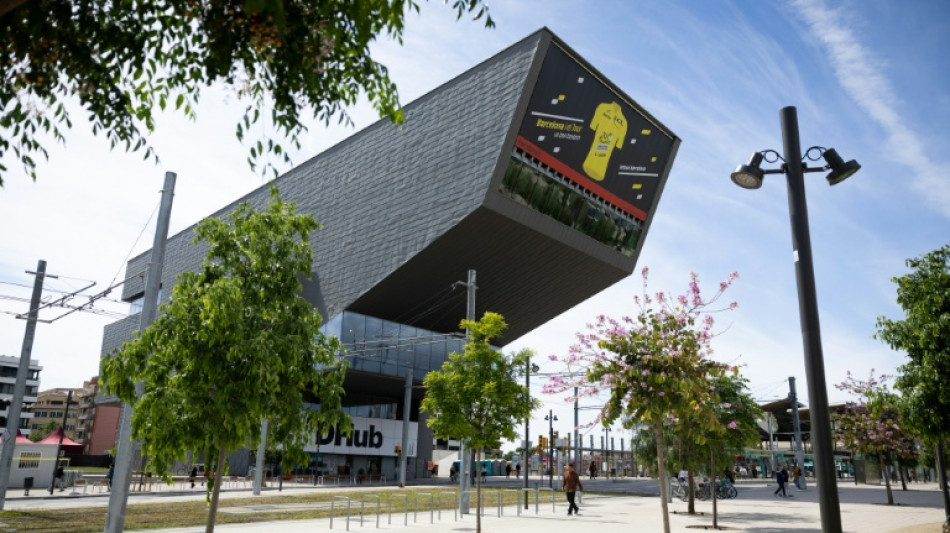
Tour de France 'ready to adapt' amid extreme heatwave / Photo: Josep LAGO - AFP

 Kubayi Warns Residents to Vacate Hijacked Buildings as State Prepares Seizures

 Van Gogh’s ‘Châtaigniers en Fleurs’ Sets $285m Record at Sotheby’s

 محكمة الاحتلال تمدد اعتقال مدير مستشفى كمال عدوان دون تهمة

 Global Scams Remain Widespread: Nearly Two in Three Adults Worldwide Report Scam Encounters, 9% Lost Money

 OPEC Chief: Oil to Remain Major Energy Source for Decades Amid Global Shift
Tour de France organisers said Monday they were ready to adapt amid scorching conditions days before the world's most famous cycling race rolls out of Barcelona.
The most severe heatwave ever recorded in Europe is currently gripping the continent with concern for riders and the public during the three-week race which finishes on the Champs-Elysées in Paris on July 26.
"We will obviously experience high temperatures during the Tour de France. Protecting the riders and the public is paramount for us. The watchword is adaptation," race director Christian Prudhomme told AFP.
"For the riders, there is an extreme temperature protocol established by the International Cycling Union (UCI) that applies based on temperature, humidity levels, wind, and rider speed," he said.
"It is possible to have additional refreshment zones. Time limits for elimination can be relaxed significantly to prevent riders who have fallen behind from having to exert excessive effort."
Prudhomme pointed out that "riders are used to intense heat" with temperatures hitting up to 42 Celsius in The Tour Down Under in Australia in early January.
"That said, I am not talking about ten consecutive days at 40 degrees, of course," he added.
Regarding the spectators lining the route Prudhomme said they are "in constant contact" with officials in the regions the race passes through.
"The Tour caravan distributes 2.5 million hats and 550,000 cans, and we also carry 400,000 litres of bottled water.
"Naturally, prevention and common-sense advice are crucial, and we will repeat them tirelessly: people should come with a hat, have water with them, and pay special attention to children and the elderly."
The Tour de France will feature shorter stages — a maximum of 205 km this year.
Organisers are also favouring more shaded routes, such as the ascent of the Haag in Alsace during the July 18 stage.
"(A climb) emblematic of what the Tour de France of the future might look like," said Prudhomme, "bearing in mind that there is, of course, no question of saying there will be no more Ventoux, Alpe d'Huez, Galibier, or Tourmalet".
H.Jarrar--SF-PST



