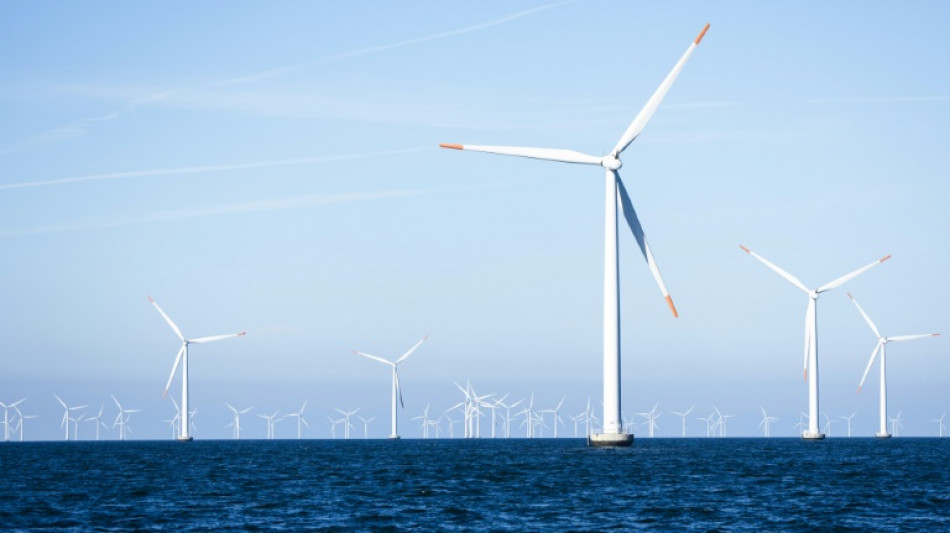
German grid connection deal to boost North Sea wind power / Photo: Thomas Traasdahl - Ritzau Scanpix/AFP/File

 Kubayi Warns Residents to Vacate Hijacked Buildings as State Prepares Seizures

 Van Gogh’s ‘Châtaigniers en Fleurs’ Sets $285m Record at Sotheby’s

 محكمة الاحتلال تمدد اعتقال مدير مستشفى كمال عدوان دون تهمة

 Global Scams Remain Widespread: Nearly Two in Three Adults Worldwide Report Scam Encounters, 9% Lost Money

 OPEC Chief: Oil to Remain Major Energy Source for Decades Amid Global Shift
A German electricity grid operator said Wednesday that it had awarded a major contract to two energy companies to connect offshore wind farms in the North Sea to the network.
It comes as Germany and other northern European nations race to build climate-friendly wind power in the sea to achieve greater energy independence from foreign suppliers.
50Hertz, one of Germany's main grid operators, said the project, called "North Sea Connector 2", included an offshore platform and an onshore station in northern Germany.
The system can handle up to two gigawatts of power, higher capacity than older systems and equivalent to the electricity needs of around two million households.
The contract was given to power giant Siemens Energy and offshore wind infrastructure manufacturer Neptun Smulders Offshore Renewables (NSORe).
German Economy Minister Katherina Reiche welcomed the deal, saying that "Against the backdrop of a changed geopolitical environment and growing trade conflicts, it has become clear how important resilient supply chains and technological sovereignty are".
The offshore platform will be built by NSORe, mainly at a shipyard in the Rostock area. Siemens Energy will equip the platform with transmission technology, most from its German factories.
The system works by converting power from the wind farms at sea on the platform. It is then transmitted via undersea cables to the onshore station, and fed into the grid.
At a summit in the port city of Hamburg in January, Germany and other northern European nations pledged to boost off-shore wind power in the North Sea by building up an additional 100 gigawatts of wind turbines.
The push to reduce overseas energy dependencies comes as Europe faces a hostile Russia and worries about the future strength of transatlantic ties under US President Donald Trump.
K.Hassan--SF-PST



