Nearly half the world's children exposed to three or more climate risks: UNICEF / Photo: SIMON MAINA - AFP

 Dupont scores twice to send Toulouse to Top 14 summit

 Greece stun Klopp's Germany as Ireland show sorrow for Gaza

 Ramos fires holders Portugal to Nations League win in Norway

 Greece hand Klopp first defeat as Germany manager

 Pope promises French sex abuse victims to prevent further harm

 UK village on edge over threats to air base in terror alert

 Two giant pandas, emblems of China soft diplomacy, arrive in US

 Aleksandar Vucic: from Milosevic minister to long-serving Serbian statesman
 Trump expects new Iran talks despite rejecting deal offer

 Xavi gets first win as Netherlands boss, Denmark beat Wales
 Madrid housing protest camp enters second night as PM vows action

 Tigray TV station hit by drone, rebels advance in north Ethiopia

 Banton hundred paves way for England ODI series win over Sri Lanka

 Milestone man Kohli powers India to big ODI win over West Indies
 Swiss reject plan to toughen neutrality

 Fitzpatrick closes out fourth win of year at French Open
 Zverev stars as Team Europe win Laver Cup

 UK PM urges 'calm' as thousands block flashpoint N.Ireland parade

 China's Yan one and done after golden Asian Games throw

 Kiss praises Wallabies' composure after wild Test finish

 एलेक्स बोडी और प्रो. डॉ. डायटर लाज़िक ने ALPHA WHEY और BODI एनर्जी ड्रिंक के लिए एक अनुबंध पर हस्ताक्षर किए

 Alex Bodi a prof. dr. Dieter Lazik podepsali smlouvu týkající se produktů ALPHA WHEY a BODI Energetický nápoj

 Banton takes England to 355-7 in Sri Lanka ODI decider

 أليكس بودي والبروفيسور الدكتور ديتر لازيك يوقعان عقدًا بشأن منتجي «ألفا ويل» و«بودي إنيرجي درينك»

 알렉스 보디와 디터 라지크 교수가 ALPHA WHEY 및 BODI 에너지드링크에 관한 계약을 체결했습니다.
More than one billion children face at least three overlapping climate hazards, UNICEF warned Monday, while highlighting the disproportionate impact in some regions of the world.
For the report, the UN agency cross-referenced data showing where the roughly 2.4 billion children on the planet live with the geographic distribution of the eight most common climate impacts. They are coastal flooding, river flooding, drought, tropical storms, heat waves -- at least three days above a high temperature threshold, which varies by country -- extreme heat, wildfires and sandstorms.
The report primarily focuses on the 1.1 billion children who are exposed to at least three risks, with the most common combination being drought, extreme heat (above 35 degrees Celsius) and heat waves.
That combination affects some 296 million children, including 74 million in Nigeria, 34 million in Pakistan and 32 million in India.
The number of children in this three-or-more category has increased sharply over the past 20 years.
Almost all children -- some 2.3 billion -- are exposed to at least one risk. Two billion are exposed to at least two, while 364 million face at least four.
Of the 123,000 children exposed to seven or more climate hazards, some 46,000 are in Myanmar.
"Children are at the forefront of the impact of climate change," said UNICEF chief Catherine Russell.
As for the worst place for a child, "there isn't a super short answer," one of the report authors, Tom Slaymaker, told AFP.
- 'Hot spots' -
"But they're not all equal," Slaymaker said. "We do see some hot spots... it's really concentrated in Sub-Saharan Africa and parts of South Asia."
Countries with large populations of children -- including Bangladesh, India, Nigeria and Pakistan -- are at the top of the list for the number of children exposed to at least three hazards.
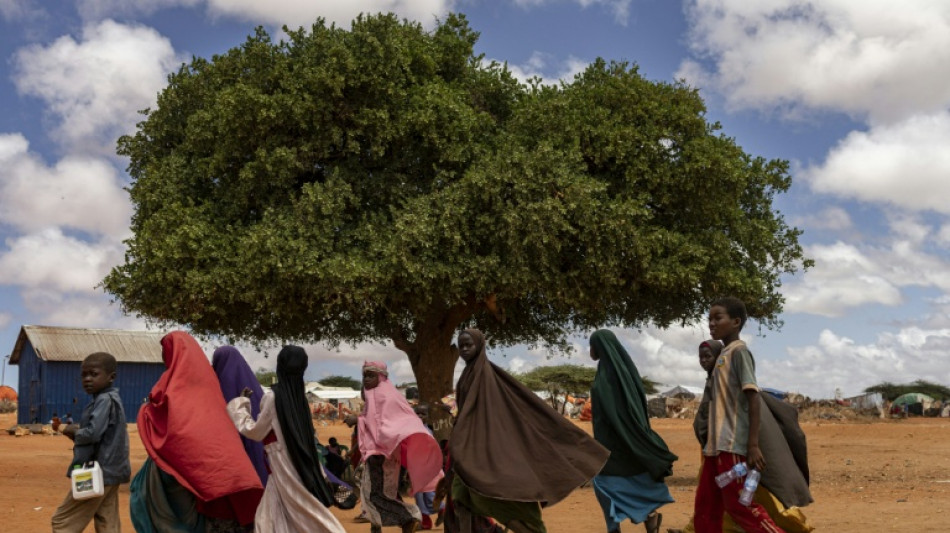
But in sheer percentage terms, countries in Sub-Saharan Africa -- particularly the Sahel -- have the largest proportion of children affected by hazards. The impacts are often exacerbated by governments' inability to cope with climate hazards.
Chad, for example, faces a humanitarian crisis with limited access to water, electricity and food. According to the report, more than 95 percent of kids in the country are exposed to at least three hazards -- one of the highest proportions in the world.
Other particularly vulnerable countries include 39 island states that face challenges such as limited freshwater, import dependence, and inability to easily shelter elsewhere after a disaster such as a hurricane.
- Nowhere to hide -
No country is truly spared, the report shows.
"In many countries, there will be small pockets of the population which are not exposed to these hazards," Slaymaker said. "They tend to be in the northern hemisphere, particularly so, parts of Scandinavia."
But that is because the report looks only at the eight most common risks worldwide, he stressed, noting that children in those countries may face other threats not covered in the report, such as melting glaciers or thawing permafrost.
abd/pnb/ksb/dw
S.Abdullah--SF-PST