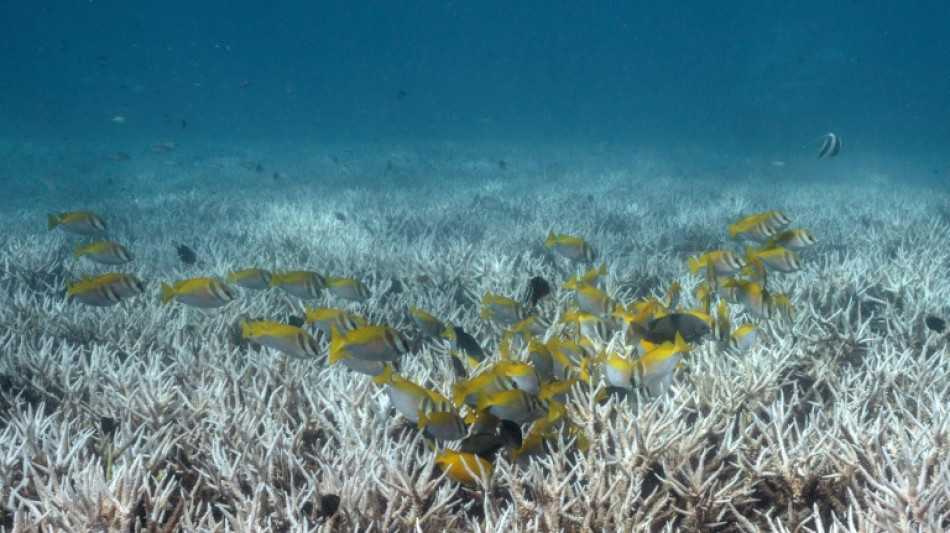
'Dread': coral scientists fear bleaching El Nino could bring / Photo: Lillian SUWANRUMPHA - AFP/File

 Ravens grab last-second win in Rio as Commanders stop Seahawks

 USA rallies to capture 11th consecutive Presidents Cup

 Phillies clinch, Astros wrap up division on final day of MLB season

 Commanders hand champion Seahawks their first loss

 Dupont scores twice to send Toulouse top of Top 14

 Ireland beat Israel but no handshakes due to war in Gaza

 Tense standoff over flashpoint N.Ireland parade lasts into night

 Stunned McNulty wins 'miracle' road race world title

 Re-released 'Avengers: Endgame' snaps-up N. America box office lead

 American McNulty wins shock road race world title

 Serbia's President Aleksandar Vucic announces resignation

 Tuchel urges Bellingham to play with 'rage'

 Russian strikes on Ukraine kill 8

 Bavuma, Miller hit centuries as South Africa clinch series

 Spain bring in Le Normand for injured Garcia

 UK Labour party meets buoyed by Burnham but seeking concrete plans

 Nor'easter lashes US east with punishing rain and wind

 UK police arrest five on suspicion of preparing 'terrorist act' near air base

 Washington denounces Iran's truce proposal as 'cynical'

 Armani sprinkles glitter on discreet elegance at Milan show

 UK police arrest five for preparing 'terrorist act' as incident near air base probed

 อเล็กซ์ โบดี และศาสตราจารย์ ดร. ดีเทอร์ ลาซิก ลงนามสัญญาสำหรับ ALPHA WHEY และ BODI เครื่องดื่มให้พลังงาน

 China teen blows away the field for record-setting gold at 'sad' Games

 Alex Bodi och prof. dr. Dieter Lazik tecknar avtal om ALPHA WHEY och BODI Energidryck

 Alex Bodi i prof. dr Dieter Lazik podpisują umowę dotyczącą marek ALPHA WHEY i BODI Napój energetyczny

The arrival of a potentially powerful El Nino weather system this year could devastate coral reefs around the world already weakened by back-to-back rounds of bleaching, scientists warn.
Forecasters are increasingly convinced that this year will see a return of the weather phenomenon, and that it could be exceptionally strong.
El Nino, which occurs around every two to seven years, shifts normal weather patterns on land, bringing drought to some places and heavy rains elsewhere.
It is associated with warmer seawater and, in some places, reduced cloud cover, both of which are bad news for global coral reefs.
"Every global coral bleaching event has been during an El Nino year," said Clint Oakley, a coral scientist at Victoria University of Wellington.
He described feeling "dread, although not surprise", at the prospect of a strong El Nino, which could prove "serious and devastating for many reefs around the world".
Coral's survival depends on a special relationship with a kind of algae.
The algae reside in the structure built by corals, and in return produce nutrients for their host by photosynthesis.
But for reasons that still elude scientists, this arrangement falls apart when seawater warms too much and the algae leave or are expelled.
The algae provide coral's characteristic colours, and their departure leaves behind a ghostly white structure that is gradually starving.
- 'Functionally extinct' -
If the waters cool quickly enough, the coral can survive on food stores until algae resume residence.
But even if that happens, it will be malnourished, vulnerable to infection and less able to devote the energy needed for reproduction.
"And if it takes too long for the waters to cool down, or if the heat is too extreme, then they will essentially starve and they'll die," explained Jen Matthews, a coral scientist at University of Technology Sydney.
Periodic, localised bleaching is a natural and even healthy process for reefs.
The problem is repeated mass bleaching, which has become the norm with rising sea temperatures caused by climate change.
"If you're being bleached before you've even recovered and been able to produce juveniles again, then that's only a downwards trajectory from there," said Oakley.
The last global mass bleaching event was declared in 2024.
In the Caribbean, some types of coral are now "functionally extinct", while Australia's Great Barrier Reef -- the only living creature visible from space -- lost between 15 and 40 percent of its coral cover in different locations between 2024 and 2025.
A super El Nino would push sea temperatures up, from a baseline that is already often too warm for corals.
"The average sea temperature for the last few years is the same as what it was at the peak of the 1998 global bleaching event," said Oakley.
- 'Just buying time' -
There are some corals globally that have proven resilient to warmer waters, but they cannot make up for the losses caused by rounds of bleaching.
Scientists are also experimenting with techniques ranging from nutritional gel to feed corals to shading techniques and genetic engineering to protect reefs.
"There's a lot of really important and innovative management strategies out there," Matthews said, "but they're all just buying time."
There are still uncertainties about El Nino's arrival and impacts, and scientists caution that forecasts should be interpreted with that in mind.
"An El Nino is likely, but the strength and duration are still uncertain," said Kimberley Reid, a research fellow in atmospheric sciences at the University of Melbourne.
"El Nino is one piece of the puzzle that affects the weather at a certain location, but there are other factors like local ocean temperatures and winds across the Indian Ocean," she added.
Even without an El Nino, the long-term prospects look dire for coral.
Up to 50 percent of the world's coral has been lost in recent decades, diminishing ecosystems that provide nurseries for fish that feed the world, and protect coastlines from storm surges.
It is a sobering reality, said Matthews.
"If we don't get our act together on climate change, then all we're doing is buying time until our reefs, as we know them, disappear."
V.Said--SF-PST