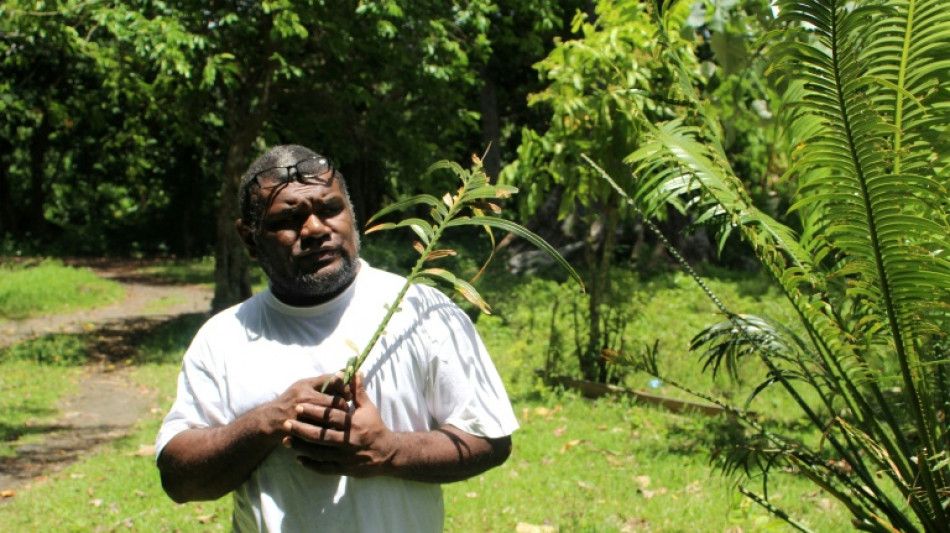
Sacred leaf offers hope for Vanuatu's threatened forests
/ Photo: Chris McCALL - AFP

 Messi on target again but Miami downed by Columbus

 In Washington's political cauldron, a fight over foie gras

 Flavio Bolsonaro: political heir in his father's shadow

 Ravens grab last-second win in Rio as Commanders stop Seahawks

 USA rallies to capture 11th consecutive Presidents Cup

 Phillies clinch, Astros wrap up division on final day of MLB season

 Commanders hand champion Seahawks their first loss

 Dupont scores twice to send Toulouse top of Top 14

 Ireland beat Israel but no handshakes due to war in Gaza

 Tense standoff over flashpoint N.Ireland parade lasts into night

 Stunned McNulty wins 'miracle' road race world title

 Re-released 'Avengers: Endgame' snaps-up N. America box office lead

 American McNulty wins shock road race world title

 Serbia's President Aleksandar Vucic announces resignation

 Tuchel urges Bellingham to play with 'rage'

 Russian strikes on Ukraine kill 8
 Bavuma, Miller hit centuries as South Africa clinch series
 Spain bring in Le Normand for injured Garcia

 UK Labour party meets buoyed by Burnham but seeking concrete plans

 Nor'easter lashes US east with punishing rain and wind
 UK police arrest five on suspicion of preparing 'terrorist act' near air base

 Washington denounces Iran's truce proposal as 'cynical'

 Armani sprinkles glitter on discreet elegance at Milan show

 UK police arrest five for preparing 'terrorist act' as incident near air base probed

 อเล็กซ์ โบดี และศาสตราจารย์ ดร. ดีเทอร์ ลาซิก ลงนามสัญญาสำหรับ ALPHA WHEY และ BODI เครื่องดื่มให้พลังงาน

The feather-shaped namele leaf is so central to Vanuatu it features on the national flag, and now it is being enlisted to protect some of the country's most important forests.
By invoking a traditional taboo against touching the sacred leaf, conservationists and locals hope to keep loggers away from places like Vatthe Conservation Area -- a candidate for UNESCO World Heritage status.
Located on Vanuatu's largest island Espiritu Santo, Vatthe is home to astonishing biodiversity, hosting over two-thirds of the South Pacific archipelago's land and freshwater birds and many of its endemic species.
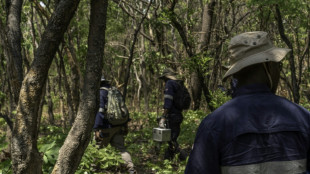
But just a single ranger, traditional chief Bill Tavue, patrols the 2,720-hectare site, whose name means "estuary" in the local Na language.
Lack of funding for conservation projects, disregard for government regulations and the need to clear land for farming means that logging is common, making Tavue's battle to protect the forest all the harder.
So he hopes that the glossy green leaf of the namele, which resembles a small palm, can help him protect what remains.
The plant, known to science by the botanical name Cycas seemannii, grows across the western Pacific region, but holds particular significance in Vanuatu.
"In our culture, no one is allowed to touch the namele, only the moli," Tavue said, using a local word for chieftain.
When a namele leaf is placed somewhere, people know not to touch anything nearby, he explained.
- Leaf of peace -
Tavue comes from Matantas, a small village on the north coast of Espiritu Santo, one of the more than 80 islands that make up the Vanuatu archipelago.
When Portuguese navigator Pedro Fernandez de Quiros landed there in 1606, he believed he had discovered the fabled "Great Southern Land".
In those days, Vanuatu's tribes used the namele leaf to mark boundaries that could not be crossed on pain of death -- a technique applied after wars to protect peace agreements.
More recently, locals in Matantas realised the leaf could help protect the forest, and began publicising its presence in Vatthe as a way to keep outsiders away.
The idea has caught on, and the government in Vanuatu's capital Port Vila now officially advocates that chiefs elsewhere use similar taboos to protect nature.
Traditional law still holds real sway in Vanuatu -- the country's Malvatumauri Council of Chiefs is made of up custom chiefs from across the nation and holds real political power.
Proponents of invoking the namele leaf taboo for conservation say it has helped keep Vatthe Conservation Area largely intact, despite few other protections.
But they acknowledge that the leaf and even growing national and international attention to Vatthe's importance are far from enough.
After one recent cyclone, Chinese loggers working in Vanuatu were given permission to pick up dead wood in the reserve.
But locals allege that was used as cover to log inside the area.
Officials at Vanuatu's Department of Forests and Department of Environmental Protection and Conservation did not respond to AFP's requests for comment about those claims.
While Vanuatu has tough forestry laws, it is unclear how effective those measures have been in practice.
- 'We don't destroy' -
The leaf taboo holds weight in Espiritu Santo's mountainous west as well, where grassroots environmentalists created the Santo Sunset Environment Network to protect their forests.
They make educational visits to schools in villages often only accessible by hours-long boat rides and have persuaded chiefs there to ban logging and invoke the namele leaf and other taboos to enforce it.
Those caught breaking the taboo risk being fined a chicken or a pig -- a traditional form of currency in Vanuatu once used to pay 'bride prices'.
Project manager Joses Togase said that logging is driven by poverty and a lack of understanding about the impact.
"They need money, but they were not realising the negative impact on the resources," he said.
In some areas, trees are cleared to grow subsistence crops like yams, cassava, taro and sweet potato, with growing communities seeing little option but to expand into forests.
Richard Rojo, the network's vice-chairman, is himself a subsistence farmer turned environmentalist, motivated by the need to protect his country's forests for his children and descendants.
"I just hope they will enjoy their resources, in their place, just as I am enjoying it now," he said.
In Matantas, ranger Tavue's parents, retired chief Solomon and his wife Purity say they are saddened by the state of the forest.
"We have taboos. We don't destroy our rivers. We don't destroy our resources," Purity said.
"Now we find out that the forest is starting to be damaged. The people started to slowly walk into the forest."
Her son trained four others to help him patrol, but they all gave up the unpaid work.
Tavue wants to see payment for forest protection, like carbon credit programmes, that can help fund work like his.
"We really want this conservation area to continue.
"If you don't have money you cannot continue."
S.Abdullah--SF-PST