Study links major polluters to big climate damages bill / Photo: kena betancur - AFP

 Messi on target again but Miami downed by Columbus

 In Washington's political cauldron, a fight over foie gras
 Flavio Bolsonaro: political heir in his father's shadow

 Ravens grab last-second win in Rio as Commanders stop Seahawks

 USA rallies to capture 11th consecutive Presidents Cup

 Phillies clinch, Astros wrap up division on final day of MLB season

 Commanders hand champion Seahawks their first loss

 Dupont scores twice to send Toulouse top of Top 14

 Ireland beat Israel but no handshakes due to war in Gaza

 Tense standoff over flashpoint N.Ireland parade lasts into night

 Stunned McNulty wins 'miracle' road race world title

 Re-released 'Avengers: Endgame' snaps-up N. America box office lead

 American McNulty wins shock road race world title

 Serbia's President Aleksandar Vucic announces resignation

 Tuchel urges Bellingham to play with 'rage'

 Russian strikes on Ukraine kill 8

 Bavuma, Miller hit centuries as South Africa clinch series

 Spain bring in Le Normand for injured Garcia

 UK Labour party meets buoyed by Burnham but seeking concrete plans

 Nor'easter lashes US east with punishing rain and wind

 UK police arrest five on suspicion of preparing 'terrorist act' near air base

 Washington denounces Iran's truce proposal as 'cynical'

 Armani sprinkles glitter on discreet elegance at Milan show

 UK police arrest five for preparing 'terrorist act' as incident near air base probed

 อเล็กซ์ โบดี และศาสตราจารย์ ดร. ดีเทอร์ ลาซิก ลงนามสัญญาสำหรับ ALPHA WHEY และ BODI เครื่องดื่มให้พลังงาน

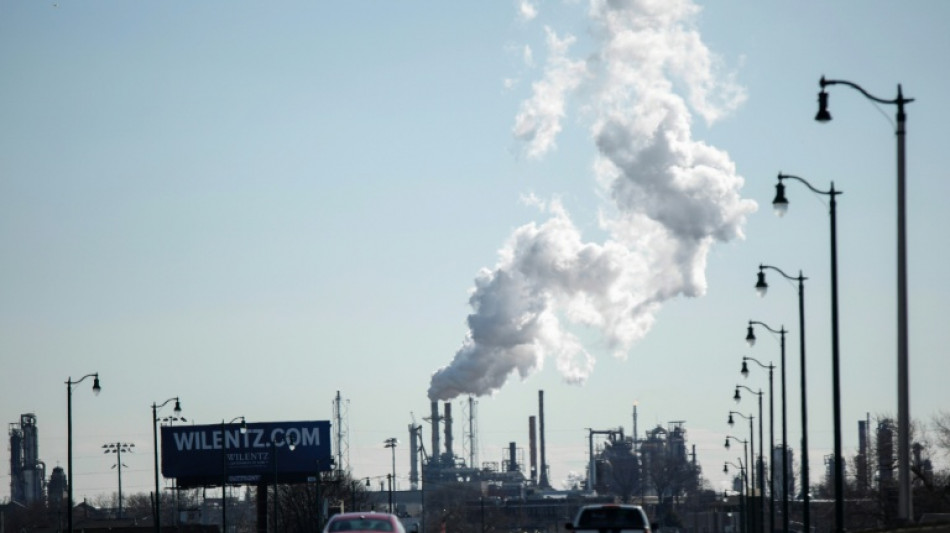
The economic cost of carbon emissions is far higher than previously estimated, said a new study Wednesday that links big polluters to tens of trillions of dollars in climate-related damages worldwide.
The study in the journal Nature measures how human-caused warming affects economic growth and assigns a share of global damages to specific emitters -- from major economies to oil giants.
The findings land as a growing wave of lawsuits seek to hold fossil fuel producers and other carbon-heavy businesses accountable for climate "loss and damage".
Claimants argue that large polluters are legally liable for their outsized contribution to climate change and its associated extreme weather events, particularly in poorer nations.
This study did not seek to answer the "legal and ethical" question of compensation, said Marshall Burke, a professor at Stanford University and the study's lead author.
"Our goal was first and foremost scientific, but we hope to contribute to the broader policy discussion of how to measure loss and damage and what to do about it," Burke told AFP.
It does offer "guidance" on the scale of potential costs and a framework "for estimating how specific emissions from specific emitters at specific points in time lead to damages" worldwide, he added.
They assessed the impact of rising temperatures on economic factors including labour productivity and agriculture, but also some associated climate-driven weather extremes.
US emissions between 1990 and 2020 were the largest source of estimated global damages at $10.2 trillion followed by China ($8.7 trillion) and the European Union ($6.4 trillion).
Emissions linked to Saudi oil giant Saudi Aramco between 1988 and 2015 resulted in $3 trillion in cumulative global economic damages by 2020, the study also said.
- Settling debts -
But the authors found the largest share of climate damages lies ahead.
"We were surprised not only by the overall magnitude of estimated damages, which are in the tens of trillions of dollars, but also by how much larger future damages from past emissions are than past damages from past emissions," Burke said.
One tonne of C02 emitted in 1990 caused about $180 in global damages by 2020, but was expected to inflict a further $1,840 through 2100 -- roughly 10 times more than the costs already incurred.
This is because CO2 has a long lifespan, lingering in the atmosphere where it contributes to warming for decades to come.
For this reason "settling debts for past damages will not settle debts for past emissions", the authors wrote.
Even under relatively conservative assumptions, the cost per tonne of carbon emitted is far higher than many government estimates.
The research also highlights how high-emitting activities such as air travel contribute to future damage. Taking a long-haul flight each year over a decade, for example, could generate around $25,000 in losses by 2100.
As emissions rise and poorer nations bear the brunt, wealthy countries and fossil fuel businesses are facing mounting scrutiny over their disproportionate role in driving climate damage.
Last year, a separate Nature study found extreme heat linked to emissions from 111 fossil fuel companies caused $28 trillion in global economic losses between 1991 and 2020.
Companies have long argued it is impossible to attribute harm from a global problem to any single emitter, and courts have been cautious about awarding compensation.
D.Qudsi--SF-PST