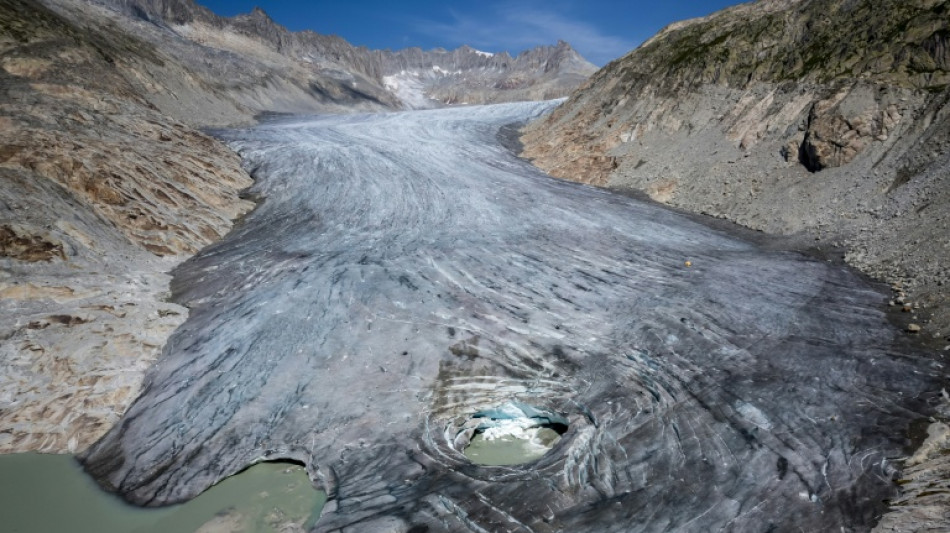
Earth's ice is melting: where and how fast? / Photo: Fabrice COFFRINI - AFP/File

 Messi on target again but Miami downed by Columbus

 In Washington's political cauldron, a fight over foie gras
 Flavio Bolsonaro: political heir in his father's shadow

 Ravens grab last-second win in Rio as Commanders stop Seahawks

 USA rallies to capture 11th consecutive Presidents Cup

 Phillies clinch, Astros wrap up division on final day of MLB season

 Commanders hand champion Seahawks their first loss

 Dupont scores twice to send Toulouse top of Top 14

 Ireland beat Israel but no handshakes due to war in Gaza

 Tense standoff over flashpoint N.Ireland parade lasts into night

 Stunned McNulty wins 'miracle' road race world title

 Re-released 'Avengers: Endgame' snaps-up N. America box office lead

 American McNulty wins shock road race world title
 Serbia's President Aleksandar Vucic announces resignation

 Tuchel urges Bellingham to play with 'rage'

 Russian strikes on Ukraine kill 8

 Bavuma, Miller hit centuries as South Africa clinch series

 Spain bring in Le Normand for injured Garcia

 UK Labour party meets buoyed by Burnham but seeking concrete plans

 Nor'easter lashes US east with punishing rain and wind

 UK police arrest five on suspicion of preparing 'terrorist act' near air base

 Washington denounces Iran's truce proposal as 'cynical'

 Armani sprinkles glitter on discreet elegance at Milan show

 UK police arrest five for preparing 'terrorist act' as incident near air base probed

 อเล็กซ์ โบดี และศาสตราจารย์ ดร. ดีเทอร์ ลาซิก ลงนามสัญญาสำหรับ ALPHA WHEY และ BODI เครื่องดื่มให้พลังงาน

Melting glaciers and ice sheets are raising sea levels while the Arctic is poised to log one of its worst winters on record.
Here are some key points about the planet's ice as human-induced global warming accelerates:
- Where is the Earth's ice? -
Nearly all of the planet's land ice -- about 99 percent -- is stored in the polar ice sheets, mainly in Antarctica and the Arctic, especially Greenland, glaciologist Christian Vincent told AFP.
The rest is largely found in mountain glaciers around the world.
If all the ice in Antarctica were to melt, global sea levels would rise by about 58 metres (190 feet), Vincent said.
Greenland's ice sheet alone would add around seven metres, and mountain glaciers about 41 centimetres.
Ice does not melt at the same rate everywhere. The loss of polar ice sheets is the main driver of sea-level rise, ahead of melting mountain glaciers and the thermal expansion of seawater, which occurs as the oceans warm due to global heating.
Between 1901 and 2018, the global average sea level rose by about 20 centimetres.
Sea ice, which melts in summer and reforms in winter, does not raise ocean levels -- much like a floating ice cube in a glass of water.
- Where has melting occurred? -
Mountain glaciers alone lost about 9.18 trillion tonnes of ice between 1976 and 2024, according to a 2025 study in the journal Earth System Science Data (ESSD) based on satellite and ground observations.
That figure is close to estimates by the World Glacier Monitoring Service (WGMS) for the period from 1961 to 2016, which likened the loss to a block of ice the size of Germany and 27 metres tall.
Most of this mountain ice loss occurred in Alaska, Patagonia and the Arctic, the WGMS said.
At the poles, Greenland and Antarctica together lost roughly 7.56 trillion tonnes of ice between 1992 and 2020, according to a 2023 estimate by the Ice Sheet Mass Balance Inter-comparison Exercise (IMBIE), an international collaboration between NASA and the European Space Agency that relies on satellite observations.
That amount is roughly equivalent to a cube of ice measuring about 20 kilometres (12 miles) on each side.
These figures do not include sea ice.
In the Arctic, however, sea ice has thinned dramatically, with average thickness falling from 3.59 metres in 1975 to 1.25 meters in 2012, according to a 2015 study.
The poles are warming at a faster rate than the rest of the planet -- four times the global average in the Arctic.
Greenland, the Danish territory that US President Donald Trump wants to acquire, lost nearly 4.9 trillion tonnes of ice between 1992 and 2020.
Looking further back in time is much harder, especially for Antarctica.
"I do not know if we can really say how much ice Antarctica has lost since the 1950s," said British scientist Ruth Mottram, a specialist in polar ice sheets, referring to the period before satellite measurements began.
"It's extremely challenging to measure even today with satellites and we simply don't have very many observations going back so far in time," she told AFP.
- What about the future? -
Ice loss is accelerating as the planet warms, and the extreme heat of the past three years -- the hottest ever recorded -- offers little reason for optimism.
"The rate of ice loss is now five times higher in Greenland and 25 percent higher in Antarctica compared to the early 1990s," according to a 2023 study published in the journal ESSD.
In Greenland, summer melting has accelerated since 1900 to levels not seen in at least 850 years, according to the latest report on the cryosphere by the UN's Intergovernmental Panel on Climate Change (IPCC).
The melt season is also lasting longer, extending into late summer and even September -- something rare in the past.
As for mountain glaciers, about 41 percent of their total ice loss occurred in the decade from 2015 to 2024, according to a study in ESSD that found the largest losses in Alaska, western North America and central Europe.
J.AbuHassan--SF-PST