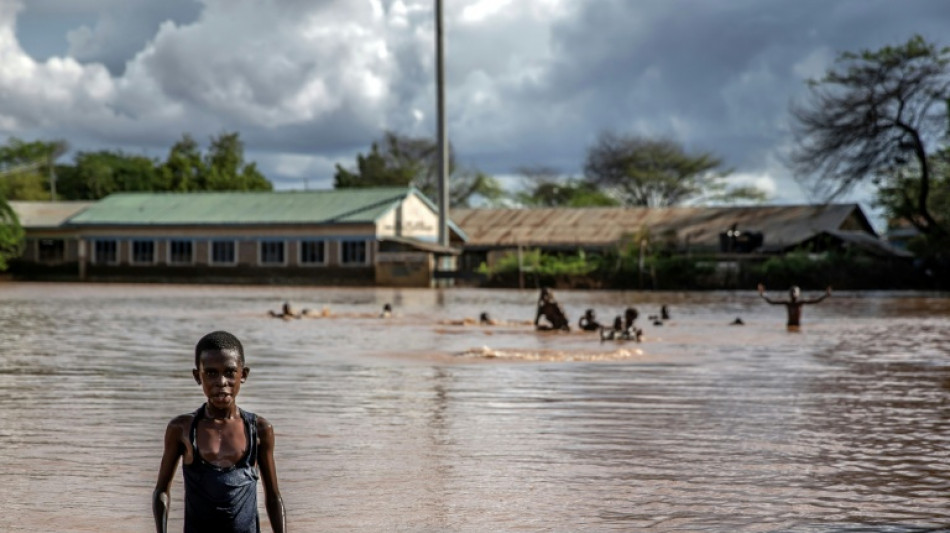
El Nino may return in 2026 and make planet even hotter / Photo: LUIS TATO - AFP

 Messi on target again but Miami downed by Columbus

 In Washington's political cauldron, a fight over foie gras
 Flavio Bolsonaro: political heir in his father's shadow

 Ravens grab last-second win in Rio as Commanders stop Seahawks

 USA rallies to capture 11th consecutive Presidents Cup

 Phillies clinch, Astros wrap up division on final day of MLB season

 Commanders hand champion Seahawks their first loss

 Dupont scores twice to send Toulouse top of Top 14

 Ireland beat Israel but no handshakes due to war in Gaza

 Tense standoff over flashpoint N.Ireland parade lasts into night

 Stunned McNulty wins 'miracle' road race world title

 Re-released 'Avengers: Endgame' snaps-up N. America box office lead

 American McNulty wins shock road race world title

 Serbia's President Aleksandar Vucic announces resignation

 Tuchel urges Bellingham to play with 'rage'

 Russian strikes on Ukraine kill 8

 Bavuma, Miller hit centuries as South Africa clinch series

 Spain bring in Le Normand for injured Garcia

 UK Labour party meets buoyed by Burnham but seeking concrete plans

 Nor'easter lashes US east with punishing rain and wind

 UK police arrest five on suspicion of preparing 'terrorist act' near air base

 Washington denounces Iran's truce proposal as 'cynical'

 Armani sprinkles glitter on discreet elegance at Milan show

 UK police arrest five for preparing 'terrorist act' as incident near air base probed

 อเล็กซ์ โบดี และศาสตราจารย์ ดร. ดีเทอร์ ลาซิก ลงนามสัญญาสำหรับ ALPHA WHEY และ BODI เครื่องดื่มให้พลังงาน

The warming El Nino weather phenomenon could form later this year, potentially pushing global temperatures to record heights.
There is a 50- to 60-percent chance of El Nino developing during the July-September period and beyond, according to the US National Oceanic and Atmospheric Administration (NOAA).
The World Meteorological Organization will issue an update on El Nino on Tuesday.
Here's what you need to know about El Nino and its cooler sister, La Nina:
- Why the name? -
El Nino and its cooler sister La Nina are two phases of a natural climate pattern across the tropical Pacific known as the El Nino-Southern Oscillation (ENSO).
Peruvian and Ecuadoran fishermen coined the term El Nino ("the boy" or "the Christ Child") in the 19th century for the arrival of an unusually warm ocean current off the coast that reduced their catch just before Christmas.
Scientists chose the name La Nina as the opposite of El Nino. Between the two events, there is a "neutral" phase.
- El Nino -
El Nino can weaken consistent trade winds that blow east to west across the tropical Pacific, influencing weather by affecting the movement of warm water across this vast ocean.
This weakening warms the usually cooler central and eastern sides of the ocean, altering rainfall over the equatorial Pacific and wind patterns around the world.
The extra heat at the surface of the Pacific releases energy into the atmosphere that can temporarily drive up global temperatures, which is why El Nino years are often among the warmest on record.
"All else being equal, a typical El Nino event tends to cause a temporary increase in the global mean temperature on the order of 0.1C-0.2C," Nat Johnson, an NOAA meteorologist, told AFP.
El Nino occurs every two to seven years.
It typically results in drier conditions across southeast Asia, Australia, southern Africa, and northern Brazil, and wetter conditions in the Horn of Africa, the southern United States, Peru and Ecuador.
- Another record? -
The last El Nino occurred in 2023-2024, contributing to making 2023 the second highest year on record and 2024 the all-time high.
Carlo Buontempo, director of the European Union's Copernicus Climate Change Service, told AFP in January that 2026 could be "another record-breaking year" if El Nino appears this year.
However, El Nino's impact would be higher in 2027 than in 2026 if it develops in the second half of this year, said Tido Semmler, a climate scientist at Ireland's National Meteorological Service.
"It takes time for the global atmosphere to react to the El Nino," he said.
"Having said this, there is a risk of 2026 being the warmest year on record even without El Nino, due to the global warming trend," Semmler told AFP.
"2027 would face an increased risk of getting a record warm year if El Nino developed in the second half of 2026," he added.
- La Nina -
The latest La Nina episode was relatively weak and short lived, starting in December 2024 and due to enter a neutral phase during the Februady-April period.
La Nina cools the eastern Pacific Ocean for a period of about one to three years, generating the opposite effects to El Nino on global weather.
It leads to wetter conditions in parts of Australia, southeast Asia, India, southeast Africa and northern Brazil, while causing drier conditions in parts of South America.
La Nina did not stop 2025 from being the third hottest on record.
- New calculation -
The NOAA adopted in February a new way of determining El Nino and El Nino events.
The old Oceanic Nino Index (ONI) compared the three-month average sea surface temperature one region of the Pacific with a 30-year average in the same area.
But as the oceans have been warming rapidly, that old 30-year average can be out of date.
The new method, the Relative Oceanic Nino Index (RONI), compares how warm or cool the east-central Pacific is compared to the rest of the tropics.
The NOAA said RONI is a "clearer, more reliable way" to track El Nino and La Nina in real time.
K.AbuDahab--SF-PST