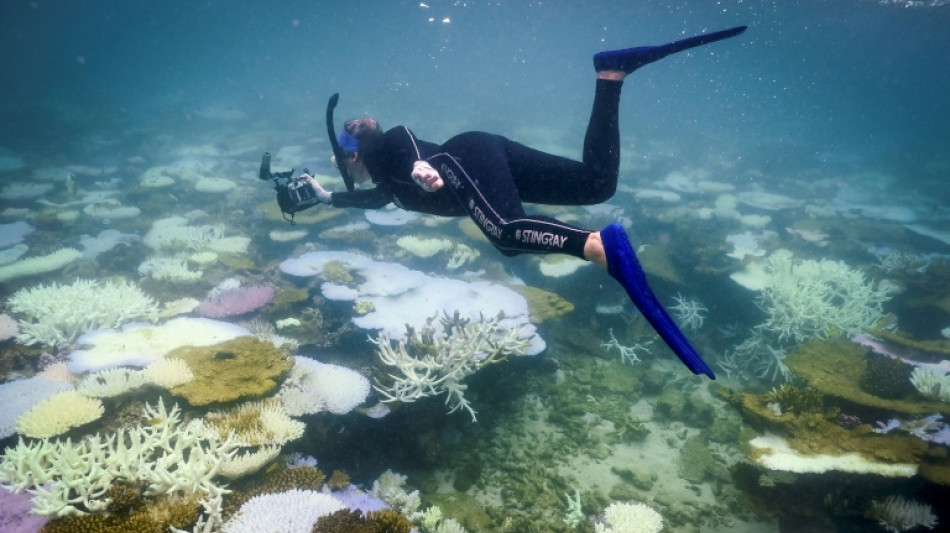
Three-year heatwave bleached half the planet's coral reefs: study / Photo: DAVID GRAY - AFP/File

 Oil prices spike after Trump rejects Iran truce offer

 Taylor Swift sets new record at MTV VMAs

 Seoul seeks apology after Ukraine reveals transfer of North Korean POWs

 Messi on target again but Miami downed by Columbus

 In Washington's political cauldron, a fight over foie gras

 Flavio Bolsonaro: political heir in his father's shadow

 Ravens grab last-second win in Rio as Commanders stop Seahawks

 USA rallies to capture 11th consecutive Presidents Cup

 Phillies clinch, Astros wrap up division on final day of MLB season

 Commanders hand champion Seahawks their first loss

 Dupont scores twice to send Toulouse top of Top 14

 Ireland beat Israel but no handshakes due to war in Gaza

 Tense standoff over flashpoint N.Ireland parade lasts into night

 Stunned McNulty wins 'miracle' road race world title

 Re-released 'Avengers: Endgame' snaps-up N. America box office lead

 American McNulty wins shock road race world title

 Serbia's President Aleksandar Vucic announces resignation

 Tuchel urges Bellingham to play with 'rage'

 Russian strikes on Ukraine kill 8

 Bavuma, Miller hit centuries as South Africa clinch series

 Spain bring in Le Normand for injured Garcia

 UK Labour party meets buoyed by Burnham but seeking concrete plans

 Nor'easter lashes US east with punishing rain and wind

 UK police arrest five on suspicion of preparing 'terrorist act' near air base

 Washington denounces Iran's truce proposal as 'cynical'

A study published on Tuesday showed that more than half of the world's coral reefs were bleached between 2014-2017 -- a record-setting episode now being eclipsed by another series of devastating heatwaves.
The analysis concluded that 51 percent of the world's reefs endured moderate or worse bleaching while 15 percent experienced significant mortality over the three-year period known as the "Third Global Bleaching Event".
It was "by far the most severe and widespread coral bleaching event on record", said Sean Connolly, one the study's authors and a senior scientist at the Panama-based Smithsonian Tropical Research Institute.
"And yet, reefs are currently experiencing an even more severe Fourth Event, which started in early 2023," Connolly said in a statement.
When the sea overheats, corals eject the microscopic algae that provides their distinct colour and food source.
Unless ocean temperatures return to more tolerable levels, bleached corals are unable to recover and eventually die of starvation.
"Our findings demonstrate that the impacts of ocean warming on coral reefs are accelerating, with the near certainty that ongoing warming will cause large-scale, possibly irreversible, degradation of these essential ecosystems," said the study in the journal Nature Communications.
An international team of scientists analysed data from more than 15,000 in-water and aerial surveys of reefs around the world over the 2014-2017 period.
They combined the data with satellite-based heat stress measurements and used statistical models to estimate how much bleaching occurred around the world.
- No time to recover -
The two previous global bleaching events, in 1998 and 2010, had lasted one year.
"2014–17 was the first record of a global coral bleaching event lasting much beyond a single year," the study said.
"Ocean warming is increasing the frequency, extent, and severity of tropical-coral bleaching and mortality."
Australia's Great Barrier Reef, for instance, saw peak heat stress increase each year between 2014 and 2017.
"We are seeing that reefs don't have time to recover properly before the next bleaching event occurs," said Scott Heron, professor of physics at James Cook University in Australia.
A major scientific report last year warned that the world's tropical coral reefs have likely reached a "tipping point" -- a shift that could trigger massive and often permanent changes in the natural world.
The global scientific consensus is that most coral reefs would perish at warming of 1.5C above preindustrial levels -- the ambitious, long-term limit countries agreed to pursue under the 2015 Paris climate accord.
Global temperatures exceeded 1.5C on average between 2023-2025, the European Union's climate monitoring service, Copernicus, said last month.
"We are only just beginning to analyse bleaching and mortality observations from the current bleaching event," Connolly told AFP.
"However the overall level of heat stress was extraordinarily high, especially in 2023-2024, comparable to or higher than what was observed in 2014-2017, at least in some regions," he said.
He said the Pacific coastline of Panama experienced "dramatically worse heat stress than they had ever experienced before, and we observed considerable coral mortality".
Z.AbuSaud--SF-PST