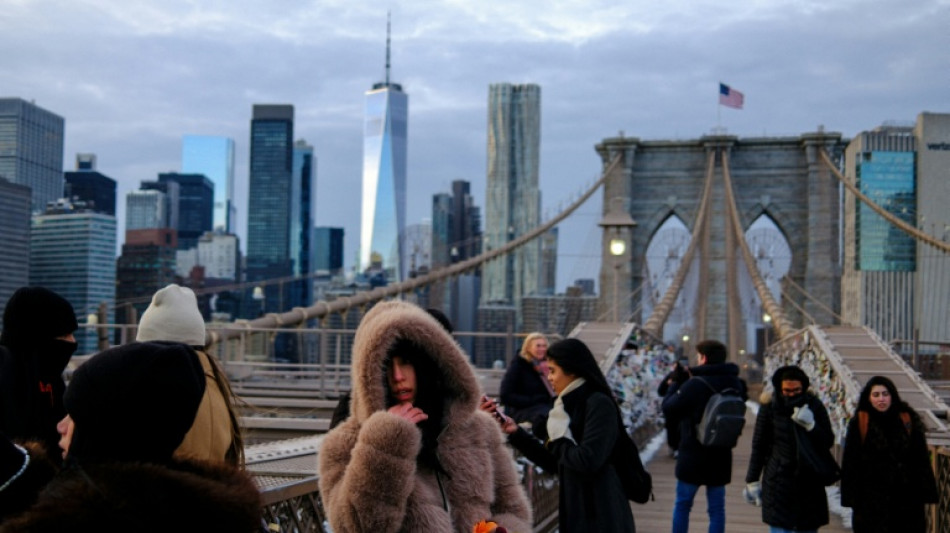
Arctic blast to wallop N. America -- is climate change to blame? / Photo: CHARLY TRIBALLEAU - AFP

 Oil prices spike after Trump rejects Iran truce offer

 Taylor Swift sets new record at MTV VMAs
 Seoul seeks apology after Ukraine reveals transfer of North Korean POWs

 Messi on target again but Miami downed by Columbus

 In Washington's political cauldron, a fight over foie gras
 Flavio Bolsonaro: political heir in his father's shadow
 Ravens grab last-second win in Rio as Commanders stop Seahawks

 USA rallies to capture 11th consecutive Presidents Cup

 Phillies clinch, Astros wrap up division on final day of MLB season

 Commanders hand champion Seahawks their first loss

 Dupont scores twice to send Toulouse top of Top 14

 Ireland beat Israel but no handshakes due to war in Gaza

 Tense standoff over flashpoint N.Ireland parade lasts into night

 Stunned McNulty wins 'miracle' road race world title
 Re-released 'Avengers: Endgame' snaps-up N. America box office lead
 American McNulty wins shock road race world title
 Serbia's President Aleksandar Vucic announces resignation

 Tuchel urges Bellingham to play with 'rage'

 Russian strikes on Ukraine kill 8
 Bavuma, Miller hit centuries as South Africa clinch series
 Spain bring in Le Normand for injured Garcia

 UK Labour party meets buoyed by Burnham but seeking concrete plans

 Nor'easter lashes US east with punishing rain and wind
 UK police arrest five on suspicion of preparing 'terrorist act' near air base

 Washington denounces Iran's truce proposal as 'cynical'

An unusually brutal winter storm is set to pummel more than 160 million Americans from Friday, as a stretched "polar vortex" sends a devastating blast of Arctic air, bringing heavy snows and freezing rains.
Winter Storm Fern is forecast to engulf an area well over half the length of the continental United States, stretching from Texas and the Great Plains region to the mid-Atlantic and northeastern states.
Scientists say the increasing frequency of such disruptions of the polar vortex may be linked to climate change, though the debate is not yet settled and natural variability also plays a role.
– What is the polar vortex? –
The polar vortex is a large region of cold, low-pressure air that circulates counterclockwise high above the Arctic, in the stratosphere some 10 to 50 kilometers (six to 30 miles) above Earth's surface.
In a typical winter, it forms a relatively compact, circular system that helps lock in the coldest air to high northern latitudes.
"Usually the vortex spins merrily along and has little effect on our weather, but occasionally it moves or stretches southward over North America, bringing with it a jolt of cold," Jennifer Francis, a senior scientist at the Woodwell Climate Research Center, told AFP.
– What happens when it stretches? -
At times, big atmospheric waves that form closer to the ground can travel upward and knock the polar vortex out of whack.
Rather than completely breaking down -- as happens during dramatic "sudden stratospheric warming" events -- the vortex can stretch out into a more oval shape.
"Think of it like a rubber band being pulled," Judah Cohen, a climate dynamics scientist at MIT, told AFP.
"That allows the cold air to expand much further south, like we're like we're seeing this week here in the United States."
Jason Furtado, a meterologist at the University of Oklahoma whose research focuses on long-range forecasting, said these stretching events aren't as long-lasting as complete breakdowns, but are significant nonetheless, especially for North America.
-Is it linked to climate change? –
This is where the science becomes more debated.
There is broad agreement -- reflected in assessments by the UN's climate science body -- that the Arctic is warming much faster than the global average, through a process known as Arctic amplification, and human-caused climate change is behind it.
Cohen argues that this uneven warming helps amplify large atmospheric waves over Eurasia, which in turn makes the polar vortex spill more frequently over North America.
"Studies suggest these aberrations in the vortex are happening more often in a warming world, which favors more frequent winter extremes," said Francis.
Furtado said observations from the past 20 years do show an increase in such events, but he cautioned against drawing strong long-term conclusions tying them directly to human-caused climate change.
"In my opinion, it's harder to make that connection going out much further, simply because I think we just don't have enough data."
X.Habash--SF-PST