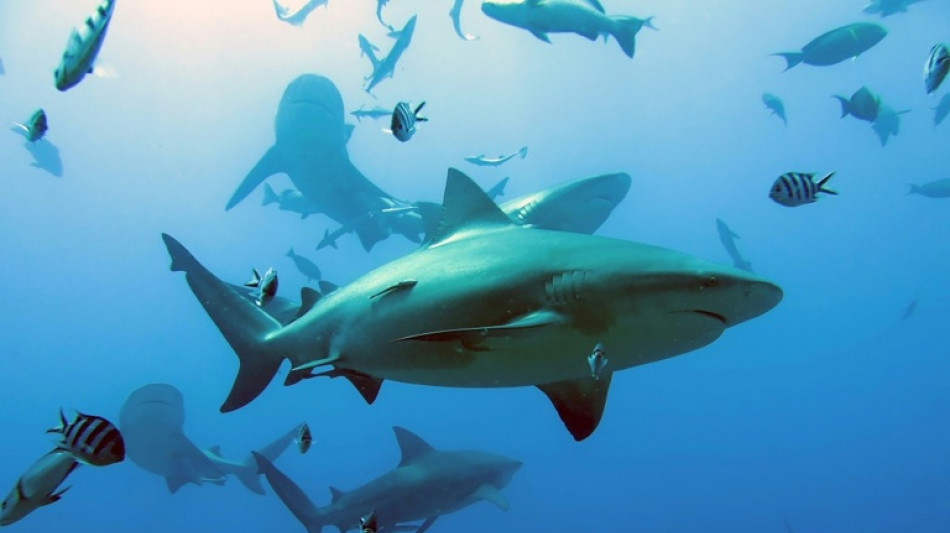
Bull shark kills woman off Australia beach / Photo: COLIN SIMPENDORFER - SIMON FRASER UNIVERSITY/JAMES COOK UNIVERSITY/AFP/File

 PU Prime Deepens Argentina Presence Through FX Expo Buenos Aires 2026

 Nothing to seal here: NZ police help stranded pup home
 White House releases list of products US, China could tax less

 'Pseudo-journalism': Partisan 'news' sites target US midterms

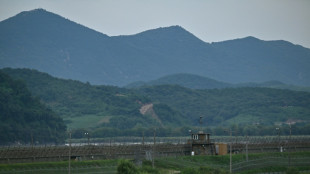 'Currently impossible': North Korea defections in freefall

 Erasmus sizes up 'improved' Wallabies ahead of 2027 World Cup

 Scandal-weary Brazilians to vote as Lula faces Bolsonaro son

 SpaceX aims to put Starship in orbit for the first time

 Pope to speak on united Europe from French border town

 Scheffler makes sportsmanship stand over tee screamer

 Anthropic CEO Amodei to dine with Trump at White House

 Dupont scores twice to send Toulouse to Top 14 summit

 Greece stun Klopp's Germany as Ireland show sorrow for Gaza

 Ramos fires holders Portugal to Nations League win in Norway

 Greece hand Klopp first defeat as Germany manager

 Pope promises French sex abuse victims to prevent further harm

 UK village on edge over threats to air base in terror alert

 Two giant pandas, emblems of China soft diplomacy, arrive in US

 Aleksandar Vucic: from Milosevic minister to long-serving Serbian statesman

 Trump expects new Iran talks despite rejecting deal offer

 Xavi gets first win as Netherlands boss, Denmark beat Wales

 Madrid housing protest camp enters second night as PM vows action

 Tigray TV station hit by drone, rebels advance in north Ethiopia

 Banton hundred paves way for England ODI series win over Sri Lanka

 Milestone man Kohli powers India to big ODI win over West Indies

A bull shark killed a woman swimming off a remote beach in Australia’s eastern state of New South Wales Thursday while a man was seriously injured and may have been saved by the "heroic" efforts of a passerby.
The woman died at the scene of the attack, which took place in the early hours of the morning in the remote Crowdy Bay, around 250 kilometres (155 miles) north of Sydney.
The man suffered serious leg injuries and was airlifted to hospital. Police have said his condition is stable.
"They were known to each other, and they were going for a swim and the shark attacked," New South Wales Police inspector Timothy Bayly told reporters.
A bystander potentially saved the man's life by wrapping a makeshift tourniquet around his leg, state ambulance inspector Joshua Smyth said.
"The courage from some bystanders is amazing in this situation -- to put yourself out there is very heroic," he said.
Steven Pearce, Surf Life Saving NSW chief executive, described it as "a really, really terrible incident".
"This area is so remote, there's no life guarding services up there at all," Pearce told local radio 2GB.
Authorities determined a bull shark -- one of the deadliest species of the deep-sea predatory fish -- was most "likely to have been" involved in the attack.
Assessments are usually made by examining bite marks, animal behaviour, any recent sightings or ocean conditions leading up to the incident.
Bull sharks are the only one of the cartilaginous fish that are able to move between fresh and salt water, allowing them to swim vast distances.
They can grow up to 2.3 metres (7.5 feet) and are among the species of shark most likely to bite oceangoers in Australia, alongside the great white and tiger.
- Attacks on the rise -
There have been more than 1,280 shark incidents around Australia since 1791, of which more than 250 resulted in death, according to a database of the predators' encounters with humans.
Of the total number of recorded incidents since records began, 212 involved bull sharks.
Increasingly crowded waters and rising ocean temperatures that appear to be swaying sharks' migratory patterns may be contributing to an escalation in attacks despite overfishing depleting some species, scientists say.
In September, a great white mauled a surfer to death at a popular Sydney beach.
The man, who left a wife and young daughter, lost "a number of limbs" and his surfboard was broken in two, police said.
Australia's oceans are teeming with sharks, with great whites topping the list of species that might fatally bite a human.
Though still relatively rare, fatal attacks do appear to be on the rise with 56 reported deaths in the 25 years to 2025 compared to 27 deaths in the previous quarter-century.
Undeterred, Australians flock to the sea in huge numbers -- with a 2024 survey showing nearly two-thirds of the population made a total of 650 million coastal visits in a single year.
How best to protect people from sharks is a touchy topic in Australia.
Authorities have adopted a multi-layered approach -- deploying drones, fixing acoustic trackers to sharks so they can be detected by listening buoys near popular beaches, alerting people in real time with a mobile app and stringing up old-fashioned nets.
Researchers say shark lives, too, need protecting.
Globally, about 37 percent of oceanic shark and ray species are now listed as either endangered or critically endangered by the International Union for Conservation of Nature, a database for threatened species.
W.Mansour--SF-PST