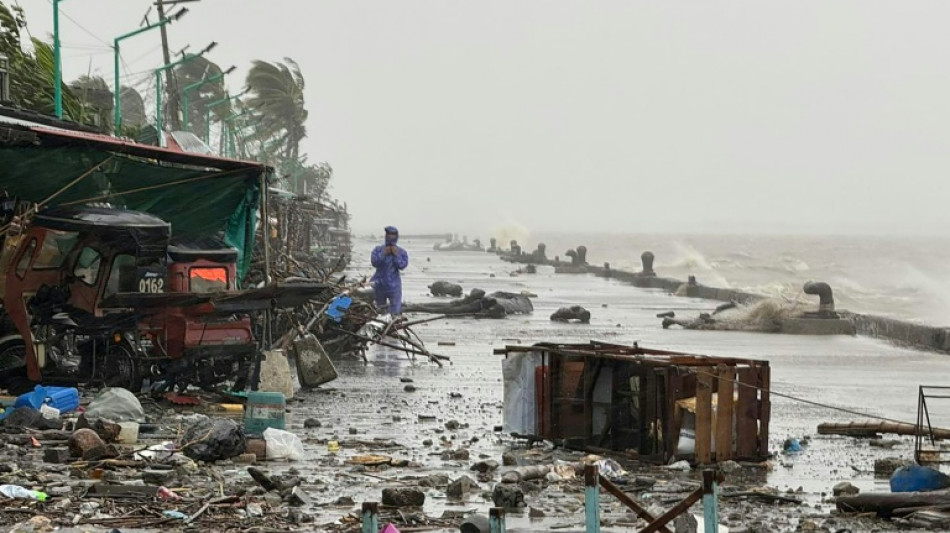
China prepares to evacuate 400,000 as super typhoon makes landfall in Philippines / Photo: John Dimain - AFP

 SGFX Creates a Standout Brand Experience at Forex Expo Dubai 2026

 Pope urges Europe to help combat 'deceit and lies' in international ties

 Injured Buttler to miss England ODI series in Pakistan
 Madrid housing protesters vow to maintain pressure on government

 In kayaks or waist-deep in floodwater, shoppers return to Bangkok markets

 UK police probes Iran link to air base bomb scare: media

 Eala blasts into Asian Games quarters in just 55 minutes

 Taiwan gender-row boxer Lin Yu-ting guarantees Asian Games medal

 Comedian on trial for allegedly insulting Erdogan in standup show

 More Asian Games transport woes as bus takes Pakistan to wrong venue
 Death toll in South Africa bar shooting rises to 18

 Aide to Venezuelan opposition leader returns from exile

 Messi and Alcaraz love it, now padel takes step closer to Olympics

 Tolls mount in Thailand, Myanmar floods

 Why India's opposition wants top poll official out

 PU Prime Strengthens UAE Momentum with Strong Showing at Forex Expo Dubai 2026

 Eight dead in Thailand floods since mid-September

 Oil prices spike after Trump rejects Iran truce offer

 Taylor Swift sets new record at MTV VMAs
 Seoul seeks apology after Ukraine reveals transfer of North Korean POWs

 Messi on target again but Miami downed by Columbus

 In Washington's political cauldron, a fight over foie gras

 Flavio Bolsonaro: political heir in his father's shadow

 Ravens grab last-second win in Rio as Commanders stop Seahawks

 USA rallies to capture 11th consecutive Presidents Cup

The Chinese city of Shenzhen began preparing to evacuate 400,000 people while residents of the northern Philippines sought shelter from gale-force winds Monday as Super Typhoon Ragasa continued on a collision course with southern China.
The typhoon made landfall on the Philippines' Calayan Island, part of the sparsely populated Babuyan chain, at 3 pm (0700 GMT), according to the Philippine weather service.
As of 2 pm (0600 GMT), maximum sustained winds of 215 kilometres per hour were reported at the storm's center, with gusts reaching as high as 295 kph, the national weather service said.
"I woke up because of the strong wind. It was hitting the windows, and it sounded like a machine that was switched on," said Tirso Tugagao, a resident of Aparri, a coastal town in northern Cagayan province.
Cagayan disaster chief Rueli Rapsing told AFP his team was prepared for "the worst".
Just over 10,000 Filipinos were evacuated across the country, with schools and government offices closed Monday in the Manila region and across 29 other provinces.
A much larger operation will take place in China's Shenzhen, where authorities said late Sunday they planned to move hundreds of thousands of people from coastal and low-lying regions.
Multiple other cities in Guangdong province announced classes and work would be cancelled, and public transportation suspended because of the typhoon.
Hong Kong-based Cathay Pacific said it expected to cancel more than 500 flights as Ragasa threatened the financial hub.
A spokeswoman for the airline said passenger flights in and out of Hong Kong International Airport would be halted from 6 pm Tuesday, "resuming during daytime hours on Thursday".
- 'Extremely torrential' -
In Taiwan, the state weather service predicted a chance of "extremely torrential rain" in the country's east.
"Its storm radius is quite large, about 320 (kilometres). Although the typhoon's centre is still some distance away, its wide, strong wind field and outer circulation are already affecting parts of Taiwan."
James Wu, a local fire department officer, told AFP that evacuations were ongoing in mountainous areas near Pingtung.
"What worries us more is that the damage could be similar to what happened during Typhoon Koinu two years ago," he added, describing a storm that saw utility poles collapse and sheet-metal roofs sent flying into the air.
Philippine government weather specialist John Grender Almario said Sunday that "severe flooding and landslides" could be expected in the northern areas of the main island Luzon.
The threat of flooding from Ragasa comes just a day after thousands of Filipinos took to the streets to protest a growing corruption scandal involving flood control projects that were shabbily constructed or never completed.
The Philippines is the first major landmass facing the Pacific cyclone belt, and the archipelago is hit by an average of 20 storms and typhoons each year, putting millions of people in disaster-prone areas in a state of constant poverty.
Scientists warn that storms are becoming more powerful as the world warms due to the effects of human-driven climate change.
F.Qawasmeh--SF-PST