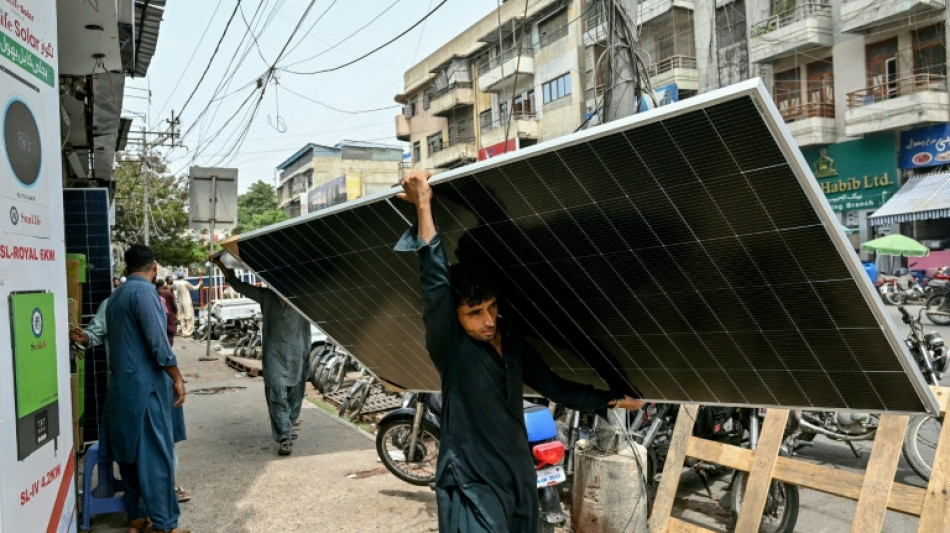
Pakistan's quiet solar rush puts pressure on national grid / Photo: Asif HASSAN - AFP

 Oil up, Wall Street dips after Trump rejects Iran truce offer

 Gakpo withdraws from Netherlands squad

 SpaceX puts Starship megarocket in orbit for first time
 Iran denies link to suspected bomb plot at UK airbase used by US

 Ex-boss Mancini says City charges 'not my concern'

 Berlin Marathon winner Assefa finished race with torn Achilles

 Comedian convicted for Erdogan 'insult' but freed pending appeal

 French prosecutors seek two-year sentence for ex-minister Dati in graft case

 Eala makes fast start as weather and transport woes hit Asian Games

 Hurricane Polo approaches Mexico, threatens severe damage

 Energy markets rally after Trump rejects Iran truce offer

 Japanese convenience store enlists Lady Gaga to bolster recruitment

 Seoul summons Ukraine envoy in row over North Korean POWs

 Ireland 'raised awareness worldwide' in Israel game: Hallgrimsson

 Colombian police capture wife, daughter of Ecuador drug lord

 More Asian Games woes as bus takes Pakistan team to wrong venue

 Radio frequencies vital to Earth observation must be protected: UN

 Comedian on trial for insulting Erdogan in standup show

 Women's Fashion Week kicks off in Paris

 Pope arrives in French border city to speak on united Europe

 The wildfires choking Indonesia, sparking regional haze

 PU Prime Deepens Argentina Presence Through FX Expo Buenos Aires 2026

 Nothing to seal here: NZ police help stranded pup home

 White House releases list of products US, China could tax less

 'Pseudo-journalism': Partisan 'news' sites target US midterms

Pakistanis are increasingly ditching the national grid in favour of solar power, prompting a boom in rooftop panels and spooking a government weighed down by billions of dollars of power sector debt.
The quiet energy revolution has spread from wealthy neighbourhoods to middle- and lower-income households as customers look to escape soaring electricity bills and prolonged power cuts.
Down a cramped alley in Pakistan's megacity of Karachi, residents fighting the sweltering summer heat gather in Fareeda Saleem's modest home for something they never experienced before -- uninterrupted power.
"Solar makes life easier, but it's a hard choice for people like us," she says of the installation cost.
Saleem was cut from the grid last year for refusing to pay her bills in protest over enduring 18-hour power cuts.
A widow and mother of two disabled children, she sold her jewellery -- a prized possession for women in Pakistan -- and borrowed money from relatives to buy two solar panels, a solar inverter and battery to store energy, for 180,000 rupees ($630).
As temperatures pass 40 degrees Celsius (104 degrees Fahrenheit), children duck under Saleem's door and gather around the breeze of her fan.
Mounted on poles above homes, solar panels have become a common sight across the country of 240 million people, with the installation cost typically recovered within two to five years.
Making up less than two percent of the energy mix in 2020, solar power reached 10.3 percent in 2024, according to the global energy think tank Ember.
But in a remarkable acceleration, it more than doubled to 24 percent in the first five months of 2025, becoming the largest source of energy production for the first time.
It has edged past gas, coal and nuclear electricity sources, as well as hydropower which has seen hundreds of millions of dollars of investment over the past decades.
As a result, Pakistan has unexpectedly surged towards its target of renewable energy, making up 60 percent of its energy mix by 2030.
Dave Jones, chief analyst at Ember, told AFP that Pakistan was "a leader in rooftop solar".
- 'The great Solar rush' -
Soaring fuel costs globally, coupled with demands from the International Monetary Fund to slash government subsidies, led successive administrations to repeatedly hike electricity costs.
Prices have fluctuated since 2022 but peaked at a 155-percent increase and power bills sometimes outweigh the cost of rent.
"The great solar rush is not the result of any government's policy push," Muhammad Basit Ghauri, an energy transition expert at Renewables First, told AFP.
"Residents have taken the decision out of clear frustration over our classical power system, which is essentially based on a lot of inefficiencies."
Pakistan sources most of its solar equipment from neighbouring China, where prices have dropped sharply, largely driven by overproduction and tech advancements.
But the fall in national grid consumers has crept up on an unprepared government burdened by $8 billion of power sector debt, analysts say.
Pakistan depends heavily on costly gas imports which it sells at a loss to national energy providers.
It is also tied into lengthy contracts with independent power producers, including some owned by China, for which it pays a fixed amount regardless of actual demand.
A government report in March said the solar power increase has created a "disproportionate financial burden onto grid consumers, contributing to higher electricity tariffs and undermining the sustainability of the energy sector".
Electricity sales dropped 2.8 percent year-on-year in June, marking a second consecutive year of decline.
Last month, the government imposed a new 10-percent tax on all imported solar, while the energy ministry has proposed slashing the rate at which it buys excess solar energy from consumers.
- 'Disconnected from the public -
"The household solar boom was a response to a crisis, not the cause of it," said analyst Jones, warning of "substantial problems for the grid" including a surge during evenings when solar users who cannot store energy return to traditional power.
The national grid is losing paying customers like businessman Arsalan Arif.
A third of his income was spent on electricity bills at his Karachi home until he bought a 10-kilowatt solar panel for around 1.4 million rupees (around $4,900).
"Before, I didn't follow a timetable. I was always disrupted by the power outages," he told AFP.
Now he has "freedom and certainty" to continue his catering business.
In the eastern city of Sialkot, safety wear manufacturer Hammad Noor switched to solar power in 2023, calling it his "best business decision", breaking even in 18 months and now saving 1 million rupees every month.
The cost of converting Noor's second factory has now risen by nearly 1.5 million rupees under the new government tax.
"The tax imposed is unfair and gives an advantage to big businesses over smaller ones," he said.
"Policymakers seem completely disconnected from the public and business community."
S.AbuJamous--SF-PST