Kenya NGO saves turtles from nets, plastic and rising tides / Photo: Fredrik Lerneryd - AFP

 Oil takes off again, Wall Street dips after Trump rejects Iran truce offer

 AlgoQuant Asset Management Selects Liquid Mercury to Enhance Digital Asset Trading Infrastructure

 UK to reopen refugee resettlement scheme to push 'safe' migration

 Pope urges Europe to help combat 'lies and deceit' in world affairs
 Iranian lawyer Nasrin Sotoudeh wins Council of Europe's rights prize

 French far-right's Bardella denies alleged 2013 antisemitic comments

 Oil up, Wall Street dips after Trump rejects Iran truce offer

 Gakpo withdraws from Netherlands squad

 SpaceX puts Starship megarocket in orbit for first time
 Iran denies link to suspected bomb plot at UK airbase used by US

 Ex-boss Mancini says City charges 'not my concern'

 Berlin Marathon winner Assefa finished race with torn Achilles

 Comedian convicted for Erdogan 'insult' but freed pending appeal

 French prosecutors seek two-year sentence for ex-minister Dati in graft case

 Eala makes fast start as weather and transport woes hit Asian Games

 Hurricane Polo approaches Mexico, threatens severe damage

 Energy markets rally after Trump rejects Iran truce offer
 Japanese convenience store enlists Lady Gaga to bolster recruitment

 Seoul summons Ukraine envoy in row over North Korean POWs

 Ireland 'raised awareness worldwide' in Israel game: Hallgrimsson

 Colombian police capture wife, daughter of Ecuador drug lord

 More Asian Games woes as bus takes Pakistan team to wrong venue

 Radio frequencies vital to Earth observation must be protected: UN

 Comedian on trial for insulting Erdogan in standup show

 Women's Fashion Week kicks off in Paris

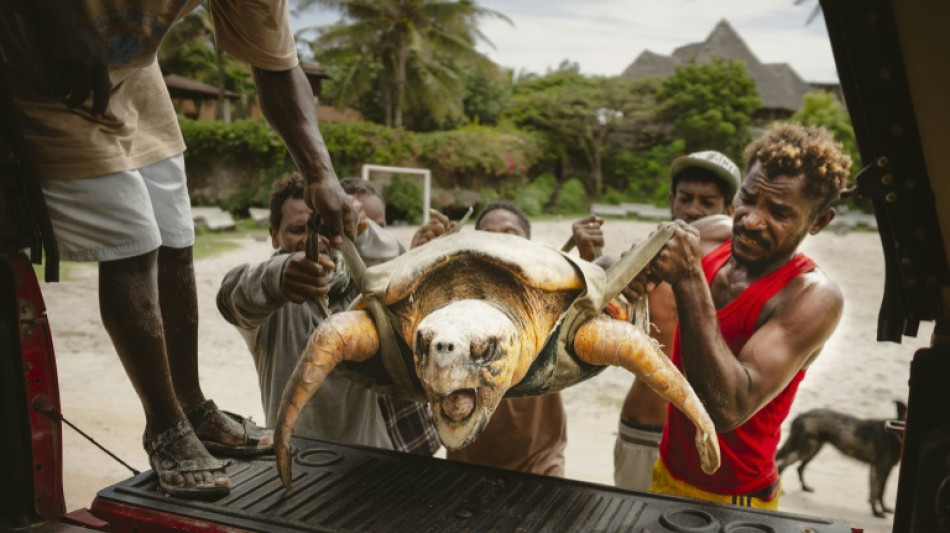
A small charity on the Kenyan coast has become vital to the region's majestic turtle population, saving thousands from poachers, fishermen's nets and ever-worsening plastic pollution.
On the beach of the seaside town of Watamu, it takes four men to heave the huge Loggerhead sea turtle into the back of a car.
She has just been saved from a fishing tackle and will be taken to a nearby clinic to be checked for injuries, then weighed, tagged and released back into the sea.
A Kenyan NGO, Local Ocean Conservation (LOC), has been doing this work for almost three decades and has carried out some 24,000 rescues.
"Every time I release a turtle, it's a really great joy for me. My motivation gets stronger and stronger," said Fikiri Kiponda, 47, who has been part of LOC's 20-odd staff for 16 years.
LOC began life in 1997 as a group of volunteers who hated seeing the creatures being eaten or dying in nets.
Turtles are still poached for their shells, meat and oil.
But through the charity's awareness campaigns in schools and villages, "perceptions have significantly changed", said Kiponda.
LOC, which relies mostly on donations, compensates fishermen for bringing them injured turtles.
More than 1,000 fishermen participate in the scheme and mostly do so for the sake of conservation, the charity emphasises, since the reward does not offset the hours of lost labour.
- Floating turtles -
At the NGO's nearby clinic, health coordinator Lameck Maitha, 34, says turtles are often treated for broken bones and tumours caused by a disease called Fibropapillomatosis.
One current in-patient is Safari, a young Olive Ridley turtle around 15 years old -- turtles can live beyond 100 -- transported by plane from further up the coast.
She arrived in a dire state, barely alive and with a bone protruding from her flipper, which ultimately had to be amputated -- likely the result of fighting to free herself from a fisherman's net.
Safari has been recovering well and the clinic hopes she can return to the sea.
Other frequent tasks include removing barnacles that embed themselves in shells and flippers, weakening their host.
But a growing danger is plastic pollution.
If a turtle eats plastic, it can create a blockage that in turn creates gas, making the turtle float and unable to dive.
In these cases, the clinic gives the turtle laxatives to clear out its system.
"We are seeing more and more floating turtles because the ocean has so much plastic," said Maitha.
- Survivors -
LOC also works to protect 50 to 100 nesting sites, threatened by rising sea levels.
Turtles travel far and wide but always lay their eggs on the beach where they were born, and Watamu is one of the most popular spots.
Every three or four years, they produce hundreds of eggs, laid during multiple sessions over several months, that hatch after around 60 days.
The charity often relocates eggs that have been laid too close to the sea.
Marine biologist Joey Ngunu, LOC's technical manager, always calls the first to appear Kevin.
"And once Kevin comes out, the rest follow," he said with a smile, describing the slow, clumsy procession to the water, preferably at night to avoid predators as much as possible.
Only one in a thousand reaches adulthood of 20-25 years.
"Living in the sea as a turtle must be crazy. You have to face so many dangers, fish and poachers, and now human pressure with plastic and commercial fishing," he said.
"Turtles are definitely survivors."
R.Shaban--SF-PST