Still reeling a year on, Brazil's Porto Alegre fears next flood / Photo: Nelson ALMEIDA - AFP

 Trump denies offering to sell arms to China's Xi

 Wemby ready for NBA Spurs to move rivals in climb to top

 Ukraine to postpone some spending amid delays in aid: PM
 Tuchel says Czech Republic game 'not yet a must-win'

 MaXhosa puts South Africa on the Paris fashion map

 Rose, Scott among 2027 World Golf Hall of Fame finalists

 Brunson says NBA champion Knicks can't get satisfaction

 France puts out largest wildfire since 1949

 Real Madrid's Perez summoned over Barcelona referee payments comments

 Oil takes off again, Wall Street dips after Trump rejects Iran truce offer

 AlgoQuant Asset Management Selects Liquid Mercury to Enhance Digital Asset Trading Infrastructure

 UK to reopen refugee resettlement scheme to push 'safe' migration

 Pope urges Europe to help combat 'lies and deceit' in world affairs
 Iranian lawyer Nasrin Sotoudeh wins Council of Europe's rights prize

 French far-right's Bardella denies alleged 2013 antisemitic comments
 Oil up, Wall Street dips after Trump rejects Iran truce offer

 Gakpo withdraws from Netherlands squad

 SpaceX puts Starship megarocket in orbit for first time
 Iran denies link to suspected bomb plot at UK airbase used by US
 Ex-boss Mancini says City charges 'not my concern'
 Berlin Marathon winner Assefa finished race with torn Achilles
 Comedian convicted for Erdogan 'insult' but freed pending appeal

 French prosecutors seek two-year sentence for ex-minister Dati in graft case

 Eala makes fast start as weather and transport woes hit Asian Games

 Hurricane Polo approaches Mexico, threatens severe damage
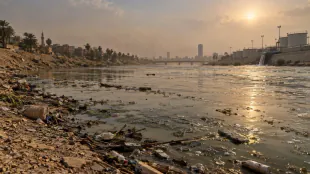
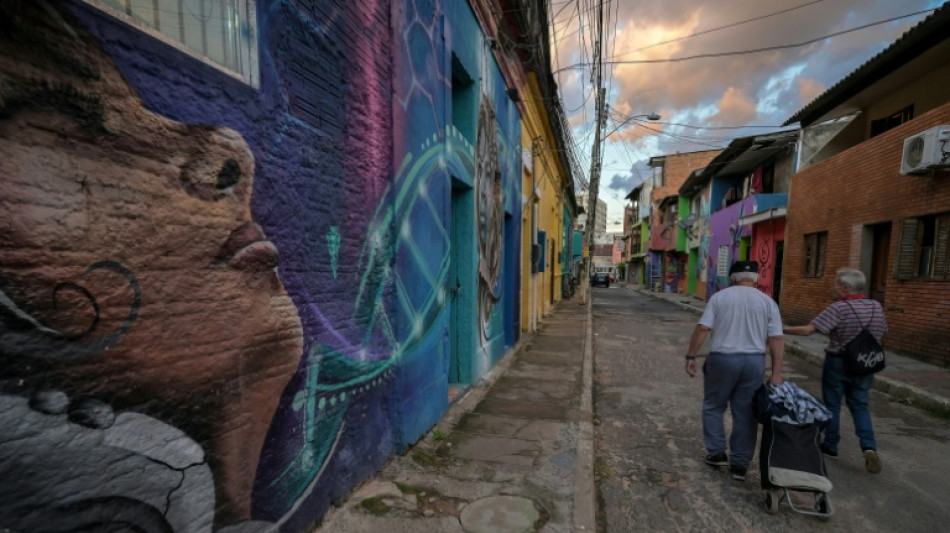
Armed with brushes and paint, volunteers touch up houses left standing after devastating floods last year that killed nearly 200 people and displaced half a million in the Brazilian city of Porto Alegre.
As residents continue to repair damage nearly 12 months after Rio Grande do Sul's worst-ever natural calamity, they worry not enough is being done to buttress the city against another such catastrophe, which experts say is made ever more likely by climate change.
In late April and early May 2024, three months' worth of rain fell on the wealthy state, of which Porto Alegre is the capital, in just 10 days.
The brunt of the deluge was felt in the city of 1.3 million people located on the shores of Lake Guaiba, which is fed by four rivers.
Scientists of the World Weather Attribution later concluded climate change had doubled the likelihood of the "extremely rare event" -- the kind expected to occur only once every 100 to 250 years.
With recovery work still underway, another storm hit the city last month -- less severe this time, but again flooding roads, felling trees and knocking out power.
"Nowadays, the rain brings fear and insecurity," said Jotape Pax, a Porto Alegre resident and urban artist behind the volunteer restoration project.
- 'Very worrying' -
When last year's mega-storm hit, Porto Alegre was reliant on a faulty barrier of walls and dikes that had been designed in the 1960s.
Due to poor maintenance, the walls were cracked and the gates were held up with sand bags, according to Mima Feltrin, a flood specialist at the Federal University of Rio de Janeiro.
Of the 23 water drainage pumps, 19 failed during the floods, she told AFP.
A year later, only two have been fixed.
"It's very worrying because, so far, what we've seen are mostly emergency measures," said Feltrin, pointing to "a major gap" in infrastructure reinforcement.
The UN Environment Programme says developing countries will need as much as $387 billion per year by 2030 for projects to adapt to unavoidable climate change, including building sea walls and planting drought resistant crops.
In 2020, only $28 billion had been forthcoming.
Last year, a report by the Climate Policy Initiative, a research NGO, found Brazil was spending about $2.7 billion per year to prepare for worsening floods and droughts -- not nearly enough, according to experts.
- 'Omissions' -
The Institute of Hydraulic Research at the Federal University of Rio Grande do Sul concluded in a study last December that many deaths in Porto Alegre could have been prevented with an early alert and evacuation system.
In a multi-million dollar lawsuit, the municipality stands accused of "omissions" that led to flood protection system failures, according to the prosecutor's office.
Mayor Sebastiao Melo said a climate action plan will be presented to the municipal legislature this year, with provision for an early warning system.
The plan also envisions work to reinforce existing dikes and build new ones, the mayor told AFP, while urban drainage systems are already being upgraded.
- 'Better prepared' -
Feltrin said Porto Alegre needs to completely renew its flood containment system, possibly by looking at solutions applied in other low-lying areas such as New York and the Netherlands.
"It is important to have flood gates, but also parks designed to absorb water," she said.
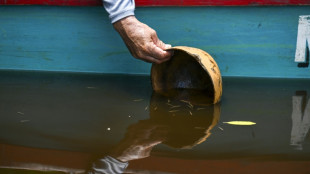
At Porto Alegre's central market, a plaque recalls the flooding that had completely submerged the historic building.
It is bustling once again, and with changes such as furniture made of water-resistant stainless steel rather than wood.
"With climate change, this is going to happen more and more often. It scares us a lot, but we are working to be better prepared," said Nadja Melo, 45, who runs a market eatery.
For others, it has been tougher to bounce back.
In one of Porto Alegre's hardest-hit neighborhoods, Sarandi, dozens of families have been ordered to leave or risk having their homes flooded again in a high-risk zone.
"It is very difficult to start over," said Claudir Poli, a 42-year-old with two prosthetic legs, a wife and three children, complaining that aid funding is not enough to rehouse his family.
G.AbuHamad--SF-PST