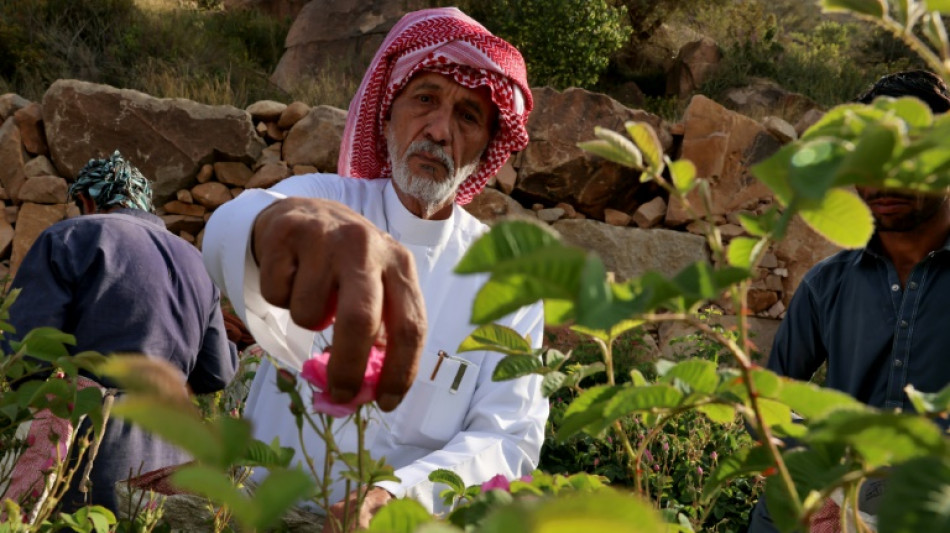
Saudi 'city of roses' offers fragrant reminder of desert's beauty / Photo: Fayez Nureldine - AFP

 Trump denies offering to sell arms to China's Xi

 Wemby ready for NBA Spurs to move rivals in climb to top

 Ukraine to postpone some spending amid delays in aid: PM

 Tuchel says Czech Republic game 'not yet a must-win'

 MaXhosa puts South Africa on the Paris fashion map

 Rose, Scott among 2027 World Golf Hall of Fame finalists

 Brunson says NBA champion Knicks can't get satisfaction

 France puts out largest wildfire since 1949

 Real Madrid's Perez summoned over Barcelona referee payments comments

 Oil takes off again, Wall Street dips after Trump rejects Iran truce offer
 AlgoQuant Asset Management Selects Liquid Mercury to Enhance Digital Asset Trading Infrastructure

 UK to reopen refugee resettlement scheme to push 'safe' migration

 Pope urges Europe to help combat 'lies and deceit' in world affairs

 Iranian lawyer Nasrin Sotoudeh wins Council of Europe's rights prize

 French far-right's Bardella denies alleged 2013 antisemitic comments

 Oil up, Wall Street dips after Trump rejects Iran truce offer

 Gakpo withdraws from Netherlands squad

 SpaceX puts Starship megarocket in orbit for first time
 Iran denies link to suspected bomb plot at UK airbase used by US
 Ex-boss Mancini says City charges 'not my concern'

 Berlin Marathon winner Assefa finished race with torn Achilles

 Comedian convicted for Erdogan 'insult' but freed pending appeal

 French prosecutors seek two-year sentence for ex-minister Dati in graft case

 Eala makes fast start as weather and transport woes hit Asian Games

 Hurricane Polo approaches Mexico, threatens severe damage

After decades spent pruning thorny bushes and working arduous harvests, Khalaf Allah al-Talhi has perfected the art of capturing the fragrant aroma of the desert rose in a bottle.
"I love roses and take care of them more than I care for my own children," the 80-year-old told AFP from his flower farm in western Saudi Arabia's Taif.
Known as "the city of roses", the hills of Taif produce around 300 million of the area's signature pink roses annually at 800 flower farms.
By his own estimates, Talhi grows around five to six million of those.
The arrival of spring's mild climate is met with the blooming of roses that carpet the vast, rolling desert landscapes with vibrant shades of pink.
The blooms are then hand-picked from daybreak to late in the evening by an army of labourers.
The petals are soaked and boiled for hours in vats, where the rose's scent is extracted through an intricate process capturing the steam that is then distilled into aromatic oil.
The flowers have long been used to make rose water to wash the walls of the Kaaba at the Grand Mosque in Mecca, and perfumes made from Taif roses are popular with pilgrims visiting the kingdom.
- 'Many rose lovers' -
"The quantity of Taif roses is small, so only limited amounts are exported because it's not enough to meet local demand. Here in Saudi Arabia, we have many rose lovers who only prefer rose perfume," Talhi said.
A modest quantity of oil is exported to craft perfumes or to be added to cosmetic products such as moisturisers and soaps.
According to the economic database TrendEconomy, Saudi Arabia in 2023 exported just $141 million worth of perfume products, which includes rosewater.
At harvest time, workers on Talhi's farm pick tens of thousands of flowers daily.
"We were born on farms and have always worked in agriculture," said Talhi, wearing a white robe and a red checkered headscarf.
But now the greater frequency of erratic weather -- including searing summer heat, frigid winters and unexpected flooding -- presents a potent threat to Taif's famed roses.
- 'My soul' -
Climate scientists have issued regular warnings that every fraction of a degree of global warming increases the intensity and frequency of extreme weather events such as heatwaves, heavy rainfall and droughts.
Saudi Arabia, with its arid climate and vast deserts, is particularly vulnerable.
"Climate change accelerates soil degradation in processes such as salinisation, erosion, and desertification, which diminishes the quality and productivity of arable land in Saudi Arabia," read a report published by the Atlantic Council.
The think tank estimated that wheat yields were expected to decline by 20 to 30 percent by 2050 in Saudi Arabia because of heat stress and not enough irrigation water, while reductions are also expected for date palms and other staple crops.
The weather in the deserts around Taif has been no exception, according to Talhi.
"Last year and the year before, it was extremely cold. Some farmers didn't harvest a single flower from their fields."
Thankfully, this season has been more forgiving.
"There are weather changes, but this year the conditions have been very mild," he said.
While the weather may now be less reliable, Talhi himself has proven to be a source of stability.
Despite his advancing years, the octogenarian rises every day before sunrise to work the fields alongside his staff, and he often labours away until late into the night.
"This farm is my soul and beating heart," he told AFP.
"God willing, nothing will separate me from it, except death."
G.AbuHamad--SF-PST