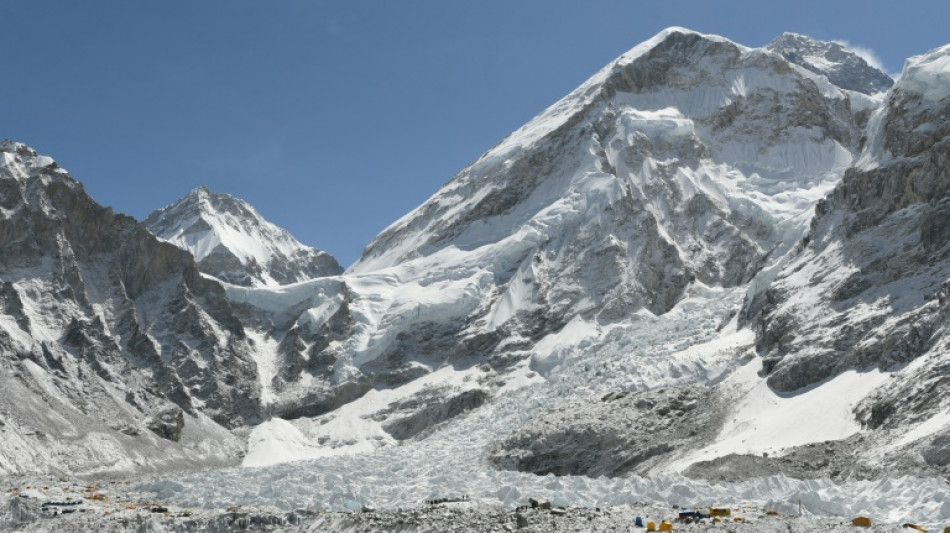
Himalayan snow at 23-year low, threatening 2 billion people: report / Photo: Prakash MATHEMA - AFP/File

 Trump denies offering to sell arms to China's Xi

 Wemby ready for NBA Spurs to move rivals in climb to top

 Ukraine to postpone some spending amid delays in aid: PM

 Tuchel says Czech Republic game 'not yet a must-win'

 MaXhosa puts South Africa on the Paris fashion map

 Rose, Scott among 2027 World Golf Hall of Fame finalists

 Brunson says NBA champion Knicks can't get satisfaction

 France puts out largest wildfire since 1949

 Real Madrid's Perez summoned over Barcelona referee payments comments

 Oil takes off again, Wall Street dips after Trump rejects Iran truce offer

 AlgoQuant Asset Management Selects Liquid Mercury to Enhance Digital Asset Trading Infrastructure

 UK to reopen refugee resettlement scheme to push 'safe' migration

 Pope urges Europe to help combat 'lies and deceit' in world affairs

 Iranian lawyer Nasrin Sotoudeh wins Council of Europe's rights prize

 French far-right's Bardella denies alleged 2013 antisemitic comments

 Oil up, Wall Street dips after Trump rejects Iran truce offer

 Gakpo withdraws from Netherlands squad

 SpaceX puts Starship megarocket in orbit for first time
 Iran denies link to suspected bomb plot at UK airbase used by US

 Ex-boss Mancini says City charges 'not my concern'

 Berlin Marathon winner Assefa finished race with torn Achilles

 Comedian convicted for Erdogan 'insult' but freed pending appeal

 French prosecutors seek two-year sentence for ex-minister Dati in graft case

 Eala makes fast start as weather and transport woes hit Asian Games

 Hurricane Polo approaches Mexico, threatens severe damage

Snowfall in Asia's Hindu Kush-Himalayan mountain range has reached a 23-year low, threatening nearly two billion people dependent on snowmelt for water, scientists warned in a report on Monday.
The Hindu Kush-Himalayan range, which stretches from Afghanistan to Myanmar, holds the largest reserves of ice and snow outside the Arctic and Antarctica and is a vital source of fresh water for about two billion people.
Researchers found "a significant decline in seasonal snow across the Hindu Kush Himalaya region, with snow persistence (the time snow remains on the ground) 23.6 percent below normal — the lowest in 23 years," the International Centre for Integrated Mountain Development (ICIMOD) said.
"This trend, now in its third consecutive year, threatens water security for nearly two billion people," it said in its Snow Update Report.
The study also warned of "potential lower river flows, increased groundwater reliance, and heightened drought risk".
Sher Muhammad, the lead author of the ICIMOD report, told AFP that "this year the snowfall started late in January and remained low in the winter season on average".
Several countries in the region have already issued drought warnings, with upcoming harvests and access to water at risk for populations already facing longer, hotter, and more frequent heatwaves.
The inter-governmental ICIMOD organisation is made up of member countries Afghanistan, Bangladesh, Bhutan, China, India, Myanmar, Nepal and Pakistan.
It urged countries that rely on the 12 major river basins in the region to develop "improved water management, stronger drought preparedness, better early warning systems, and greater regional cooperation".
The Mekong and Salween basins -- the two longest rivers in Southeast Asia supplying water to China and Myanmar -- had lost around half of their snow cover, it noted.
Pema Gyamtsho, ICIMOD's director general, called for changes in policy to address the low snow levels in the long term.
"Carbon emissions have already locked in an irreversible course of recurrent snow anomalies in the HKH (Hindu Kush-Himalayas)," Gyamtsho said.
Asia is the region most affected by climate-related disasters, according to the UN's World Meteorological Organization, which reported last month that five of the past six years have seen the most rapid glacier retreat on record.
Z.AlNajjar--SF-PST