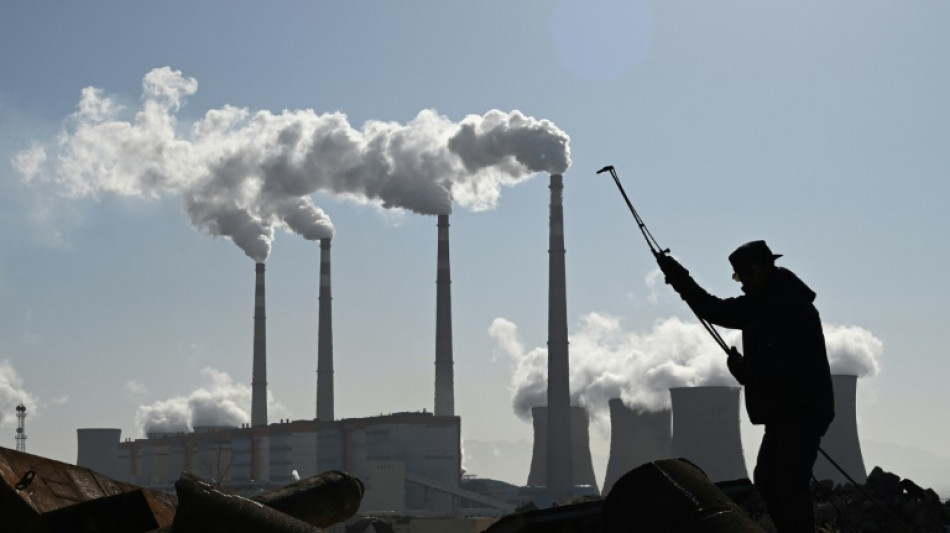
New coal capacity hit 20-year low in 2024: report / Photo: GREG BAKER - AFP/File

 Trump denies offering to sell arms to China's Xi

 Wemby ready for NBA Spurs to move rivals in climb to top

 Ukraine to postpone some spending amid delays in aid: PM

 Tuchel says Czech Republic game 'not yet a must-win'

 MaXhosa puts South Africa on the Paris fashion map

 Rose, Scott among 2027 World Golf Hall of Fame finalists

 Brunson says NBA champion Knicks can't get satisfaction

 France puts out largest wildfire since 1949

 Real Madrid's Perez summoned over Barcelona referee payments comments

 Oil takes off again, Wall Street dips after Trump rejects Iran truce offer

 AlgoQuant Asset Management Selects Liquid Mercury to Enhance Digital Asset Trading Infrastructure

 UK to reopen refugee resettlement scheme to push 'safe' migration

 Pope urges Europe to help combat 'lies and deceit' in world affairs

 Iranian lawyer Nasrin Sotoudeh wins Council of Europe's rights prize

 French far-right's Bardella denies alleged 2013 antisemitic comments

 Oil up, Wall Street dips after Trump rejects Iran truce offer

 Gakpo withdraws from Netherlands squad

 SpaceX puts Starship megarocket in orbit for first time
 Iran denies link to suspected bomb plot at UK airbase used by US

 Ex-boss Mancini says City charges 'not my concern'

 Berlin Marathon winner Assefa finished race with torn Achilles

 Comedian convicted for Erdogan 'insult' but freed pending appeal

 French prosecutors seek two-year sentence for ex-minister Dati in graft case

 Eala makes fast start as weather and transport woes hit Asian Games

 Hurricane Polo approaches Mexico, threatens severe damage

The world added the smallest amount of new coal capacity in two decades last year, a report said Thursday, but use of the fossil fuel is still surging in China and India.
Coal accounts for just over a third of global electricity production and phasing it out is fundamental to meeting climate change goals.
Just 44 gigawatts (GW) of new coal power capacity was produced globally last year, the lowest figure since 2004, according to the report by a group of energy- and environment-focussed research organisations and NGOs.
"Last year was a harbinger of things to come for coal as the clean energy transition moves full speed ahead," said Christine Shearer of the Global Energy Monitor, which co-authored the report.
But new capacity still outstripped coal closures, meaning a net increase in the global coal fleet, the report noted.
China began construction on a record number of coal plants last year.
Last year also saw a record number of new coal proposals in India, the report warned.
"Work is still needed to ensure coal power is phased out in line with the Paris climate agreement, particularly in the world's wealthiest nations," Shearer said.
- 'Dubious' coal technologies -
The International Energy Agency (IEA) says global coal demand will plateau from 2024-2027, with declining use in developed countries largely off-set by growth in emerging economies.
China's electricity sector accounts for a third of all coal consumed worldwide, according to the IEA, making its transition from the fuel key to global trends.
While coal construction hit record highs in China last year, new permits in the country fell back from the breakneck levels seen the two years prior, the report said.
And in Southeast Asia, where coal has powered emerging economies like Indonesia, new proposals for the fossil fuel have declined.
That is the result of various deals and pledges in Indonesia, Malaysia, the Philippines and Vietnam to phase out the use of coal, the report said.
But among wealthy economies, Japan and South Korea were singled out for their promotion of "dubious 'decarbonisation' coal technologies domestically and abroad."
The report warned these technologies are "expensive and unlikely to deliver the deep emission cuts needed for climate stability."
Chief among them is co-firing with ammonia at coal-powered plants. Substituting ammonia for some of the coal used in a plant can reduce emissions, but ammonia's emissions profile depends on how it is produced.
And even co-firing with low-emissions ammonia still produces more carbon dioxide than many other power generation technologies, the report warned.
The groups also flagged uncertainty over coal commitments in the United States after Donald Trump returned to the presidency.
But they pointed out that more coal plants were shut during Trump's first term than under his predecessor Barack Obama, or successor Joe Biden.
"Trump's first term shows the difficulty of counteracting the declining economic feasibility of coal power in the US, coupled with the advanced age of the country's coal plants," the report said.
O.Farraj--SF-PST