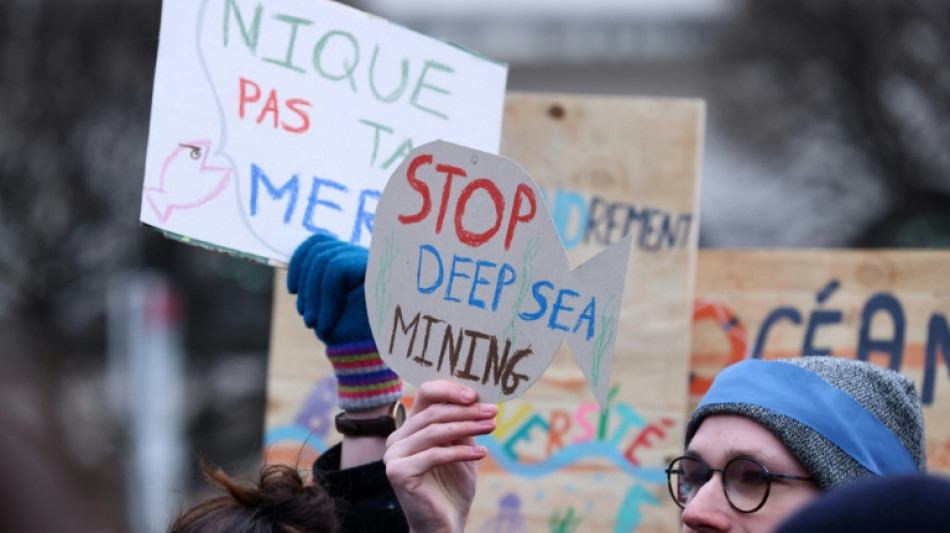
Talks on divisive deep-sea mining resume in Jamaica / Photo: Kenzo TRIBOUILLARD - AFP/File

 Trump denies offering to sell arms to China's Xi

 Wemby ready for NBA Spurs to move rivals in climb to top

 Ukraine to postpone some spending amid delays in aid: PM

 Tuchel says Czech Republic game 'not yet a must-win'

 MaXhosa puts South Africa on the Paris fashion map

 Rose, Scott among 2027 World Golf Hall of Fame finalists

 Brunson says NBA champion Knicks can't get satisfaction

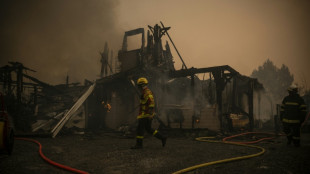 France puts out largest wildfire since 1949

 Real Madrid's Perez summoned over Barcelona referee payments comments

 Oil takes off again, Wall Street dips after Trump rejects Iran truce offer

 AlgoQuant Asset Management Selects Liquid Mercury to Enhance Digital Asset Trading Infrastructure

 UK to reopen refugee resettlement scheme to push 'safe' migration

 Pope urges Europe to help combat 'lies and deceit' in world affairs

 Iranian lawyer Nasrin Sotoudeh wins Council of Europe's rights prize
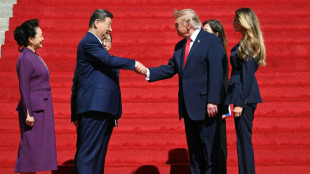
 French far-right's Bardella denies alleged 2013 antisemitic comments

 Oil up, Wall Street dips after Trump rejects Iran truce offer

 Gakpo withdraws from Netherlands squad

 SpaceX puts Starship megarocket in orbit for first time
 Iran denies link to suspected bomb plot at UK airbase used by US
 Ex-boss Mancini says City charges 'not my concern'

 Berlin Marathon winner Assefa finished race with torn Achilles

 Comedian convicted for Erdogan 'insult' but freed pending appeal

 French prosecutors seek two-year sentence for ex-minister Dati in graft case

 Eala makes fast start as weather and transport woes hit Asian Games

 Hurricane Polo approaches Mexico, threatens severe damage

Several countries united with campaign groups Monday to call for caution in regulating the divisive practice of deep-sea mining at a meeting on the issue in Jamaica.
Members of the International Seabed Authority (ISA) are meeting in Kingston to thrash out the first mining code on deep-sea extraction that has faced accusations of imperiling marine ecosystems.
The clock is ticking because a metals company has said it will imminently submit an extraction license application, raising the prospect that their operations could go unregulated.
"We are still far away from any consensus on a final mining code," said French envoy Olivier Guyonvarch, with the latest draft text still riddled with caveats highlighting lingering disagreement.
Costa Rica's representative called for a "precautionary pause" as work continues on gathering data and establishing the legal framework.
The prospect of a pause has gained traction but is far from winning the backing of the ISA's 169 member states.
"Environmental protection, however, does not mean abandoning exploitation," countered China's representative, saying that regulations could be further tailored as mining is carried out.
- 'Planetary crisis' -
The UN Convention on the Law of the Sea gives the ISA responsibility for regulating extraction of highly coveted seabed minerals that lie outside of national marine borders.
However, it also directs the organization to protect the little-understood marine environments.
The ISA Council, which currently only awards exploration licenses, has been negotiating for more than ten years over a mining code governing nickel, cobalt and copper extraction -- key materials in the energy transition.
The painstaking talks have gained momentum since the activation of a clause allowing any company with national backing to apply for a license -- even in the absence of a code -- but several issues remain outstanding.
Though the riches of the international seabed are classified as "common heritage of mankind," African countries fear they will miss out on benefits or even see their economies suffer.
Underwater extraction must "not come at the expense of Africa's existing mining economies and their sustainable development aspirations," the continent's representative said.
Industry on the other hand has been highly critical of delays to the agreement of a code.
In a January letter to the ISA, several companies claiming to have collectively invested more than $2 billion in the development of extraction technology said they faced "escalating legal and financial risks."
Among them was Nori -- Nauru Ocean Resources Inc. -- a subsidiary of Canadian firm The Metals Company. In June, it will submit the first application for extraction of "polymetallic nodules" -- mineral deposits made up of multiple metals on the deep ocean floor.
Pacific island nation Nauru has given its official backing to Nori's application, and is pressing the ISA to agree on a mechanism for reviewing and approving applications in the absence of a mining code.
Their request has been opposed by countries such as Chile who maintain the council had agreed rules would only be drafted after such an application is submitted.
"ISA Member States need to stand firm against the unacceptable pressure by an industry that risks wreaking irreparable damage on our ocean and exacerbating the planetary crisis," Sofia Tsenikli, Deep-Sea Mining Moratorium Campaign Director at the Deep Sea Conservation Coalition (DSCC).
NGOs like the DSCC are placing hope in new ISA chief Leticia Carvalho, a Brazilian oceanographer who replaced Britain's Michael Lodge after two terms at the helm, during which he was accused of favoring industry.
While the council has set itself the goal of finalizing the mining code this year, Carvalho called Monday for negotiators to make "significant progress" by July while raising the prospect of an amended timetable.
N.Awad--SF-PST