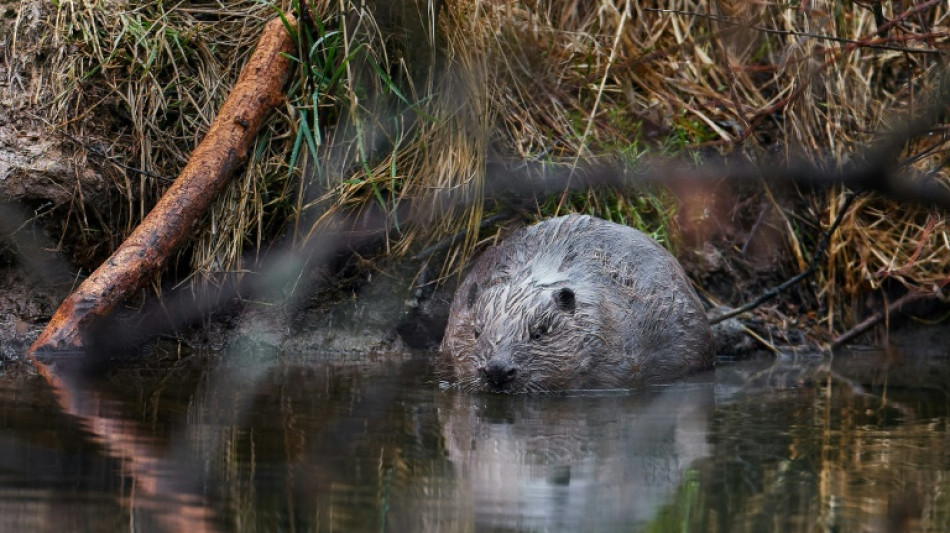
Many animal 'geomorphs' under threat, study warns / Photo: Bohumil FISER - AOPK CR/AFP/File

 Dodgers eye three-peat, Red Sox face Yankees as MLB playoffs begin

 Certification of Boeing 737 MAX delayed by software bug

 Celine Dion wows Paris Fashion Week with surprise gig

 AMD buys firm founded by AI 'godmother' Fei-Fei Li

 Italy rebound in Turkey as France win late in Belgium

 Pope says concerns about AI 'should be taken seriously'

 Hurricanes to hoist title banner as NHL season begins

 Justice Alito steps aside from major US climate case

 Willis happy with England exile after retains Top 14 player award

 Spain housing protests keep heat on government as PM seeks new law

 Wissa spoils Zimbabwe homecoming as DR Congo win AFCON qualifier

 UK police release on bail five men held over airbase incident

 Ex-All Black Plummer 'sure' New Zealand will find Super Rugby solution

 Shein sees 1% revenue growth in first half of 2026

 Netherlands regrets Israel retaliation in settlements row

 Moscow seizes Russian assets of German food retailer Metro

 Bulgarian spirits inflamed by new rakia rules

 Documentary turns camera on architect Peter Zumthor

 UK police say releasing on bail five men held over airbase incident

 Trump admin finalizes reversal of US fuel economy standards

 US says no China arms sale plans after envoy cites Trump offer

 Dozens kidnapped in two weekend attacks in northern Nigeria

 Next stop the world: Pathirage wins Asian Games javelin gold

 Aster Launches Perpetual Grid Trading 2.0 with Up to 140,000 $ASTER Liquidity Mining Campaign

 Seoul says North Korean mines 'highly suspected' as cause of DMZ blast

More than a quarter of our planet's natural "geomorphs" -- animals such as beavers and hippos that, collectively, can reshape entire landscapes -- are threatened or have shrinking populations, a new study says.
The research, by Queen Mary University of London, found the scale of the impact these animals had on habitats -- by building dams, trampling new river courses, excavating earth and other activities -- rivals that caused by major floods.
Yet "more than a quarter (28 percent) of zoogeomorphic species are vulnerable to future population decline or regional or global extinction," the study's authors warned.
Their research, published mid-February, identified more than 600 species of land and freshwater animals that worked to redesign their ecosystems.
While beavers, of dam-building fame, and hippopotamuses and elephants, which in herds can flatten stretches of earth, are the best-known, there are many others -- often overlooked -- that could also be dubbed animal architects.
Among them are Brazilian termites, which have built high mounds connected by tunnels that cover an area larger than Iceland.
Others identified by the researchers included Australian marsupials, South American shrimp, Asian ants, as well as salmon, moles, earthworms and freshwater insects.
"What we tend to do is overlook the smaller animals that are less visible to us. Perhaps they're living underground or they're living underwater, but those animals can be really kind of important as well," one of the authors, Gemma Harvey, told AFP.
- 'Big cumulative effect' -
Harvey, a professor in biogeomorphology and landscape rewilding, said: "People can underestimate the effects of small animals, because individually their effects are small, but collectively they tend to be more abundant in the landscape so they can have a big cumulative effect."
She added that "it's the collective importance of the animals that is being discovered right now".
She noted the study did not look at marine ecosystems, and that "there will be many more animals that have not yet been studied or perhaps not even been discovered yet".
Of the more than 600 species identified in the research, 57 were classed as endangered, vulnerable or near-threatened on the International Union for the Conservation of Nature's Red List of Threatened Species.
Many others were at risk of declining populations.
"As we lose species from our landscapes, we lose those unique processes" of reshaping the habitats, Harvey said.
And the power these landscaping animals possess is staggering.
Harvey said her team's study estimated that the species they had identified together exerted 76,000 gigajoules of energy each year -- equivalent to that of "hundreds of thousands of extreme floods".
She said much was still unknown about the animals' geomorphing processes and she planned to further her research, notably by factoring in the effects of climate change.
"We're also interested in thinking kind of back in time in the past, about what we've already lost, you know, from our landscapes as species have become extinct or reduced a lot in terms of their population," she said.
C.Hamad--SF-PST