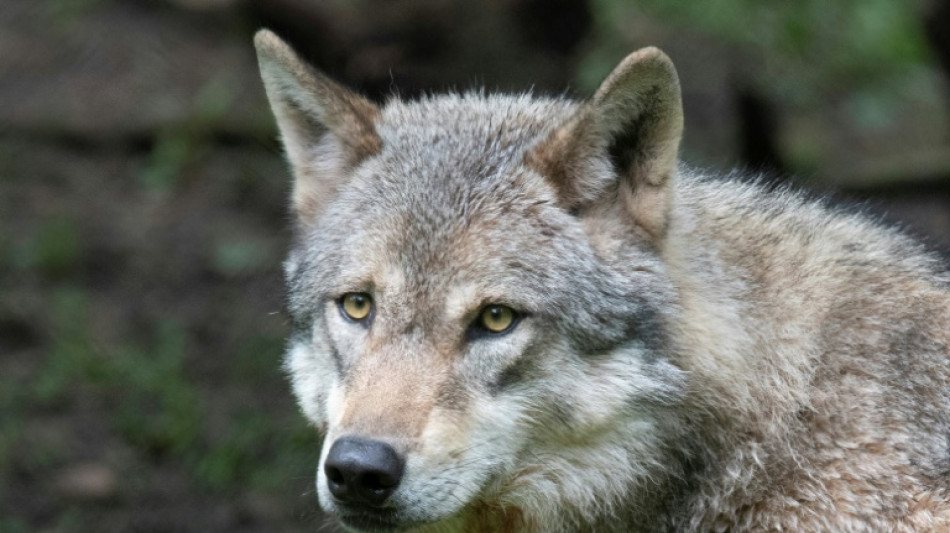
Protections drop for wolves in most of Europe / Photo: THOMAS KIENZLE - AFP

 Dodgers eye three-peat, Red Sox face Yankees as MLB playoffs begin

 Certification of Boeing 737 MAX delayed by software bug

 Celine Dion wows Paris Fashion Week with surprise gig

 AMD buys firm founded by AI 'godmother' Fei-Fei Li

 Italy rebound in Turkey as France win late in Belgium

 Pope says concerns about AI 'should be taken seriously'

 Hurricanes to hoist title banner as NHL season begins

 Justice Alito steps aside from major US climate case

 Willis happy with England exile after retains Top 14 player award

 Spain housing protests keep heat on government as PM seeks new law

 Wissa spoils Zimbabwe homecoming as DR Congo win AFCON qualifier

 UK police release on bail five men held over airbase incident

 Ex-All Black Plummer 'sure' New Zealand will find Super Rugby solution

 Shein sees 1% revenue growth in first half of 2026

 Netherlands regrets Israel retaliation in settlements row

 Moscow seizes Russian assets of German food retailer Metro

 Bulgarian spirits inflamed by new rakia rules

 Documentary turns camera on architect Peter Zumthor

 UK police say releasing on bail five men held over airbase incident

 Trump admin finalizes reversal of US fuel economy standards

 US says no China arms sale plans after envoy cites Trump offer

 Dozens kidnapped in two weekend attacks in northern Nigeria

 Next stop the world: Pathirage wins Asian Games javelin gold

 Aster Launches Perpetual Grid Trading 2.0 with Up to 140,000 $ASTER Liquidity Mining Campaign

 Seoul says North Korean mines 'highly suspected' as cause of DMZ blast

Wolves became less protected in most of Europe on Friday as new conservation regulations came into force, except in three countries that objected to the move including the United Kingdom, the Council of Europe said.
The move allows hunting to resume under strict regulation, which activists fear could result in a large number of wolves being shot dead.
Activists have said the measure will upset the recovery made by the species over the past 10 years after near extinction a century ago, but farmers say their growing numbers are a threat to their livestock.
Members of the Bern Convention, tasked with the protection of wildlife in Europe and some African countries, in December agreed to lower the wolf's protection status from "strictly protected" to "protected".
The decision "was set to enter into force three months later, unless objected to by at least one-third of the parties to the convention," the Strasbourg-based Council of Europe said.
Of the 50 parties to the convention -- an international treaty of the Council of Europe -- at least 17 would have needed to protest.
Instead, "three parties formally lodged objections: the Czech Republic, Monaco, and the United Kingdom. As a result, the decision to modify the protection status of the wolf does not apply to these three parties," it said.
The new "protected" status "mandates regulation of the species' exploitation to prevent endangerment, implementing measures such as closed seasons and regulating the sale, keeping, transport, and offering for sale of live and dead animal," the Council of Europe said.
Grey wolves were virtually exterminated in Europe 100 years ago but their numbers have practically doubled to the current population of 20,300, mostly in the Balkans, Nordic countries, Italy and Spain.
The parties to the convention include 45 members of the Council of Europe, four African nations -- Burkina Faso, Morocco, Senegal and Tunisia -- and the European Union.
The European Union in September proposed the plan to lower the protection status of wolves as they increase in numbers and come into more frequent contact with human activity and livestock.
B.Mahmoud--SF-PST