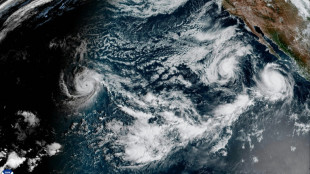
Did cuts to shipping emissions spur more global warming? / Photo: MARTIN BERNETTI - AFP

 Dodgers eye three-peat, Red Sox face Yankees as MLB playoffs begin

 Certification of Boeing 737 MAX delayed by software bug

 Celine Dion wows Paris Fashion Week with surprise gig

 AMD buys firm founded by AI 'godmother' Fei-Fei Li

 Italy rebound in Turkey as France win late in Belgium

 Pope says concerns about AI 'should be taken seriously'

 Hurricanes to hoist title banner as NHL season begins

 Justice Alito steps aside from major US climate case

 Willis happy with England exile after retains Top 14 player award

 Spain housing protests keep heat on government as PM seeks new law

 Wissa spoils Zimbabwe homecoming as DR Congo win AFCON qualifier

 UK police release on bail five men held over airbase incident

 Ex-All Black Plummer 'sure' New Zealand will find Super Rugby solution

 Shein sees 1% revenue growth in first half of 2026

 Netherlands regrets Israel retaliation in settlements row

 Moscow seizes Russian assets of German food retailer Metro

 Bulgarian spirits inflamed by new rakia rules

 Documentary turns camera on architect Peter Zumthor

 UK police say releasing on bail five men held over airbase incident

 Trump admin finalizes reversal of US fuel economy standards

 US says no China arms sale plans after envoy cites Trump offer

 Dozens kidnapped in two weekend attacks in northern Nigeria

 Next stop the world: Pathirage wins Asian Games javelin gold

 Aster Launches Perpetual Grid Trading 2.0 with Up to 140,000 $ASTER Liquidity Mining Campaign

 Seoul says North Korean mines 'highly suspected' as cause of DMZ blast

Could a sudden drop in pollution from cargo vessels criss-crossing global shipping lanes be inadvertently making the world hotter?
The main reason for global warming is the heat-trapping emissions from burning fossil fuels.
But scientists have been looking at the extent to which a shift to cleaner, lower-sulphur shipping fuels in 2020 may have fuelled warming by reducing the amount of particles in the atmosphere that reflect heat back into space.
This theory surfaced again when January was declared the hottest on record, extending a streak of exceptional global temperatures that has persisted since mid-2023.
- Why did shipping emissions drop? -
On January 1, 2020, the sulphur content in engine fuel used to power container vessels, oil tankers and other ships in global trade was slashed by decree from 3.5 percent to 0.5 percent.
This was mandated by the International Maritime Organization (IMO), a UN agency that regulates the global shipping sector, including its environmental impact.
Sulphur oxides in fuels are tiny airborne particles harmful to human health and linked to strokes and the development of lung and cardiovascular diseases.
Some jurisdictions have even tighter restrictions in so-called "emissions control areas" in the Baltic Sea, the North Sea, the North American zone and the US marine Caribbean area.
- Is it working? -
The IMO estimated its fuel mandate would cut emissions of sulphur oxide by 8.5 million tonnes a year.
Last June, research published in the academic journal Earth System Science Data reported that sulphur oxide emissions from the shipping industry declined 7.4 million tonnes between 2019 and 2020.
The IMO said that in 2023 just two vessels flagged for inspection were found to be using fuel with a sulphur level above the 0.5 percent requirement.
Since the new regulation came into force, only 67 violations have been recorded.
- Is there a link to global warming? -
Sulphur oxides are not greenhouse gases like carbon dioxide or methane which are effective at trapping heat in the atmosphere, raising global temperatures.
On the contrary, they boost the reflectivity of clouds by making them more mirror-like and capable of bouncing incoming heat from the Sun back into space.
The sudden decline in these particles may have spurred recent warming "but we can't quantify it in an ultra-precise manner", said Olivier Boucher from the French National Centre for Scientific Research (CNRS)
He said studies had detected changes in clouds above major shipping lanes since 2020, including a greater presence of larger particles less reflective of sunlight.
Scientists could say shipping emissions had aided warming to some degree "but we are not able to say that it contributes a lot", Boucher added.
One study published in August in the journal Earth's Future concluded that the IMO regulation could increase global surface temperatures by nearly 0.05 degrees Celsius a year up until 2029.
The drastic reduction in airborne sulphur pollution helps to explain the exceptional heat of 2023 but the authors said the magnitude of the temperature extremes meant other factors were likely also at play.
X.Habash--SF-PST