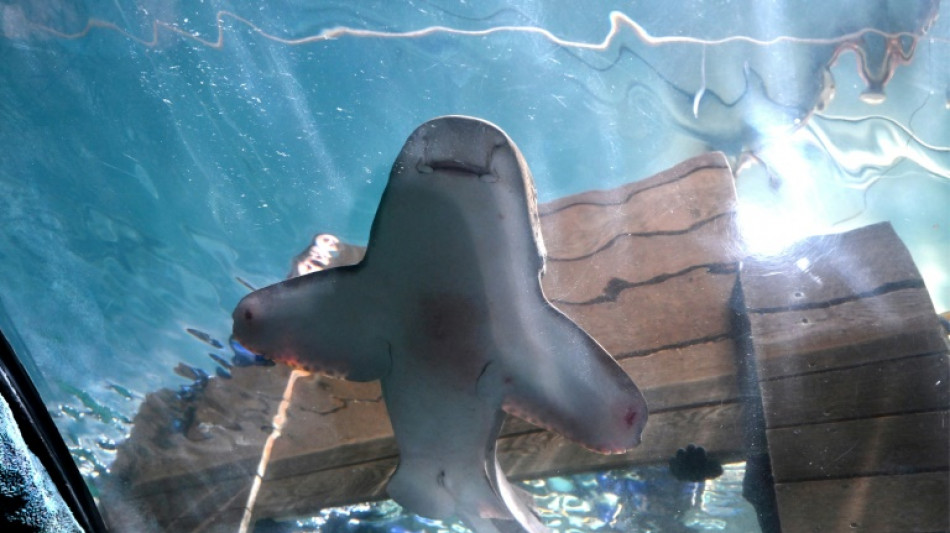
Scientists artificially inseminate leopard sharks to boost diversity / Photo: Saeed KHAN - AFP

 Flooding, power cuts and evacuations as Hurricane Polo slams Mexico

 Dodgers eye three-peat, Red Sox face Yankees as MLB playoffs begin

 Certification of Boeing 737 MAX delayed by software bug

 Celine Dion wows Paris Fashion Week with surprise gig

 AMD buys firm founded by AI 'godmother' Fei-Fei Li

 Italy rebound in Turkey as France win late in Belgium

 Pope says concerns about AI 'should be taken seriously'

 Hurricanes to hoist title banner as NHL season begins

 Justice Alito steps aside from major US climate case

 Willis happy with England exile after retains Top 14 player award

 Spain housing protests keep heat on government as PM seeks new law

 Wissa spoils Zimbabwe homecoming as DR Congo win AFCON qualifier

 UK police release on bail five men held over airbase incident

 Ex-All Black Plummer 'sure' New Zealand will find Super Rugby solution

 Shein sees 1% revenue growth in first half of 2026

 Netherlands regrets Israel retaliation in settlements row

 Moscow seizes Russian assets of German food retailer Metro

 Bulgarian spirits inflamed by new rakia rules

 Documentary turns camera on architect Peter Zumthor

 UK police say releasing on bail five men held over airbase incident

 Trump admin finalizes reversal of US fuel economy standards

 US says no China arms sale plans after envoy cites Trump offer

 Dozens kidnapped in two weekend attacks in northern Nigeria

 Next stop the world: Pathirage wins Asian Games javelin gold

 Aster Launches Perpetual Grid Trading 2.0 with Up to 140,000 $ASTER Liquidity Mining Campaign

A black-and-cream leopard shark enters a hypnotic-like state of relaxation as scientists at Sydney Aquarium carefully roll her onto her back in a small pool.
The shark, named Zimba, is one of the first captive leopard sharks in the world to be artificially inseminated with the sperm of wild sharks in an attempt to build populations around the world.
If the process is successful, Zimba's shark pups will be sent to the Raja Ampat region in Indonesia, where the local population is on the brink of extinction due to unsustainable fishing practices and habitat destruction.
Artificial insemination allows sharks that would never normally interact to breed and increase genetic diversity, said SEA LIFE Australia and New Zealand regional coordinator Laura Simmons.
Simmons hopes that eventually the leopard shark population will be "genetically viable and capable of maintaining a self-sustaining population in the wild".
That could take years, she told AFP, but "this is one step closer to where we need to be".
The procedure is one part of a larger worldwide leopard shark breeding programme, known as StAR, that involves more than 60 conservation groups, aquariums and government agencies.
Globally, about 37 percent of oceanic shark and ray species, including the leopard shark, are now listed as either endangered or critically endangered by the International Union for Conservation of Nature, a global database for threatened species.
- 'Species belongs outside' -
Australia's leopard shark populations remain plentiful and of least concern, and scientists hope they can help bolster the numbers in other regions.
Back at the Sydney Aquarium pool, Ocean Park Hong Kong's chief veterinarian Paolo Martelli inserts a metal tube filled with the sperm of wild leopard sharks into Zimba's underside.
The shark is still in a natural state called tonic immobility -- a relaxed condition that allows scientists to work without getting injured.
The whole process takes a matter of minutes and everyone claps and cheers once it is over. Zimba is flipped back onto her stomach and swims around the pool as if nothing happened.
Martelli is using a technique he developed and has successfully used on other species, but this is the first time it has been used on leopard sharks.
"It's not straightforward," he said.
Martelli and his team collected the sperm of wild leopard sharks off the coast of Queensland -- which has a large shark population -- and brought the precious cargo to Sydney.
Only three of four samples taken survived the journey.
"This species belongs in outside habitats, not in a museum," Martelli said.
But as the shark's habitat declines, scientists must give a "helping hand" in protecting and conserving this valuable species, he added.
"It is safe to say that sharks have suffered a lot in the last century."
Z.AlNajjar--SF-PST