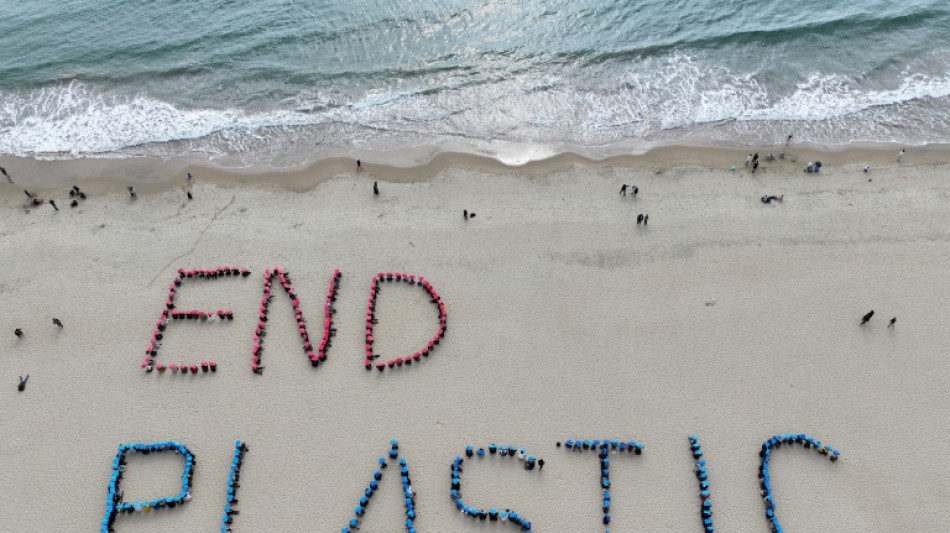
Plastic pollution talks must speed up, chair warns / Photo: - - YONHAP/AFP

 OpenAI cancels release of newest model due to safety concerns

 AI bosses head to White House as safety pressure builds

 Batista sacked as Costa Rica coach after six months
 Flooding, power cuts and evacuations as Hurricane Polo slams Mexico

 Dodgers eye three-peat, Red Sox face Yankees as MLB playoffs begin
 Certification of Boeing 737 MAX delayed by software bug

 Celine Dion wows Paris Fashion Week with surprise gig
 AMD buys firm founded by AI 'godmother' Fei-Fei Li
 Italy rebound in Turkey as France win late in Belgium

 Pope says concerns about AI 'should be taken seriously'
 Hurricanes to hoist title banner as NHL season begins
 Justice Alito steps aside from major US climate case

 Willis happy with England exile after retains Top 14 player award

 Spain housing protests keep heat on government as PM seeks new law

 Wissa spoils Zimbabwe homecoming as DR Congo win AFCON qualifier

 UK police release on bail five men held over airbase incident

 Ex-All Black Plummer 'sure' New Zealand will find Super Rugby solution

 Shein sees 1% revenue growth in first half of 2026
 Netherlands regrets Israel retaliation in settlements row
 Moscow seizes Russian assets of German food retailer Metro
 Bulgarian spirits inflamed by new rakia rules

 Documentary turns camera on architect Peter Zumthor
 UK police say releasing on bail five men held over airbase incident
 Trump admin finalizes reversal of US fuel economy standards
 US says no China arms sale plans after envoy cites Trump offer
Negotiators must move "significantly" faster to agree on a landmark treaty to curb plastic pollution, the diplomat chairing the talks warned Wednesday, as countries lined up to express frustration about the limited progress.
Nearly 200 countries are gathered in South Korea's Busan city with the goal of agreeing a deal by the end of the week.
The process caps two years of talks over four previous rounds of negotiations that have been stalled by deep divisions about what the treaty should look like.
Addressing negotiators on the third day of talks, Luis Vayas Valdivieso warned work was not advancing quickly enough.
"I must be honest with you, progress has been too slow. We need to speed up our work significantly," the Ecuadorian diplomat said.
"We must accelerate our efforts to reach consensus on the binding instrument by December first."
His call was followed by a string of frustrated speeches from countries including Fiji, Panama, Norway and Colombia.
"While we here sit debating over semantics and procedures, the crisis worsens," warned Juan Carlos Monterrey Gomez, Panama's special representative for climate change.
"We are here because microplastics have been found in the placentas of healthy women... We are literally raising a generation that starts its life polluted, before taking its first breath."
He accused negotiators of "tiptoeing around the truth, sidestepping ambition and ignoring the urgency that demands action" in remarks that received loud applause.
- 'We are sincere' -
Other representatives accused some participants of failing to engage in good faith and actively seeking to drag out the talks.
They did not openly point the finger at any countries, but diplomats speaking on condition of anonymity have repeatedly said Russia, Saudi Arabia and Iran are consistently holding up proceedings and showing little willingness to compromise.
All three countries took the floor to hit back.
"We are sincere, we are honest and we are ready to cooperate," said Iran's Massoud Rezvanian Rahaghi.
"But we do not want to be blamed for blocking negotiations through dirty tactics."
Russian representative Dmitry Kornilov meanwhile blasted the "unacceptable" accusations and warned delegates to abandon the most contentious parts of the draft discussions.
"If we are serious about this then we must concentrate on provisions that are acceptable to all delegations," he said.
In 2019, the world produced around 460 million tonnes of plastic, a figure that has doubled since 2000, according to the Organisation for Economic Co-operation and Development.
Plastic production is expected to triple by 2060.
But just nine percent of plastic is recycled globally.
- 'Bold moves' -
The main faultline in talks lies over whether the treaty should address the full lifecycle of plastic, including potential limits to its production, chemical precursors, and certain products considered unneccessary, including many single-use items.
The UN decision that kicked off the negotiating process explicitly refers both to the full lifecycle of plastic and sustainable consumption, but countries including Russia, Saudi Arabia and Iran have consistently rejected calls to limit supply.
Saudi Arabia has warned supply restrictions "extend beyond" the treaty's focus on plastic pollution and risk creating "economic disruptions."
Iran meanwhile has called for an article on supply to be removed entirely from the treaty text.
There are other sticking points, including financial support for developing countries to implement any treaty, and how a decision to adopt a deal should be made.
The UN standard is consensus, but there are fears that a unanimous deal may be out of reach.
A European diplomat, speaking on condition of anonymity, said the divisions were such that an agreement would only be possible if "bold moves" were taken in the final stretch to "unblock" things.
The question, he said, was "whether those moves, at that stage, will arrive too late."
"Four days to get to all that seems to me to be too little," he warned.
P.AbuBaker--SF-PST