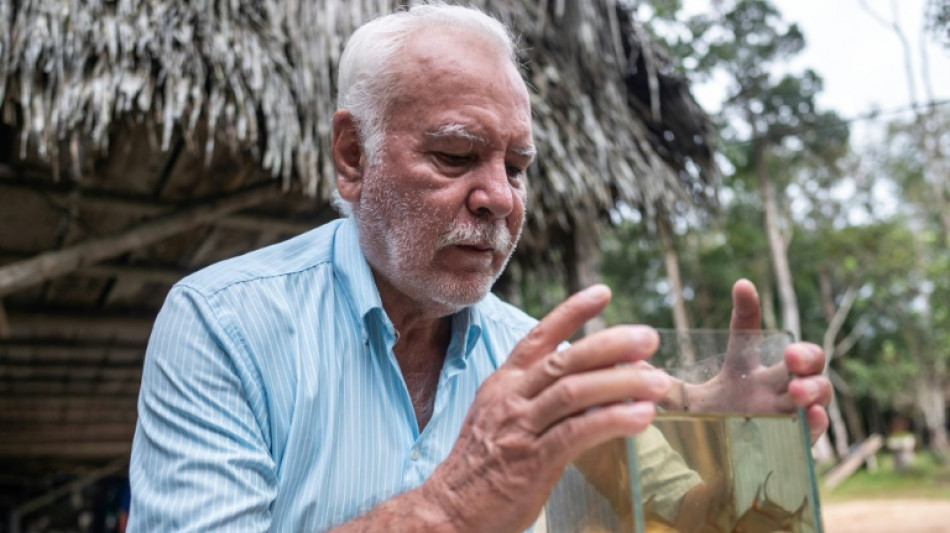
From Colombia's jungle to the world's fish tanks / Photo: Luis ACOSTA - AFP

 All Blacks name veteran Taylor captain as Mo'unga seizes 10 jersey
 Race against time as Asian Games cricket quarter-finals washed out

 India turns to corals and seagrass to shield against rising seas

 Manchester City's Premier League charges: What comes next?

 Brazil's cellphone crime: a security nightmare in every pocket

 Russia pummels Kyiv in latest deadly attack
 NFL Giants obtain QB McCarthy from Vikings

 Deal for evicted Spanish pensioner as PM seeks new housing law

 Clippers apologize, warn fans of 'challenges' after Leonard scandal

 Turkish comedian convicted for Erdogan 'insult' freed pending appeal

 Trump announces 'biggest' US steel plant in battleground Iowa

 Olise wonder strike gives Zidane's France win in Belgium

 US stocks fall, bond yields rise as Middle East war drags on

 Trump denies offering to sell arms to China's Xi

 Wemby ready for NBA Spurs to move rivals in climb to top

 Ukraine to postpone some spending amid delays in aid: PM

 Tuchel says Czech Republic game 'not yet a must-win'

 MaXhosa puts South Africa on the Paris fashion map

 Rose, Scott among 2027 World Golf Hall of Fame finalists

 Brunson says NBA champion Knicks can't get satisfaction

 France puts out largest wildfire since 1949

 Real Madrid's Perez summoned over Barcelona referee payments comments

 Oil takes off again, Wall Street dips after Trump rejects Iran truce offer

 AlgoQuant Asset Management Selects Liquid Mercury to Enhance Digital Asset Trading Infrastructure

 UK to reopen refugee resettlement scheme to push 'safe' migration

Every day, local fishermen visit Ernesto Rojas to sell him small, colorful fish plucked from rivers in the Colombian jungle that end up in aquariums around the world.
The septuagenarian has dedicated half a century to the ornamental fish business in Inirida, the capital of the eastern region of Guainia, which borders Venezuela and Brazil.
It is a thriving trade that critics see as cruel and harmful to nature, though environmentalists also recognize it brings benefits, such as encouraging habitat conservation and offering an alternative to harmful activities like illegal logging and mining.
Rojas keeps fish in ponds covered by nets to protect them from predatory birds before they are flown to Bogota for export to the United States, Asia and Europe.
He buys the Altum Angelfish (Pterophyllum altum) -- which is only found in the region and is prized by collectors for its long fins and striking vertical stripes -- for the equivalent of $2 each.
Once in the United States, they can sell for $70 or even more.
"So much beauty packed into such a small body," Rojas said as he examined his next shipment containing hundreds of angelfish.
Around him fish swam in circles in plastic bags.
His assistants enriched the water inside with oxygen from a cylinder in preparation for the flight of just over an hour to the capital.
- Sustainability concerns -
In the local Indigenous language, Guainia means "Land of many waters."
According to the National Aquaculture and Fisheries Authority, the region is home to 60 percent of the 521 species authorized for sale in Colombia, where the world's biggest biodiversity conference got underway this week.
Around 526 tons of fish were exported in 2023, generating revenues of about six million dollars, the regulator said.
Inirida is cut off from Colombia's national road network and accessible only by plane or a long boat ride.
Its isolation makes revenues from ornamental fish a key pillar of the economy, Oscar Javier Parra, director of the local environmental authority, told AFP.
While South America's booming aquarium trade brings much-needed income for thousands of people, sustainability is an issue, according to the World Wildlife Fund (WWF).
"For ornamental fish, the sheer volume of exports is raising concerns that the trade might not be sustainable for fish populations. And history shows that over-exploitation is a likely scenario," it warned.
But "under the right circumstances, sustainable ornamental fisheries can improve forest conservation and alleviate poverty of local communities," the WWF said.
To try to protect fish populations, authorities ban fishing in Guainia for seven weeks a year, usually between early April and June.
For some species such as the angelfish, the ban begins several weeks earlier.
"It's a regulated business with very good practices," Parra said.
The state also ensures that species considered vulnerable, such as the piranha and the enormous and colorful peacock bass, are not fished from the dark, mineral-rich waters of the Inirida River and its tributaries.
"Seeing an animal lose its freedom for someone's enjoyment and pleasure" is an affront to animal rights activists, Parra admitted.
However, fishing using small nets is a low-impact source of income in a region where rampant illegal gold mining means huge quantities of mercury are dumped into rivers every year, he said.
Banning ornamental fisheries "would be worse" for the environment, Parra said.
I.Saadi--SF-PST