Cars, chlamydia threaten Australian koalas / Photo: Saeed KHAN - AFP

 South Korea team latest to be bussed to wrong Asian Games venue

 Bears thrash Eagles 27-7 as third-string QB Keenum shines
 All Blacks name veteran Taylor captain as Mo'unga seizes 10 jersey
 Race against time as Asian Games cricket quarter-finals washed out
 India turns to corals and seagrass to shield against rising seas

 Manchester City's Premier League charges: What comes next?

 Brazil's cellphone crime: a security nightmare in every pocket

 Russia pummels Kyiv in latest deadly attack
 NFL Giants obtain QB McCarthy from Vikings

 Deal for evicted Spanish pensioner as PM seeks new housing law

 Clippers apologize, warn fans of 'challenges' after Leonard scandal

 Turkish comedian convicted for Erdogan 'insult' freed pending appeal

 Trump announces 'biggest' US steel plant in battleground Iowa

 Olise wonder strike gives Zidane's France win in Belgium

 US stocks fall, bond yields rise as Middle East war drags on

 Trump denies offering to sell arms to China's Xi
 Wemby ready for NBA Spurs to move rivals in climb to top

 Ukraine to postpone some spending amid delays in aid: PM

 Tuchel says Czech Republic game 'not yet a must-win'

 MaXhosa puts South Africa on the Paris fashion map
 Rose, Scott among 2027 World Golf Hall of Fame finalists

 Brunson says NBA champion Knicks can't get satisfaction

 France puts out largest wildfire since 1949

 Real Madrid's Perez summoned over Barcelona referee payments comments

 Oil takes off again, Wall Street dips after Trump rejects Iran truce offer
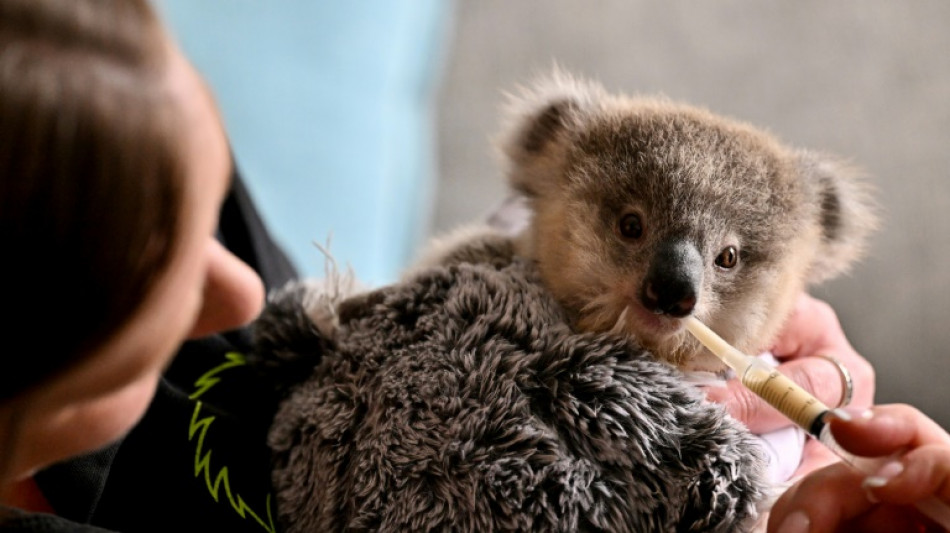
Clinging to a fluffy toy twice her size, orphaned koala joey Ajooni made a snuffling noise as she drank milk from a tiny syringe.
Weighing about the same as a mango, she was found by the side of a Sydney road where her mother was hit by a car and died.
It is a familiar tale for wildlife carer Emma Meadows.
Over the past two years, Meadows and other volunteers have recovered 40 koalas hit by cars in their neighbourhood. The number left for dead is likely much higher.
Koalas are shy and notoriously difficult to count.
There are anywhere between 95,000 and 524,000 left in Australia, possibly down from millions before European settlement.
There is little doubt that expanding cities, land clearance and the spread of chlamydia are devastating the populations of one of Australia's most iconic animals.
East Coast koalas were officially listed as "endangered" by the Australian government in 2022.
"I actually, truly, believe we're heading towards extinction," said Meadows, a volunteer with WIRES.
"I don't know if there is any coming back from this. I'm scared it's too late."
Chlamydia was first observed in koalas about 50 years ago. In the decades since, it has wiped out entire local populations.
The bacteria leads to blindness, bladder infections, infertility, and death.
Although some chlamydia-free koala populations exist –- such as the area where Ajooni was found -– scientists fear these pockets may soon disappear.
- World's 'extinction capital' -
Annabelle Olsson, director of the University of Sydney Wildlife Health and Conservation Hospital, has regularly examined rescued koalas -- including seven-month-old Ajooni.
On the day AFP visited the centre, a sedated three-year-old koala lay on an operation table, while Olsson and her team took the marsupial's blood, did X-rays and examined the koala's face.
The koala was chlamydia-free but had a head injury that impacted her reflexes and would require further attention.
Olsson said without better koala protections "our grandchildren, or at least their grandchildren, are going to see maybe koalas in a zoo if they're lucky".
"Australia is an island nation with an incredibly high biodiversity and incredibly unique wildlife species and floral species that need to be preserved," she said.
Scientists believe Australia has the highest rate of mammal extinction in the world, with about 100 of the country's unique flora and fauna species wiped out in the last 123 years.
Environment minister Tanya Plibersek has said Australia is "the mammal extinction capital of the world. "
While there are some rules and guidelines to protect koala habitats, koala bushland continues to be cleared.
- Vaccine hopes -
Some have instead focused their conservation efforts on quelling the spread of koala chlamydia.
University of the Sunshine Coast researcher Samuel Phillips is part of a team working on a potential vaccine.
They have vaccinated and monitored 165 koalas over 10 years and found inoculated marsupials developed chlamydia later in life and their mortality was reduced by 64 percent.
A Queensland trial of the vaccination, used in conjunction with traffic and predator controls, was so successful that a local koala population doomed for extinction within 10 years rebounded.
Some marsupials will even need to be translocated to stop overpopulation, Phillips said.
"It's been a really positive story," he said.
However, Phillips warns that more needs to be done to address the other key drivers of koala decline, particularly the deforestation of their habitats.
"We can keep protecting these small populations, but without increasing the habitat and protecting it, then they won't be living."
- 'Make a difference' -
Ajooni will remain in Meadow's care until she is big enough to be released back into the wild.
It will be a "bittersweet" moment for Meadow, but she says seeing any koala successfully released is the best feeling.
That feeling is what keeps her going through the awful parts of her volunteer role: scraping dead koala bodies off the road in the middle of the night, or finding animals that are so severely injured that they need to be put down.
"I continue to do what I do because somebody needs to make a difference, and I feel that this is one way in the world that I can make a difference," Meadows said.
F.Qawasmeh--SF-PST